
Short reminder: A year ago Gallant and Katz stood united to announce their “complete siege”. Katz, personally responsible for the cutting of water, went even further with his words than Gallant and openly proclaimed his intent to commit a crime against humanity, namely by depriving the entire population of Gaza from access to freshwater. Starvation as method of warfare remains illegal even if it is a reprisal directed against the civilian population to enforce the release of the hostages). The policy was finally rescinded under international pressure. However, persons like this, completely ignoring even Israel’s own official interpretations of international humanitarian law, are certainly unfit for office of Defense Minister.
Author: mop
-
93 killed in bombing of a shelter in Beit Lahia
Mistakes like the killing of around 93 Palestinians in a bombing of a building serving as a shelter in Beit Lahia (Gaza) indeed tragically happen in all wars with major airpower involvement (think of the bombing of the MSF hospital in Kunduz by USAF, it was an example for carelessness and disregard, but some of these cases won’t be avoidable overall). The scandal should not be the carnage itself, as horrible as it is. It is quite likely that the IDF indeed targeted some spotter with binoculars (even a civilian doing spotting in support of the operations of militants is thereby directly participating in hostilities and becomes a legitimate target) and that they did not know about the sheltering people. This means it was not a massacre. But on the other hand this might well be another example of the apparent overall recklessness and carelessness of Israeli targeting pracices during the current war in Gaza, where non-combatant casualty cut-off values by far exceed everything from previous wars, where such decisions are completely left to the discretion of individual officers (who might be vengeful, bored or otherwise undisciplined), where there is no accountability (let alone punishment), where there is no culture of questioning decisions based on implications for Palestinian civilians, where a quick and dirty and zero risk approach is prefered over careful intelligence work, where all the mass fatalities (often barely covered by local media) are proactively denied or justified even before there is any investigation, and remain uncovered by local media. This is at least what we can draw from the +972 Magazine reports drawing from various IDF sources. I wish that the lower daily fatalities compared to last fall/early winter were for improvements within the IDF, allein mir fehlt der Glaube.
-
„Humanitärer Waffenstillstand“?
Wann hat sich eigentlich diese unsinnige Rede vom „humanitären Waffenstillstand“ eingeschlichen? Humanitäre Feuerpausen sind ein Konzept mit eigener Bedeutung – zeitlich begrenzte Einstellung der Feindseligkeiten, womöglich auch einseitig, um humanitäre Entlastung mit Nahrung und Medizin oder Fluchtkorridore zu eröffnen. Humanitäre Interventionen sind Kriege, die eben nicht mit Selbstverteidigung, sondern mit der dringlichen Unterbindung schwerster und umfassender Menschenrechtsverletzungen legitimiert werden – ein vor allem seit den 90ern vermehrt angerufenes Konzept, das nach Ansicht mancher militärische Gewalt auch ohne Mandat des UN-Sicherheitsrats rechtfertigen können soll. Bloß was soll ein humanitärer Waffenstillstand sein? Dass Waffenstillstände akut zur Verbesserung der humanitären Lage, sprich Grundversorgung und sicheres Ausdemhausgehen für die Bevölkerung im Kriegsgebiet führen, mag zwar nicht immer der Fall sein, ist aber sicherlich nicht die Ausnahme. Waffenstillstände werden eben gefordert, wenn unter den gegebenen politischen und militärischen Bedingungen der Preis (wozu auch ein humanitärer Preis gehört) für die Weiterverfolgung womöglich legitimer Kriegsziele als zu hoch erscheint. Das scheint mir hier in der Tat der Fall zu sein und das kann ja auch gerne die Außenministerin auch so sehen. Bloß warum müssen solche ganz basalen Entscheidungen im Krieg jetzt alle humanitär heutzutage sein?
In der Tat geht es auch um ganz unhumanitäre Abwägungen: Die Hamas kann sich eine gewisse Rekonsolidierung in Gaza bei einem Waffenstillstand erhoffen, muss dafür allerdings auf den endzeitlichen Kampf unter allumfassender Beteiligung von Hezbollah, Iran und der restlichen „Achse“ verzichten. Israel kann mit weniger Kräften in Gaza stärkere Drohungen gegenüber der Hezbollah aufbauen, verzichtet aber eben auf die Tötung von Sinwar und das illusionäre Ziel der Tötung eines jeden einzelnen Hamas-Fußsoldaten. Nicht sehr humanitär, trotzdem gut, wenn die Zerstörung bald ein Ende nimmt und die Geiseln freikommen.
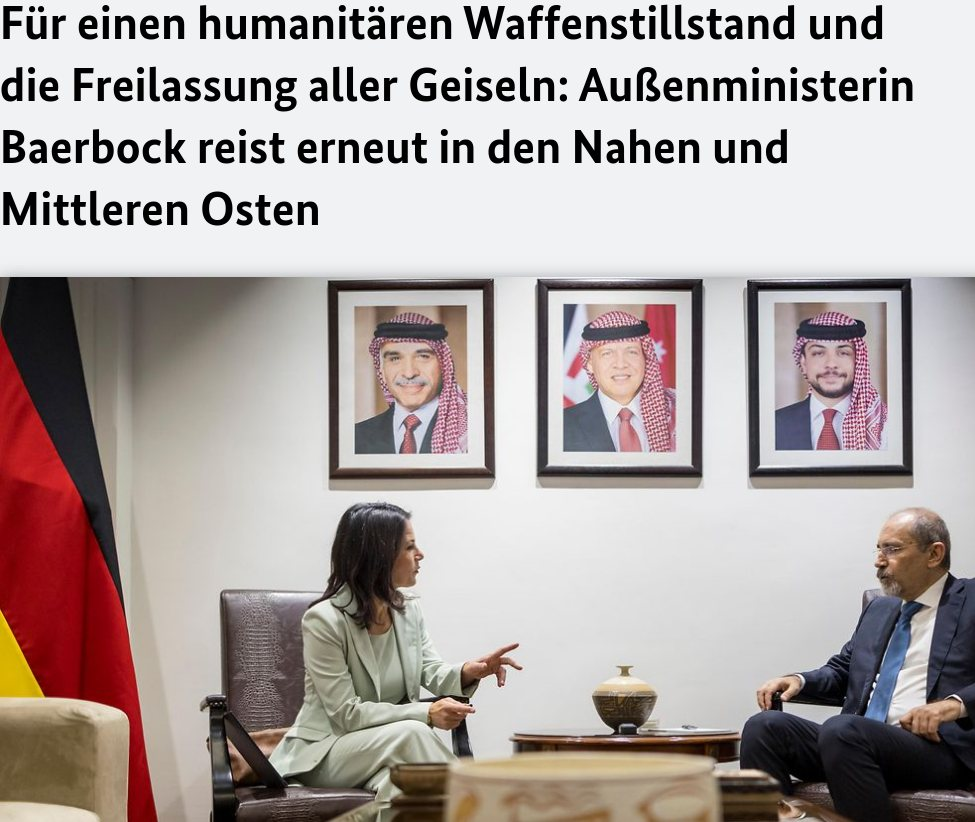
Ergänzung: Erste Recherche sagt, dass der Begriff in UN-Kreisen seit dem sogenannten humanitarian ceasefire für Bahr el-Ghazal im Südsudankonflikt vom 15. Juli 1998 während der dortigen Hungersnot (von der ich noch nie gehört hatte) benutzt wird (drei Monate befristet, hielt dann bis ins darauffolgende Jahr). Dann auch für das sogenannte humanitarian ceasefire von N’Djamena für Darfur im Jahr 2004 (hielt nach Verlängerungen dann bis 2006).
Wenn ich Nachrichten vom UNSC gelesen habe letzten Herbst/Winter, machte es den Eindruck: Die einen fordern ceasefire, USA wollen nur humanitarian firepause, dann probieren es UAE oder Brasilien eben mal mit “humanitarian ceasefire”, was auch immer das dann sein soll.
Das Wort humanitarian soll vmtl. auch deutlich machen, dass man es Israel und der Hamas ersparen will, ein politisches Abkommen miteinander zu schließen, auch wenn es das natürlich sehr wohl ist. Nunja, wenn dieses Wording sein muss …
Die WHO definiert übrigens humanitarian ceasefire als
“Cease-fires agreed to by the protagonists in an armed conflict to allow the provision of health and humanitarian assistance, such as immunization campaigns and food supplies”.
-
Languages of dehumanisation
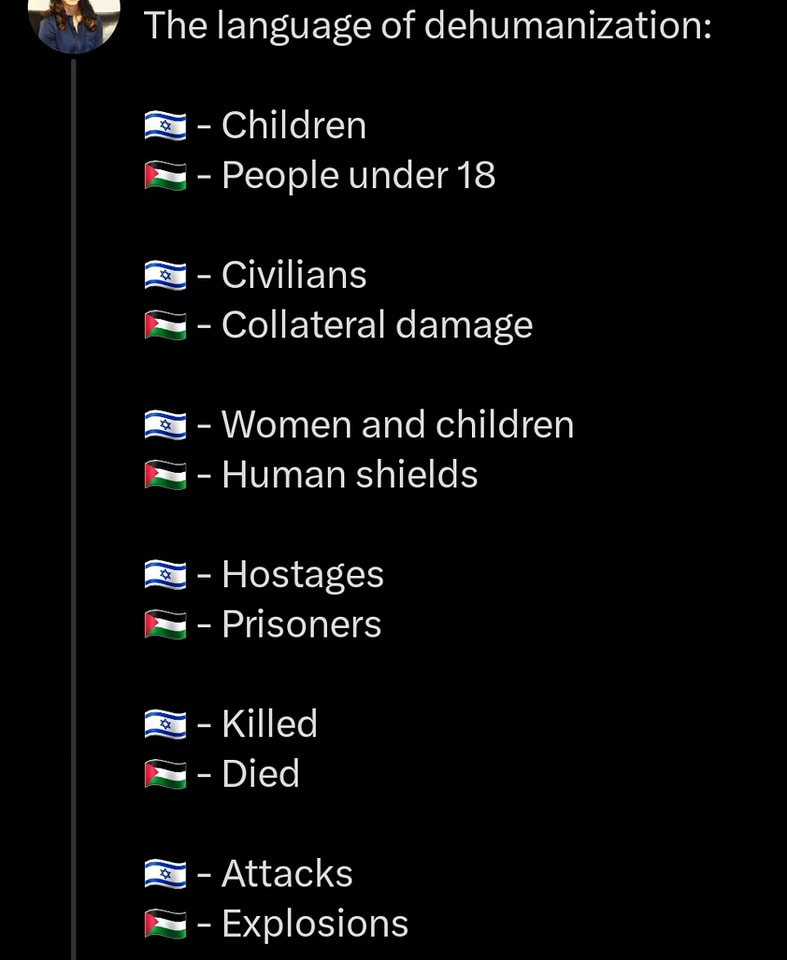
Is this the whole story of dehumanization?
There are many languages of dehumanisation. And war means dehumanisation, so its language will inevitably reflect that. Instead of just decrying how the other side dehumanises, one should try to find a language by which one can actually understand the realities of dehumanisation, of the killings and their motivations. If we just want to play the blame game concerning dehumanising language, this can be easily turned around: From the Palestinian side for example there is the language of refering to all Jewish Israelis as “Zionist settlers” to justify their murder. And there is the Palestinian dehumanisation of Palestinians themselves, where uninvolved children being killed are declared to be “martyrs” to make their death serve the national or religious cause.
Nuance would be required: For example I would prefer refering to concrete ages of victims on both sides, because the term children can be misleading on both sides (however, according to UN Convention on Children’s Rights everyone below 18 is considered a child, if people want to use this terminology consistently and know what they are doing, okay, still the general public will be mislead).
Concerning collateral damage: Yes, one has to differentiate between the intentional killing of civilians for its own sake (a strategy used by Hamas since the late 80s to sabotage any peace perspective with Israel) and collateral damage when achieving a military objective. Collateral damage however can be unnecessary or disproportionate (as it apparently often is with the IDF tactics) and then it is nevertheless a war crime. These standards have to be applied on both sides. There are also intentional killings of civilians for its own sake from the Israeli side—either by militant settlers or (as it happens in most wars) by ruthless soldiers, however, these certainly do not constitute the majority of civilian deaths and they are also not at the centre of Israeli strategy.
Hostages and prisoners: Yes, not all of the persons taken by Hamas and PIJ on October 7th are hostages, some of them are prisoners of war. Yet most of them actually were civilians, which is a clear war crime by Hamas and PIJ. At the same time there is clear evidence that Israel detained Palestinians without charges for longer than necessary to use them for bargaining, which is unlawful hostage-taking, too. However, detaining militants is not hostage-taking, and not even every unlawful detention of suspects is hostage-taking.
Human shields: When Hamas and PIJ are operating from within crowded civilian facilities, this is indeed human shielding. However, this does not justify any unnecessary or disproportionate collateral damage. Furthermore when the IDF strikes buildings merely because some rank and file Hamas militant lives there with his family, but not for achieving a concrete military objective like taking control of that building, it is utterly perverse to justify these killings with alleged human shielding. At the same time the use of Palestinian human shields by the IDF is likewise a warcrime (sending Palestinian civilians into tunnels, strapping Palestinians on military cars).
-
The ICJ advisory opinion on the occupation of the West Bank gives little clarification
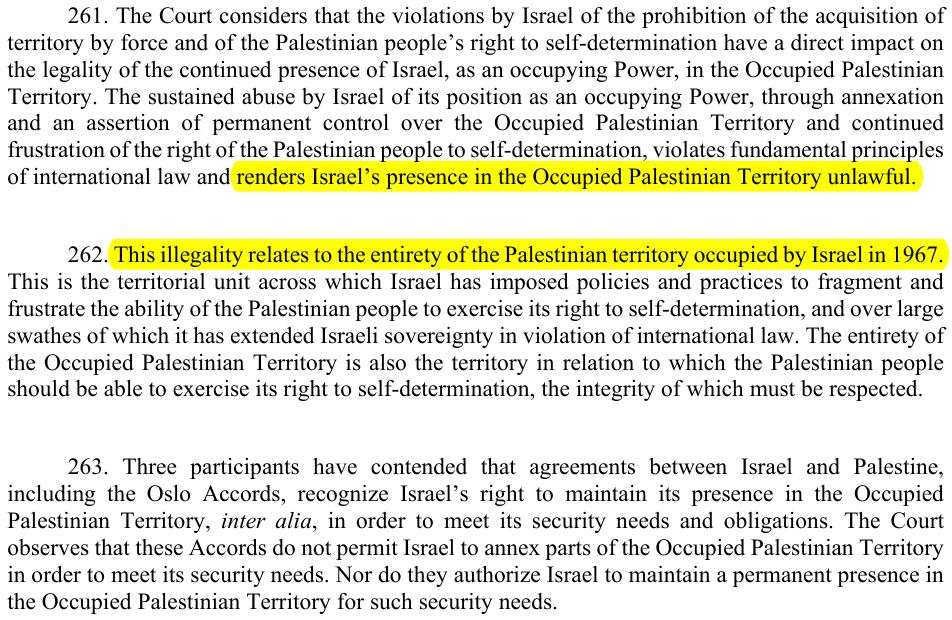
I am disappointed by the ICJ advisory opinion concerning the legality of the ongoing occupation of the West Bank, East Jerusalem and Gaza by Israel—or in their clumsy wordings: “the continued presence of Israel in the Occupied Palestinian Territory”. Why? The opinion provides no methodological answer to the most central question, namely when a possibly legal occupation accompanied by breaches of its legal obligations by the occupying power turns into being itself illegal. Paragraph 261 simply states:
“The sustained abuse by Israel of its position as an occupying Power, through annexation and an assertion of permanent control over the Occupied Palestinian Territory and continued frustration of the right of the Palestinian people to self-determination, violates fundamental principles of international law and renders Israel’s presence in the Occupied Palestinian Territory unlawful.”
However, the opinion gives no explanation whatsoever on which grounds such an inference can be made. The judges have failed to present a principle on which the majority opinion concerning this issue may be based (maybe because there was no majority for any such principle). The issue was simply decided by a majority with judges Sebutinde, Tomka, Abraham, and Aurescu disagreeing. Sebutinde I will not take serious (in the Genocide Convention case she was far more apologetic of Israeli actions than Israeli ad-hoc judge Barak; here she supports the expansion of settlements). However, the declaration by Tomka, Abraham, and Aurescu clearly points out this lack of argument in the opinion. They claim that such inferences cannot be drawn without considering different areas of the West Bank separately, evaluating the legality of the Israeli presence in each of them, based on material findings concerning involved Israeli security interests, which are largely lacking in the opinion.
Within the majority concerning this issue some judges (at least Salam and Yusuf) entertain that the occupation has been illegal from the beginning in 1967. However, given the obscurity of both Egyptian and Israeli intentions in 1967, the defensive character of Israel’s pre-emptive strike is very contested, it might even be impossible to decide, certainly opinions on this issue should on procedural grounds not be made pivotal for an advisory opinion like this, given the court’s inability to investigate these questions more deeply on a material level. The judges Nolte and Cleveland provide a more nuanced argument for the illegality of the continued occupation: In their opinion there is a “clear intention of Israel to permanently appropriate the West Bank in its entirety”. It is this overarching intention, which runs contrary to a motivation by self-defense which can legitimise an ongoing occupation, which turns the occupation of the West Bank in its entirety illegal. However, I do not understand exactly how under these circumstances Nolte and Cleveland can still claim that the illegality implies a “duty to withdraw ‘as rapidly as possible’”, even if they try to qualify what “as rapidly as possible” may mean. Let us assume a new Israeli government would clearly distance itself from expansionism in the West Bank and stop the expansion of outposts but without taking further steps. In that case, of course settlements, annexations, dispossessions and certain repressive practices would remain illegal. However, despite few material changes suddenly security interests (self-defense) and agreements from the Oslo accords could again become legitimate reasons to continue the occupation, there would no longer be a unilateral duty to withdraw.
Politically speaking all this is a disappointment, since it fails to address the very basis of a legal framework for any territorial compromises to be made in a peace agreement between Israel and Palestine.
In any case the various separate opinions and declarations by the judges provide very interesting information about how they think about the Israeli—Palestinian and the Israeli—Arab conflict more generally, beyond the indications we already received from the Genocide Convention case.
-
“One solution: Intifada revolution”?
It is 1st of May. People are shouting: “One solution: Intifada revolution”. Every radical, revolutionary leftist should be insulted by these claims. The slogan “one solution: revolution” is typically used by anarchists or other left-radicalists to indicate that only a total rebuilding of economic, political and social relations is the adequate response to our most urgent problems, i.e. some kind of national liberation is certainly not enough. Let us assume you are a leftist and you are truly convinced that an “intifada revolution” (Palestinian national liberation by all means …) is what is most needed right now, e.g. you are adhering to some stagist concept of the Third International supposing that in colonial and semi-colonial countries national liberation has to precede the preparation for a social revolution. Then your slogan should rather be “two solutions: intifada first, social revolution second”. Even if you are some kind of a Maoist adhering to the idea that it is the same spirit of revolutionary struggle entailed by both national and social revolutions and in that sense you want to call revolution the “one solution” while still adovcating for national liberation as the most pressing issue, still the “one solution” is not about the “intifada” part of the revolution. Especially if you are an intersectionalist leftist, of course you have to reject all of these “one single solution” rhetorics. And yet these slogans are warmly received by many leftists.
Of course this is nitpicking. However, when these slogans are welcomed by leftists, it is one more example for the willingness of Trotskyites, who fancy themselves some imaginary proletarian class basis of national liberation movements and claim to agitate this class basis to shake off their nationalist delusions, to fall prey to these very nationalist illusions. It is one more example of the disastrous consequences of stagist models tending to forget the second stage—after many decades of experiences with the results of anticolonial struggles leftists should understand this danger very well. By the way the stagism of the Third International at least demanded some kind of bourgeois democracy as the result of the first stage, the national liberation of the colonies—something which would be hard to achieve with Hamas as the leading force.
For my part I reject the whole idea behind the slogan “one solution: revolution”. Whatever your notion of revolution might be: The slogan neglects both the importance of reform within a revolutionary strategy, and the problems and dangers within a (post-)revolutionary society. And whatever the precise semantics of “intifada”, whether you are thinking more of the first or the second intifada for example, it is certainly not a viable framework to end the irreconcilable confrontation of the Zionist and the Palestinian national project, and to build a basis for peace and coexistence of Jews and Arabs in Israel and Palestine.
-
The IDF’s automated target selection in Gaza
One of the most important investigations on the Israeli methods of warfare since October 7th, particularly concerning the first couple of months has now been published by Yuval Abraham in +972 Magazine. The report provides a detailed and systematic account of the targeting procedures of the IDF. Its sources from within the IDF corroborate various conjectures concerning the IDF’s method for which there was so far mostly indirect evidence from the results:
• Standards for judging the proportionality of an airstrike have totally eroded compared to previous wars. At times there have been non-combatant casualty cut-off values of as high as 20 for the elimination of a single rank and file Hamas militant (i.e. 20 civilian casualties were demt proportionate). The IDF denials sound very general and vague, they just refer to the truism that every decision is made individually. This issue has also been insufficiently addressed by all those defenders of IDF who only pointed at the fact that proportionality does not mean ‘equal number of civilian casualties on both sides’, but could not define their own positive standards of proportionality and could not give a judgement whether the IDF adhere to such a standard.
• Largely there is no prior surveillance of targeted civilian houses to estimate the precise number of civilians in the house as it is common in other wars (Lauren Leatherby of NY Times reported on this issue before, considering it highly unlikely that the rate of airstrikes could be compatible with adequate surveillance of life-pattern).
• The significance of political pressure to proceed as quickly as possible becomes very apparent: If there are not enough targets per day, then bars get lowered for identifying a person as a sufficiently likely Hamas/PIJ militant and a sufficiently worthy target. The pressure to proceed as quickly as possible, because of shrinking international support and growing international pressure for a ceasefire but also with respect to promising soldiers to get home again and to sustain society, is a major theme of the Israeli political discourse often ignored by the international public. However, while more rapid rates of eliminating Hamas militants might therefore be seen as a political advantage, they are no definite military advantage which could factor into proportionality assessments. This is a very different issue from the necessity to proceed quickly during manoeuvre warfare, i.e. with airstrikes to support the advancement of groundtroops which has to be done quickly to avoid losses (still there have been doubts whether e.g. the use of 2,000 pound bombs along the entire frontline when encircling Gaza City was proportionate, cf. the CNN investigation by Tamara Qiblawi et al.).
• Spontaneous actions by individual officers for which there is no accountability play a significant role (for example when some officer/soldier just decided to add 1,200 additional suspected Hamas militants to the list of targets (IDF spokesperson Jonathan Conricus, when interviewed by the Urban Warfare Project Podcast, also pointed out that unlike in the US, where whenever there is an objection by a legal advisor concerning proportionality/necessity/precaution and thereby legality of an airstrike a responsible superior commander has to be involved to decide, in the IDF the officers can always just override the objections of a legal advisor without consulting a superior commander).
We are confronting an entirely novel type of warfare raising new political, ethical and legal questions. The methods of targeted killing are employed at large scale and high intensity in an attempt to achieve a decisive victory largely based on these methods. This is very different e.g. from US practices of targeted killing for example in Afghanistan, Pakistan, Yemen or Somalia where drone strikes have been used to weaken insurgencies, in the hope of thereby strengthening the stability of a more or less existing government. Still classical manoeuvre warfare had to be used against the Taliban regime in Afghanistan and the Baath regime in Iraq and Daesh in Iraq and Syria. Furthermore the US just like Israel used and use targeted killings to deplete certain groups of terrorist capacities. Furthermore targeted killings have often been part of limited retaliatory strikes—while retaliation in itself a legitimate objective for military actions, retaliatory strikes with the attention to avoid more large-scale decisive defensive actions have been largely accepted internationally in recent decades. Israel has shown that it is neither willing to establish a full occupation of Gaza (many of the troops have been retreated, Hamas was allowed to regain control in many areas, most notably it was able to redeploy their troops into Shifa hospital, Israel is not willing to take the duty of supplying Palestinians themselves at large scale) nor has any plan been established to create a new international or Palestinian administration of Gaza. The numbers of Hamas militants killed (alongside the destruction of Hamas rocket sites and tunnels) thereby remains the only achievement concerning the strategic goal of dismantling Hamas rule. Notwithstanding the question whether this strategy can work, we also see entirely new legal questions coming up when the killing of rank and file militants becomes the primary method of warfare, detached from both tactical goals of securing offensive manœuvres and the stabilisation of any kind of governance. Both the military advantages to measure proportionality and military necessity become hard to define under these circumstances. Conventional legal wisdom (for example concerning the disproportionality of killing rank and file enemy combatants not currently involved in some concrete operation together with their families in their homes) seems to have become completely irrelevant for a military pursuing this kind of strategy. Of course this development and the sometimes bizarre legal justifications do not come out of the blue, they are a response to Hamas strategies given certain technical capacities, building upon the previous evolution of counter-insurgency, counter-terrorism strategies and the recasting and evolution of international law accompanying these developements, particularly the US drone warfare (cf. the works by Bernard Harcourt). Still, Avraham Yuval is very right to point at the “AI machine directing Israel’s bombing spree in Gaza” as a new phenomenon, marking a qualitatively new kind of warfare.
-
Map tricks
The infamous, misleading “Palestinian loss of land” map has been known for quite a while now. But did you know that equally misleading maps have been shared widely by supporters of maximalist Israeli territorial claims in recent years? Not only pro-Zionists abroad, even some Israelis underscroe their claims by this totally ahistorical nonsense. It is not just some joking meme, but shockingly even people with an academic actually believe in the historical falsities purported by this map which can be refuted by 1min of Wikipedia research.
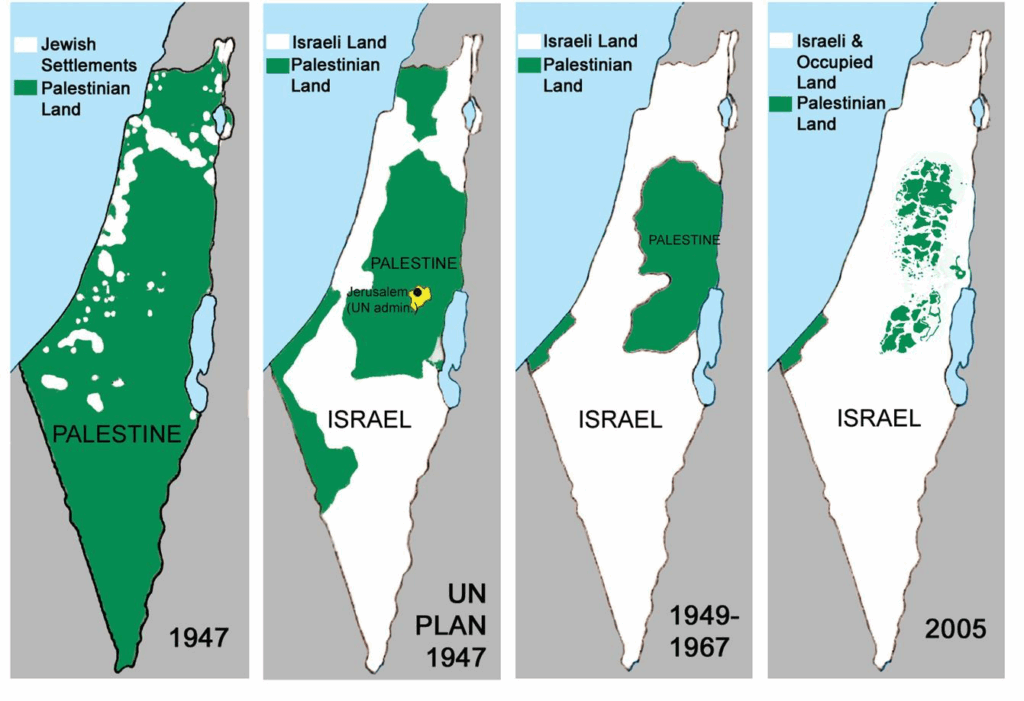
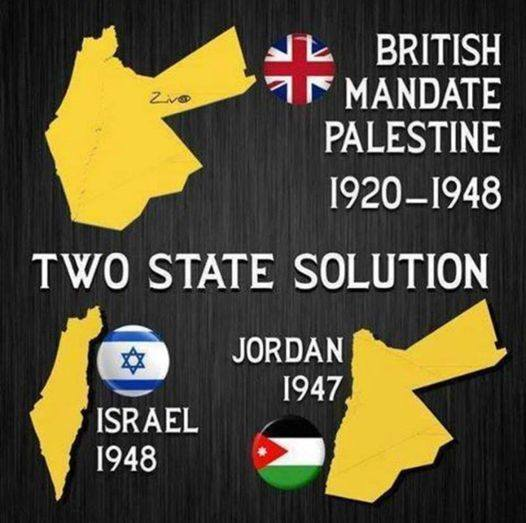
While the “Palestinian loss of land” map is based on manipulating the viewer by using the colors “white” and “green” for very different things on each of the maps, the “Israel-Jordan Two State Solution” map is based on a simple misunderstanding of the League of Nations Mandate for Palestine.
Just to spell it out concerning the “Palestinian loss of land”: Map #1 depicts centers of Jewish population in white and all the rest (including unpopulated desert areas). Map #2: A partition plan rejected by the Arabs. Map #3: White: Israel. Green: Gaza, occupied by Egypt, and the West Bank, occupied and annexed by Jordan. Map #4: White: Israel and Area C. Green: Area A+B administered by the Palestinian Authority (in 2005; some versions of the map use some more recent Palestinian more-or-less realities).
Concerning the “Israel-Jordan Two State Solution” map: There never was any political or administrative entity encompassing only Cisjordan (=Mandatory Palestine) and Transjordan. Only *after* the British had already installed the administration of Emir Abdullah in Transjordan in 1921, the League of Nations in 1922 extended the so called “Mandate for Palestine” (which originally, in 1920, only refered to Cisjordan=Palestine) to Transjordan to retroactively put the British rule over Transjordan on a legal basis. This was possible because the San Remo resolution in 1920 did not fix boundaries of “Syria”, “Mesopotamia”, and “Palestine” but effectively allowed France and Britain to agree on these boundaries later on. While the administration of Mandatory Palestine (Cisjordan) had already been established in 1920 immediately following the San Remo conference, in 1920 Transjordan was still part of the shortlived Arab Kingdom of Syria (not part of some “original land mass of Palestine”). And of course the Golan occupied by Israel in 1967 and annexed in 1981 was neither part of Mandatory Palestine nor of Transjordan.
By the way here we have the proof that you do not have to be religious to believe in a totally ahistorical map of “Greater Israel”. To be honest I have greater respect for religious people refering to very speculative, but carefully crafted reconstructions of territorial boundaries refered to in the Bible than for secular people creating maps based on a very silly misunderstanding of the Mandate for Palestine. Of course neither map can be a foundation for legitimate political claims today or for peace in the Middle East.
What do we learn from this? Well, on the one hand it is a very lost cause to hope that there will be peace based upon some universal rational insight into just the right amount of legitimate claims. There is no ultimate set of true, legitimate, historical claims. The course of history has not been determined by a gradual decline of a original legitimate, just state of affairs, but by a series of injustices perpetrated by many different parties. The invocations of the ultimately true historical claims create political circumstances where people come up with insanities like these maps. There definitely are some certainly legitimate and some certainly illegitimate claims, and we can correct people when they ignore some basic historical and legal facts, however, not every dispute can be resolved by appeal to such facts. Instead, ultimately the conflict has to be solved politically.
This means that people have to understand the destructive nature of maximalist and irredentist territorial claims. However, it also implies that one should not demonise people on either side just for using some silly maps—I am also thinking of these kinds of maps which show either exclusively Israel or exclusively Palestine “from the river to the sea”. We have to recognise how easily people get blinded within their echo chambers and are ready to believe all kinds of non-sensical narratives based on some manipulative graphic memes. Instead of assuming most determined genocidal motives behind any kind of stupid map and distortion of history from either side, we should appeal to people’s imagination of what a desirable peace and coexistence might look like, appeal that they understand the destructiveness of maximalism and then they might open up even for some historical facts which are really novel for them and which might then help to strengthen mutual understanding.
-
Forged death tolls in Gaza and forged global climate data?
UPenn professor of statistics Abraham Wyner published a piece on why he entirely dismisses the death tolls reported from Gaza as fake numbers. His article has been shared widely, also appealing to his authority as a statistician. However, in the following I want to explain why I consider his arguments to be largely 1) unsubstantial and 2) probably not of good faith.
His arguments are largely based upon two observations: 1) The death toll increases very regularly during the period from October 26 to November 10 for which Hamas Government Media Office reported some more detailed data. However, Wyner does not give an argument why the variation of 15% should be too small. If the pattern of attacks was completely regular and only chance would account for the variation of daily fatalities, then the Poisson distribution would predict a variation of 6%. Why shouldn’t there be only a small variation of daily fatalities during a two weeks period of constant IDF advance without huge changes in tactics? People without knowledge of statistics trust Wyner’s authority as a statistician when he says that 15% variation would be unnatural. However, he provides no material or mathematical argument whatsoever why a higher variation would be expected. Before and after those two weeks, by the way, the variation was significantly higher. For these periods Gaza Health Ministry / Government Media Office published less comprehensive data sets, yet one wonders whether there is also some level of deliberateness involved in picking only these two weeks to object to the limited variation.
2) The numbers of killed adult males are not much higher than the numbers of killed adult females, which is generally atypical in wars and would imply that only very few Hamas/PIJ combattants or male civilians engaged in hostilities have been killed, significantly less then what is to be expected from other known IDF and Hamas estimates. Wyner takes this argument from a report published by the Washington Institute. However, the hypothesis entertained in this very report is very much at odds with Wyner’s hypothesis that Hamas would report far too many fatalities. The Washington Institute report assumes that the Gaza Health Ministry and Hamas Government Media Office in fact simply underreported the number of killed adult males. This makes a lot of sense. Armies around the world, particularly in authoritarion and semi-authoritarian regimes, want to avoid that their enemies and also their own public and supporters and fighters and often even some of their commanders get to know the true numbers of fighters killed. Particularly when the Gaza Health Ministry was reporting lists of the deceased with ID numbers to the Palestinian Health Ministry in Ramallah or even to the public, it is clear that Hamas wants to avoid Israel to get information about killed fighters and their identities. Wyner is of course free to contradict. But instead he just cites the Washington Institute report and silently reinterprets its findings without any argument and without even mentioning the hypothesis originally entertained by the Washington Institute. This is clearly intellectually disingenous.
There is a third argument 3), namely an anomalous negative correlation between male and female fatalities. Well, there is a day in the numbers where the male death toll actually decreased. So obviously some corrections or methodological modifications (which might be politically motivated, like excluding Hamas fighters from the death toll) have been made on this day (as it commonly happens in all kinds of health statistics offices around the world), two other days with nearly no added male fatalities and two other days with nearly no added female fatalities may be explained by corrections, late reporting or methodological modifications, too. Now Wyner, who obviously knows that chance cannot account for a negative number of daily deaths, includes the negative number into his data set for which he wants to test whether the negative correlation with female fatalities can be explained by chance. The so-called p-value test now tells that if male and female casualty numbers would vary independently, randomly then there is only a very tiny chance of p<0.0001 that this negative correlation will be observed. However, here we have a classic example for the proneness of the p-value test to misinterpretations of its result. Wyner tests a particular hypothesis of randomly distributed male and female fatalities to then reject it. However, we already knew from the beginning that this hypothesis is crap, since obviously negative fatality numbers are to be explained by some more specific mechanism. Then Wyner abstracts from that and tells us: hooray, the whole date set cannot be explained by chance, it must be manipulated, his alternative hypothesis (according to which Hamas fabricated the numbers entirely according to a pre-determined scheme in a top-down approach, yet they added a decrease of male fatalities for one day) must be true …
Here is my plausible explanation for the negative correlation between killed men and women: It might be that the reports of killed men had to go through an extra step of clearance, which would sometimes take an extra day. In fact this is quite compatible with the data with many days with many dead women reported followed by a next day with many dead men reported. Such a clearance process, with limited administrative capacities for counting deaths, would also contribute to the low daily variation of overall fatalities. Maybe there are arguments against this, but certainly not this p-value test.
A last argument is certainly ridiculous, namely that civilian-to-combattant-fatality ratio would be much higher according to Hamas numbers than during previous wars. Yes, exactly, this is most likely the case, because the IDF changed their operational tactics (also under pressure from the government). With the same line of argument we could say, Hamas numbers must be quite accurate, because they used to be quite accurate in previous wars (if we exclude the question of who is a combattant). However, we know that IDF tactics changed. The question is in how far Hamas fidelity of reporting changed during this war in which the stakes are much higher for both parties than in previous wars in Gaza.
By the way in a 2011 paper—instantly rebuked by several climate scientists—Abraham Wyner also claimed to have proven that renowned climate scientist Michael Mann manipulated his statistics to prove global warming following the industrial revolution. I have not looked into Wyner’s paper myself, but given the degree of dishonesty observed now maybe I do not want to. Recently Wyner has earned around $100.000 for giving “expert testimony” in defense of two right-wing climate denialists which face a lawsuit for defamation of Michael Mann.
Of course it is very clear that there are many flaws in the data by Gaza Ministry of Health and Hamas Government Media Office. Responsibilities shifted. Administrative capacities collapsed. Civilians killed by “friendly” fire like in al-Ahli hospital (by a faild PIJ rocket) are included in the death toll (very regular practice, I have rarely seen death tolls for wars making such a distinction all the time, Israeli authorities also do not make this distinction for October 7, although I have to emphasise that the conspiracy theories that most Israeli civilians were not killed by Hamas but by friendly fire are completely made up, based on manipulation and denial of what Hamas’ explicit terrorist directives). Fighters are very probably excluded from death lists. There is no distinction between combattants and non-combattants in the list (however, while estimates have been published by Israeli authorities, most of the Israeli reporting on the victims of the October 7 attack and massacre also do not make this distinction).
However, there are two major lines of argument why the death tolls published by the Gaza Ministry of Health and Hamas Government Media Office are to be considered good estimates for the numbers of civilians/non-combattants killed (after substracting a small und unknown number of combattants included in the toll and after adding an unknown number of people still buried under ruins):
1) According to an investigation by Yuval Abraham published in Mekomit IDF intelligence spied on Gaza Ministry of Health and concluded that their data gathering for the death tolls is at least sufficiently methodologically sound that it can be used for estimates of civilian fatalities caused by Israeli attacks. And in fact IDF officials used this data because their own intelligence was too busy with identifying new targets to care about post-strike evaluations of fatalities.
2) Two statistical analyses published in The Lancet confirms accuracy of Gaza Ministry of Health data by checking its strong correlation with data collected at various health facilities in a decentralised manner, data on UN staff and by satellite imagery, but also by checking the internal consistency of the decentrally collected data which would still add up to containing the majority of the ministry of health death toll. Wyner objects that UN staff would not be a representative sample because of UNRWA’s links to Hamas, however, even according to Israeli estimates the portion of Hamas/PIJ fighters within UNRWA staff is lower than within the general adult population—Hamas militants within UNRWA are still a huge problem questioning UNRWA’s impartiality as a humanitarian organisation, but the fact that some Qassam militants have day jobs in UNRWA does not provide any objection to the JHU study.
Why does all this matter? We simply should not live in denial of the scores of Palestinian civilians dying in Gaza. Considering the best estimates we have it is very likely that for every killed Hamas/PIJ combattant 2.5 Palestinian civilians and around 0.02 IDF soldiers get killed in Gaza. The ratio of civilians killed is far worse than in any of the liberation operations against cities held by Daesh like Mosul, Raqqa, Falluja, Marawi. Both IDF/Israeli government and Hamas/PIJ strategy and tactics have to be held accountable for this horrendous scale of death and suffering.
-
Advance empathy suppression
I do not know whether anyone has already written about this phenomenon. Immediately after the October 7th massacre I recognised the same rhetorical line in several speeches in solidarity with Israel, grieving the dead and the plight of the hostages, at demonstrations or other community events in Germany: Each time the orators were calling the audience to prepare for the emergence of pictures of horror from Gaza as the war would unfold such that they would not be dissuaded from their conviction of the necessity to dismantle Hamas by these pictures. Friends told me that they have heard the very same line on different occasions.
This line is not the product of a carefully crafted speech, it is a very spontaneous, emotional appeal. This is clear, since—notwithstanding its ethical implications—it does not serve the purpose of these speeches, it is utterly counterproductive: If we are talking about “horrible pictures” depicting crimes, then anyone who tries to convince the public that the IDF are about to wage a just war should certainly avoid announcing their willingness to turn a blind eye to pictures depicting war crimes even before these war crimes happened. If we are talking about “horrible pictures” depicting unavoidable civilian suffering due to cautious and proportionate military attacks or destructions of infrastructure, then anyone who tries to convince the public that the IDF are about to wage a war in accordance with proportionality requirements concerning the objectives of the war, air strikes, destruction of infrastructure or security restrictions on humanitarian relief should certainly avoid saying that one is going to neglect the very suffering against which the proportionality one claims to care about is to be measured. If you do not register the suffering, you cannot check proportionality. If we are talking about fake pictures or pictures not actually showing what their captions proclaim it goes without saying that these have to be debunked and can be ignored, no need for toughness.
After having heard this line multiple times, I was devastated, I had to cry. What makes it devastating is that it is precisely not a conscious call to commit war crimes, it is not a conscious expression of contempt towards the suffering of civilians in Gaza. It is a psychologically understandable reaction. It is a way to cope with one’s inability to endure feelings of ambivalence concerning the actions of the Israeli army and government. It is an attempt to provide an easy solution for dealing with the flood of disinformation spread by the “pro-Palestinian”, pro-Hamas propaganda. It is supposed to provide an easy way out of the moral dilemmata imposed on the IDF by Hamas’ use of human shields. It is an attempt to circumvene the difficult task of subjecting the IDF to public scrutiny given the intransparency of their procedures and their own regular misinformation. Not wanting one’s friends and relatives to be fighting for a just cause in an armed force which would commit war crimes as it did in the past (like other armed forces around the world), people justify ignorance towards crimes which they unconsciously anticipate. Even before the scale of disregard of the IDF for civilian casualties, the relaxed proportionality requirements for air strikes, and the lack of enforcement of rules of engagement became evident, people already started to suppress their empathy. People who have empathy for Palestinians felt obliged to suppress their empathy in advance. The experiences with these psychological effects maybe contribute to understand better why the Israeli public and media, while to a large extent being very critical of Netanyahu’s failures and the lack of future perspectives provided by his government (except the Gaza resettlement dystopia advanced by its even more right-wing elements), has at such a scale failed to critically investigate and question the IDF policies and tactics leading to such large civilian fatalities (more than 20.000…). Maybe they help to understand how the Israeli public could reach a point where so many people buy the lies that there would be no contradiction between the legitimate aims to dismantle Hamas’s military capabilities and to bring the hostages home, and where even the shooting of hostages carrying a white flag against all rules of engagement is excused as a “mistake”.
All of us have to be vigilant to fight against these psychological inclinations. Neither our analysis of military and political actions nor our ethical judgements, our empathy must ever be subdued to demands of maintaining the perceived integrity of one’s party and the consistency of one’s psychological identification with a party.