
Two days after the massacre perpetrated by Hamas in Israel, Israeli defense minister Gallant and energy minister Katz (both Likud) announced a “complete siege” of Gaza, cutting it off from water, food, fuel, and electricity until Hamas would release all hostages. Fortunately the US made their position clear and achieved that these measures have been partially lifted. After one week water pipeline supply was reestablished to southern Gaza. Since end of last week there are some humanitarian relief deliveries of food, water and medicine arriving from Egypt. Yet the consequences of lack of water and energy are still horrific. Last week UNRWA stated that they would only be able to provide 1 liter of water per day for each person sheltering in their facilities; fortunately, UNRWA seems to have fixed this, wells are operative now and basic supply with water could be restored. But still there are catastrophic hygienic conditions in the crowded shelters amplified by the lack of water with high risk of diseases spreading. Furthermore, hospitals in northern Gaza, which are overwhelmed because of all the injured anyways, have run out of fuel and can no longer run all the devices needed to treat their patients. Southern Gaza has even less medical infrastructure and transporting patients is dangerous, if not impossible.
There have been a lot of discussions concerning the legal status of these measures. I think these legal considerations are really important to understand the historical significance of the current events and their political implications, the legal notions serve as a guideline to gain a nuanced understanding of the conflicts involved and international humanitarian law also provides an important framework for the international diplomacy inevitably involved in the conflict (which will hopefully not spillover and escalate at further fronts beyond Gaza). Yet, since this legal sophistry might seem cynical, I want to quickly give my moral and political view: The measure of cutting water, which has been announced and now partially revoked, to enforce the release of hostage is utterly immoral, irrational and also a politically devastating deception of the Israeli public. Structurally this kind of measure is a case of indiscriminate, possibly lethal measure of coercion against the civilian population of the enemy to coerce him to end a (real or perceived) injustice, in these respects ressembling the taking of hostages by Hamas, despite all the other differences between the fundamental political goals of Israel and Hamas. These methods of coercion, treating civiian lifes as mere means, undermine any kind of ethical relationships. The weaponisation of humanitarian aid threatens to question all set boundaries of warfare. Early in the war the announcement of the “complete siege” set the tone for what is to follow, brutalising the discourse and framing the war as an endeavour against the general population of Gaza. Furthermore the measure cannot work, since unlike the general population of Gaza Hamas fighters will always have access to their stockpiles of food and to wells. Yes, at some points in history starvation of the general population worked as a mean of coercion, for example in the Biafra war (where starvation killed round about a million people of Biafra). Back then the progressive, separatist forces of Biafra finally capitulated. But is this to be expected from the Hamas and PIJ Jihadists? They would certainly rather start killing hostages if they would really get into trouble getting food. Thus, the message to the Israeli and world public was: We are doing something for the hostages, we stand together firmly and decidedly, applying the harshest measures of force to free the hostages, while in fact a public discussion of the hardly resolvable conflict between different objectives, freeing the hostages, protecting Israeli soldiers and weakening/defeating Hamas is avoided (while some members of government like Smotrich declared early on that the fate of the hostages should not be a priority). As an infringement of Israeli and international humanitarian law the measure already did great damage for the cooperation with international allies, it increases the risk of further escalations elsewhere than in Gaza and ultimately it weakens the rule of law in Israel and does damage to any potential future peace process. Those seeking to demonise Israel for its pursuit of legitimate military goals against tyrannical Jihadi forces in an act of self-defense against their massacres among the Israeli civilian population, should be reminded however that the “complete siege” has been partially lifted after US calls for adherence humanitarian international law and also controversy within Israeli society, and that its immediate effects have luckily been limited particularly thanks to Gaza’s own ground water supplies and UN stockpiles. But now let us look at the legal details. While not being a legal expert, I try to stay in line with general textbook opinions concerning the rules for sieges and expert opinions on the announced siege of Gaza, supplemented by some explanations and observations which might help to clear some missunderstandings which I have encountered in conversations.
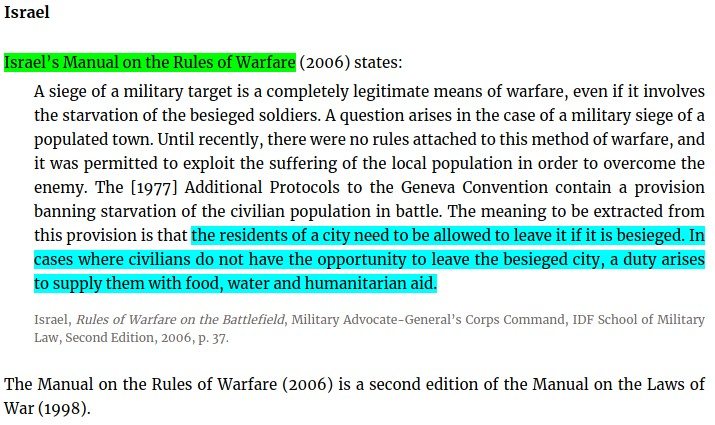
What are the legal prohibitions and obligations at stake? Let us consider the prohibitions: The one central, most relevant article is Article 54 of the First Additional Protocol to the Geneva Conventions from 1977: “Starvation of civilians as a method of warfare is prohibited.” While the article does not address medicine or energy, the Israeli Manual on the Rules of Warfare explicates concerning the application of this article to sieges: “The meaning to be extracted from this provision is that the residents of a city need to be allowed to leave it if it is besieged. In cases where civilians do not have the opportunity to leave the besieged city, a duty arises to supply them with food, water and humanitarian aid.” This provision would have been violated if the announced “complete siege” would have been carried on, without a possibility to evacuate (it does not matter that the borders are controlled jointly by Egypt and Israel and that it would be their joint decision not to let people leave). Fortunately most of the population of northern Gaza was now able to evacuate south of Wadi Gaza, where there are now at least somehow better supplies and where water is running again, luckily attempts by Hamas to prevent people from fleeing have largely not been successful, but still tens of thousands of civilians have sheltered in the north, especially at UNRWA facilities and the Shifa hospital, some of them are unable to move due to medical conditions. They require to be provided with humanitarian aid.
Other possible prohibitions arise from the prohibition of attacks not discriminating between civilians and combattants and attacks against legitimate targets but with disproportionate collateral civilian damage (Article 52 First Additional Protocol, starving the entire population would definitely be disproportionate in the long run). However, this would require a very broad understanding of the term “attack” (Article 49 First Additional Protocol: “acts of violence against the adversary, whether in offence or in defence”), the entire siege would have to be understood as one attack, which is certainly no legal consensus, despite some discussions trying to expand the traditional understanding of the word to include for example pillaging of medical facilities or cyber sabotage.
Furthermore there are some possibly relevant positive obligations in international humanitarian law: Articles 55 and 56 of the Fourth Geneva Convention and Article 69 of the Fist Additional Protocol obligate an occupying power to provide for food, water, hygiene and healthcare. However, it is legally disputed whether Gaza is to be considered as occupied by Israel. The government in Gaza is exercised by Hamas, not by Israel and unlike the West Bank it is also not jointly administered by Israel and the Palestinian Authority, thus it is not a classical example of occupation. However, first of all since Israel supported by Egypt controls the borders and airspace and has further means of influence (i. e. by controlling supplies to Gaza coming from the Palestinian Authority and third parties) there is at least some level of control, furthermore legally—as it has been confirmed by the Israeli courts—all the Palestinian territories constitute one legal entity, in which Israe exercises varying levels of control. Thus for example the UN consider these whole territories as occupied. Anyways, in the current situation of the siege another article applies, namely Article 70 of the First Additional Protocol mandating humanitarian relief in “any territory under the control of a Party to the conflict, other than occupied territory”. However, such relief is supposed to be based on joint action of the conflict parties, the article does not in all cases imply strictly unilateral obligations. Article 23 of the Fourth Geneva Convention proscribes the free passage for necessary humanitarian aid even towards the enemy (an obligation applying to both Israel and Egypt). But it also contains restrictions, namely that the deliveries can be impeded if they would be diverted to the enemy’s armed forces or would provide an advantage to the enemy. Thus it is in accordance with this rule of humanitarian international law that Israel stresses that humanitarian aid to be delivered via Egypt is conditional on guarantees that it is not diverted to Hamas. However, such guarantees can be provided by international organisations. Currently Israel refuses to give safety guarantees to the WHO for deliveries of fuel to hospitals urgenty in need in the northern part of Gaza, pointing at fuel reportedly having been stolen by Hamas from UNRWA. However, proportionality has to be met, some incidents of diverted humanitarian aid (even if it contains dual use goods like fuel) cannot give a justification for a complete blockade of deliveries by an international organisation like the WHO. Article 54 of the First Additional Protocol contains a similar provision that even infrastructure with a dual use, possibly providing both for the benefit of enemy forces and for essential needs of the civilian popuation, may only be rendered useless, if this does not need to an absolute lack of the essential needs of the civilian population. Unfortunately decades of skillful diplomacy by Arab States, which achieved to create strong anti-Israeli alliances within the UN and established institutionalised double-standards directed against Israel within UN bodies, led to a deep distrust of Israeli governments against the UN. However, there are hardly any actors more suitable than organisations like WHO and ICRC to implement the humanitarian relief.
To summarise: At least against the deprivation of the civilian popuation from food and water as a mean of warfare there is a very clear prohibition without further restrictions, as it is also recognised in the IDF’s legal manual. At this point we notice how important it is for the legal evaluation to look at the subjective intentions involved to determine the legal status of certain actions in war: Energy minister Katz explicitly declared: “Humanitarian aid to Gaza? No electric switch will be turned on, no water tap will be opened and no fuel truck will enter until the Israeli abductees are returned home.” He made it explicitly clear that the goal would be to deprive the general civilian popuation of water and electricity. It is this deliberateness which is shocking and against which one can remind everyone of the concise words of the Israeli High Court of Justice on the State’s requirement “to refrain from deliberately harming the civilian population located in the Gaza Strip”. Katz did not say that he wanted to pass on the responisbility for deliveries to Egypt (therefore it is also irrelevant whether there have been silent or explicit agreements between Israel and Egypt concerning the blockade and whether Egypt really delayed the supply because of an Israeli air attack). He explicitly declared his intention to make certain essential goods unavailable to the general population of Gaza and implemented a measure actually suitable to causally achieve this goal—for the legal (and also moral) evaluation of this intended action it does not matter that the success of his actions in achieving his goals is contingent upon other factors (for example Hamas having diverted pipes for rocket production instead of maintaining the water infrastructure, or Egypt not deivering water to Gaza). He did not say that he wanted to starve the Hamas combattants or create some situation of chaos to allow for Israeli operations. He explicitly declared that he would make humanitarian relief subject to conditions not provisioned by international humanitarian law: “Humanitarianism for humanitarianism. And no one can preach morality to us.” Thus there was a clear intention of collective punishment and intimidation directed at the civilians of Gaza (contrary to Article 33 Fourth Geneva Convention).
More precisely the announced measure of a “complete siege” has to be considered a reprisal: A reprisal is defined as an action within war which would in itself be unlawful used to force the enemy to stop his own unlawful behaviour. In this case the unlawful behaviour of the enemy is the taking of hostages (Article 34 Fourth Geneva Convention). So does this provide a legal justification? Reprisals are not outlawed by the treaties and legal according to customary international law, but subject to some limitations, which have evolved in particular since World War II, when the right of reprisals served as justification for nearly limitless suspensions of protections for civilian populations in the Hague Convention. Article 33 of the Fourth Geneva Convention outlaws reprisals against a civilian population under one’s own control. The First Additional Protocol contains a bunch of prohibitions of reprisals, for example against civilian objects, cultural heritage and infrastructure supplying essential needs of the civilian population. However, many countries have not joined the First Additional Protocol and for example Israel, while agreeing that major parts of the First Additional Protocol are customary international law, officially objects to the rules concerning prohibitions of certain reprisals. However, several institutions, including the International Federation of Red Cross and Red Crescent and the International Criminal Tribunal for Yugoslavia: “the rule which states that reprisals against the civilian population as such, or individual civilians, are prohibited in all circumstances, even when confronted by wrongful behaviour of the other party, is an integral part of customary international law and must be respected in all armed conflicts.” (Prosecutor v. Martić) “It cannot be denied that reprisals against civilians are inherently a barbarous means of seeking compliance with international law.” (Prosecutor v. Zoran Kupreškić et al.) According to this opinion legal reprisals are limited to only quite special cases, e.g. using an unlawful weapon (like chemical weapons) in case the enemy did the same to gain an advantage. One should note that if reprisals directed at the civilian population were to be considered legal, this might also be used to legitimise the indiscriminate rocket attacks on Israel by Hamas and Islamic Jihad, which are generally and in my opinion rightly considered to be war crimes. However, there are legal opinions not agreeing with this judgement, for example Christopher Greenwood argues that reprisals directed at the civilian population are not prohibited by customary international law, since both explicit objections and state practice go against this assumption. One should keep in mind that at least when a war becomes a total war on both sides and when there are no external powers capable of limiting the conflict, it seems utterly impossible to avoid reprisals (cf. my previous post concerning reprisals in the history of humanitarian international law and comparisons which have been drawn concerning the current war between Hamas and Israel). However, even if one argues that some reprisals against the civilian popuation might be legal, there is always a proportionality requirement according to customary humanitarian international law: The severity of the breach of law used as a reprisal shall not exceed the severity of the breach of law one intends to suppress by means of the reprisal. Thus as soon as the “complete siege” would have been carried on for a longer time this breach of law affecting 2 million civilians would have certainly become more severe than the taking of hostages by Hamas, thus violating proportionality. To reiterate: Fortunately this idea has now been given up by the Israeli government.
Finally a few words on the terms “war crime” and “genocide”: I only talked about a breach of international humanitarian law, because not every such breach is to be considered a war crime. War crimes are primarily defined by the Rome Statute of the International Criminal Court. The definition of a war crime in international armed conflicts is broader than the definition in non-international armed conflicts. Closely related to the issue of occupation there is also the question whether the conflict between Israel and Hamas can be considered to be international. Israel generally assumes that the whole Israeli-Palestinian conflict is of a non-international character. If one considers the conflict to be international it is easier to consider a “complete siege” to be a war crime (and also attempts or conspiracies to commit such a crime can be persecuted by the ICC), otherwise one would have to look more closely at the actual effects of the “complete siege” to decide the question. However, this question is mainly relevant for the question of criminal accountability, which is at this point unrealistic anyways and is also not the most pressing political or humanitarian issue. To avoid irrelevant discussions many diplomats and humanitarian organisations prefer to simply refer to breaches of humanitarian international law.
Concerning the term “genocide”, often used far too quickly in all kinds of conflicts nowadays, one has to remember that not any illegal, indiscriminate act against a civilian population has a genocidal intention. Legally an act of genocide requires an “intent to destroy, in whole or in part, a national, ethnical, racial or religious group, as such”. While a single, isolated military action can legally be an act of genocide, it has to be intentionally directed against the “group as such”. In the case of the massacre of Srebrenica this has been evident because of the separation of male Muslim Bosniaks to be murdered. The attempted reprisal by Gallant and Katz was directed against a besieged population and not at destroying Palestinians as a national, ethnical group. There has not been any genocide against Palestinians. However, of course there are genocidal rhetorics among right-wing Israelis, which make the current situation even more dangerous.
Concerning the antisemitic massacre perpetrated by Hamas one should differentiate between Hamas’ overall antisemitic political agenda, which includes genocidal ambitions against the Jews in Israel. Their terrorist message to the public delivered through their slaughtering of civilians might not be most adequately understood as an intention to destroy an “ethnical group in part as such”, even if this is their long term genocidal goal. Just like the antisemitic massacres perpetrated by the Ukrainian nationalist army of Petljura and by the Russian anti-revolutionary army of Denikin in the Russian civil war are seldom considered as acts of genocide. More often than not the focus on the contested concept of genocide, often quoting mainly the legal definitions, in recent years has blurred the historical, social, psychological and political understanding of ideologically motivated mass atrocities against civilians.
This might sound shallow to some, but let us avoid political cynicism and grieve the losses and still hope that it will be possible to reduce civilian deaths, and that in the end, despite all the danger, there will be an opportunity again for peace and social progress in the holy land.
Leave a Reply