
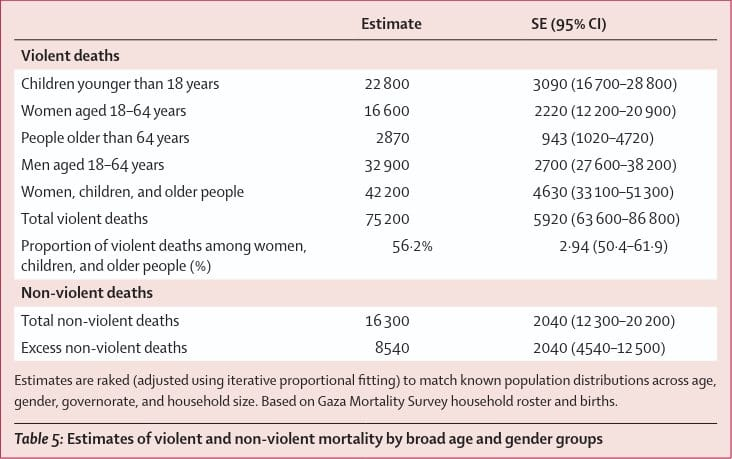
The results of the first independent survey on the number of deaths have finally been published (Spagat et al.)! About 75.000 (±6.000) Gazans had been killed in the war as of January 2025—significantly exceeding the numbers by the Hamas Ministry of Health. Adding the death toll accounted for by the Hamas Health Ministry since January, it is rather safe to say that about 100.000 Gazans have been killed “in/because of fighting”. The statistical evaluation is based on a household survey conducted by the PCPSR on the ground in Gaza. A preprint had already been published last summer, now the paper passed peer review and editing for publication in The Lancet Global Health. Based on this preprint, already in November Gómez-Ugarte, Chen et al. provided a projection of around 100.000 violent deaths during the war in Gaza.
After another recent IDF statement estimating that about 25.000 “terror operatives” have been killed during the war, a ratio of 3 non-combatants killed for every 1 combatant seems to be a good estimate. Usually numbers from warring parties about numbers of killed enemy combatants are to be considered as upper limits. In the case of Israel in particular we have to assume that the IDF to some degree does not only count combatants and civilians directly participating in hostilities (which, for the sake of simplicity, I also call combatants here) as “terror operatives”, but also political Hamas cadres that are not part of the chain of command and therefore civilians, Hamas propagandists, or Hamas policemen (whose status has to be debated). Furthermore, as Israel killed suspected members of the Qassam or Quds brigades in individually targeted strikes in their homes, rather than in combat, in large numbers, one also has to assume that some of these strikes were based on old intelligence and actually killed only former members of the militias (which has no more basis in IHL than the horrific claims by some Palestinians that unmobilised Israeli reservists would be legitimate targets). Furthermore, as +972 documented, several IDF officers reported and complained about a culture focussed on killed enemies as exclusive measure for success, also resulting in overreporting, also reflected by government propaganda with inflated figures and meaningless claims about “eliminated battalions”.
However, the 83% (5 to 1) estimate for civilians among the killed by +972/Yuval Abraham, seems to be too high: It assumes that the ratio of combatants killed could be calculated by dividing the number of killed persons identified by IDF as known militia members (consequently not including civilians directly participating in hostilities or newly recruited militia members unknown to Israeli intelligence haven access to old membership lists), which would mean that Hamas was utterly failing with their attempts of hiding identities of killed fighters by censoring the Health Ministry death lists or by never reporting about those killed in underground structures. However, during some periods of the war the rate was probably actually coming close to being that bad: With about 13.000 killed reported between March and mid-August 2025, in the same period the IDF claimed to have killed only 2.100 “terror operatives” (at least 4 to 1, ranges of error to be considered), in a period when strategic operative goals of the IDF became even less clear than already at the beginning of the war.
A ratio of 3 to 1 is devastating—it might be best compared to Russia’s destruction of Grozny 1999/2000. While the ratio might still be better than the toll of the Sri Lankan army in its 2009 final offensive to destroy the Tamil Tigers, justifying massive indiscriminate use of artillery by the LTTE’s use of human shields within alleged humanitarian zones that, however, did not guarantee separation of civilians from fighters, it is far worse than what we have seen in the fight against he Islamic State during the liberation of Raqqa, Mosul, and Falluja (some ratios around 1:1 or 1.5:1), despite the Islamic State’s ruthlessness of forcing civilians to stay with them in the city centers as human shields at gun point. 3 to 1 is not the ratio that you will expect from a modern high-tech army with thousands and thousands of tanks and modern armoured vehicles, helicopters for rapid medical evacuation, night-vision, years of focus on preparation for urban combat, and allegedly a functioning internal oversight for compliance with international humanitarian law. Given the fact that only less than 500 IDF soldiers killed and that Hamas and PIJ have been faced in battle for territory only to a very limited degree, the ratio is inexcusable with a too high risk for soldiers that would render the airstrike patterns compliant with proportionality, necessity, and precaution requirements. Rather the numbers confirm the soldiers’ report concerning the total erosion of proportionality standards for airstrikes and general discipline of ground forces (e.g. when it comes to the establishment of “free fire zones”)—amounting to a systematic crime against humanity as policy. US officer John Spencer from the Modern War Institute, whom I used to respect for all his valuable work on Urban Warfare, has to be blamed for dismissing Gaza Ministry of Health fatality numbers, while making baseless claims (not matching with his own research for example about Mosul) about extraordinary efforts by the IDF that would have led to exceptionally low civilian fatalities compared to other urban operations. The Netanyahu government has to be blamed for conscious lies about a 1:1 or 1.5:1 civilian to combatant ratio among the killed.
According to the now published survey about 54% of those killed were women and children, which is quite consistent with the lastest Ministry of Health numbers (about 52%), within the statistical error margins. These latest Ministry of Health numbers are the result of various iterations of corrections of the death lists, adding newly identified fatalities and removing some Gazans that were still alive, but registered dead (and who in many cases complained about that!), and some natural deaths. Previous Ministry of Health as well as Hamas Government Media Office estimates (the latter were only initially used by UN bodies and later dropped), particularly during 2024, had claimed that close to 70% of fatalities were women and children. Very early on, through the work of Gabriel Epstein of the Washington Institute, it had become apparent that Hamas was underreporting, delayed in reporting and sometimes retroactively removing dead adult males from the death tolls, strongly suggesting that death lists got censored for the sake of not revealing information about killed fighters. Despite this clear evidence that among the unreported fatalities the ratio of men should be higher than among the reported, various representatives of UN humanitarian and human rights organisations—including UNHCHR Volker Türk, whose communication during the war I otherwise highly respected—presented the “close to 70% of fatalities are women and children” figure as fact and did great damage to the reputability and credibility of their organisations and raised big questions about their information evaluation mechanisms. Likewise propagandists like statistics professor Abraham Wyner (who otherwise earns money for presenting highly reputable research on global warming as forgery) have to be condemned who—whether deliberately or not—misinterpreted the irregularities of the censored death tolls (with statistical bogus arguments) to claim that fatality numbers would likely be lower. Furthermore (I am refering to the great work of Gabriel Epstein here again), contrary to some claims by defenders of the IDF and the Israeli government, there is no evidence that the Ministry of Health numbers would today still contain significant numbers of natural deaths or people that are still living. Quite unnecessary to mention that all those spin doctors have to be blamed (or pitied for their ignorance and their wishful thinking), who attributed the overrepresentation of male youth and adult men among those killed exclusively to killed combatants. It is totally what you expect from a war in an extremely patriarchal society like Gaza that male youth and adult men, while being civilians, engage in much higher risk activities. Additionally—in the context of a war where the main militias on one side exclude women—they are more often mistaken for combatants and inhibitions by soldiers to kill them despite not thinking they are combatants are probably lower.
The study by Spagat et al. also provides estimates for excess mortality, with 8.500 excess non-violent deaths (with a huge error margin). Most of these deaths would have been avoidable as well, if a legitimate safe zone would have been established by Israel, where civilians would have been separated from combatants and properly supplied. These numbers confirm that earlier estimates (for example in a letter published in The Lancet) of total excess deaths based on multiplying the reported fatalities by numbers like 5 were baseless—or rather based on comparison with totally different cases of wars in regions with extremely undeveloped infrastructure, no sufficient systematic reporting systems, out of sight of most of the international community, and where protracted conflict led to dispersion of refugees over vast areas, and a total breakdown of already weak supply structures (think of the Second Congo War as an extreme example). However, due to the food and hunger crisis in late spring and early summer following Netanyahu’s renewed food blockade since March 2025, non-violent excess mortality rates might be significantly higher later in 2025 up until the ceasefire compared to the period studied in the survey.
Leave a Reply