
I have seen Kurdish and non-Kurdish activists blaming Kurdish leaders of the SDF for seeking a compromise agreement with Damascus, rather than pursuing military campaigns with the help of Israel. And I have seen quite some Israelis on social media sharing quite irresponsible, uninformed, often distorted contents about the situation of Kurds in Syria.
Concerning the last year and a bit I can affirm: While many Kurds, including from the PYD and the PKK, have been quite critical of Israel (especially given the war on Gaza), there have been quite some attempts to advocate for more Israeli involvement in north-eastern Syria, including “guarantees” by the stupid Israeli Foreign Minister Gideon Saar (who, due to the corrupt and criminal nature of the entire government, somehow got the appeal of being a voice of reason) “given” to the Democratic Autonomous Administration of Northern Syria (DAANES) in a direct phone call, engagement between Israeli officials and Kurdish activists and campaigns by Kurdish Jews in Israel as well as publicity campaigns by the Israeli Foreign Ministry. Now, Saar’s “standing with the Kurds” has been proven to be worthless.
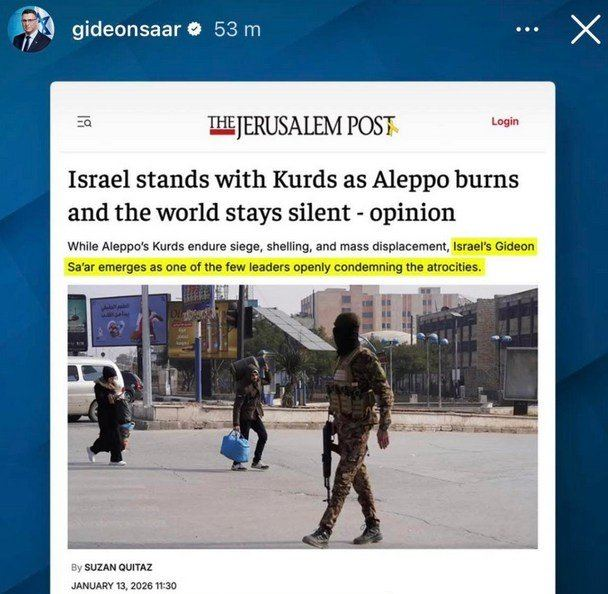
However, to me it was rather clear that this Israeli government provided no suitable basis for a trustable alliance. The Syria policy has been driven by security paranoia, populism, by trying to appeal to Druze Likud voters any by an “if everything I have is airpower, then every problem looks like a target to be bombed” approach, but has not been based on any sound evaluations of the situation in Syria or honest engagement with Kurdish and SDF (let alone Democratic-Confederalist) political ambitions.
The vast majority of those Israelis who fall for their government’s demagoguery has no clue that Erbil and Rojava are two different things and that the SDF included not just Kurds, but a large number of Arab militia men as well as Armenians, Yazidis, and Assyrians, the PR by foreign minister Saar largely consisted of playing some kind of Middle-East minority bingo, the inflationary use of the term “genocide” when it comes to Syria by Israeli politicians and media was simply pathetic.
Early March last year the defense minister Katz (whose only qualification is being a Netanyahu yes man) announced that Israel will defend the Druze area of Jaramana. Apparently he did not look at a map and did not realise that this is an indefensible suburb of Damascus. There was a symbolic bombing in Damascus and of course this made nothing better for Duze in Jaramana. Those people (whether Saar himself, Kurds or Israelis) who instilled the phantasy that Israel might come to rescue in Sheikh Maqsoud (even more remote from Israel than Jaramana, and likewise indefensible) I consider to be coresponsible for the useless prolongation of fights in Sheikh Maqsoud (decision by the local council) after that had already been a withdrawal agreement, including the death of five Kurdish suicide bombers.
In Sweida the situation is of course entirely different, because this area can be supplied by Israel and it is considered by the Israeli government to constitute strategic depth, it is about having a foot in the door in Syria.
No matter how often Israeli politicians called the Damascus government “Jihadi terror regime in suits”, this does not change anything about the fact that at the end of the day Sharaa’s regime represents quite the type of Muslim State that the Israeli government likes: Centralised, technocratic, pro-business, Sunni authoritarianism with a revered strongman, where religion supports the strong grip on society without being conceived as a revolutionary force, just like in the Emirates and Bahrain. But only by politically opposing this model of government, and not by this mere “protecting minorities” demagoguery entertained by the Israeli government (which becomes pointless as soon as the government stops executing large scale massacres), a point could have been made for principled support of the DAANES.
At best there were legitimate hopes that some Israeli strikes might help to buy time. But Israeli security paranoia was unable to provide an alternative view for the future of Syria—of course not, as Netanyahu just like the Trump government was not in principle opposed to the type of new government in Damascus (in the case of the US, however, at least the military establishment’s long-standing direct connections with the SDF are still a basis for some support). Buying some time might give some leverage, but only if you have some viable vision for the future of Syria, in no way it could have made agreements with Damascus superfluous.
The current demise of the DAANES is a tragedy—unfortunately irresponsible “pro-Israel” advocacy and false promises from Israeli leaders have also played a role in it.
Leave a Reply