“If civilians used as human shields by terrorists get killed by bombing or shelling, it is solely the responsibility of the terrorists. If civilians are killed in the vicinity of terrorists it will always be proportionate, because at least the surviving population gets liberated from the terrorists who took their own population hostage. The civilians decided to stay with the terrorists, thereby they are taking part in the conflict, they should not have special protection and not taken into account when they are in the vicinity of terrorists to be targeted. Terrorists should not be incentivised to use human shields by refraining from targeting them when civilians are around, because this will just lead to even more casualties in the future.”
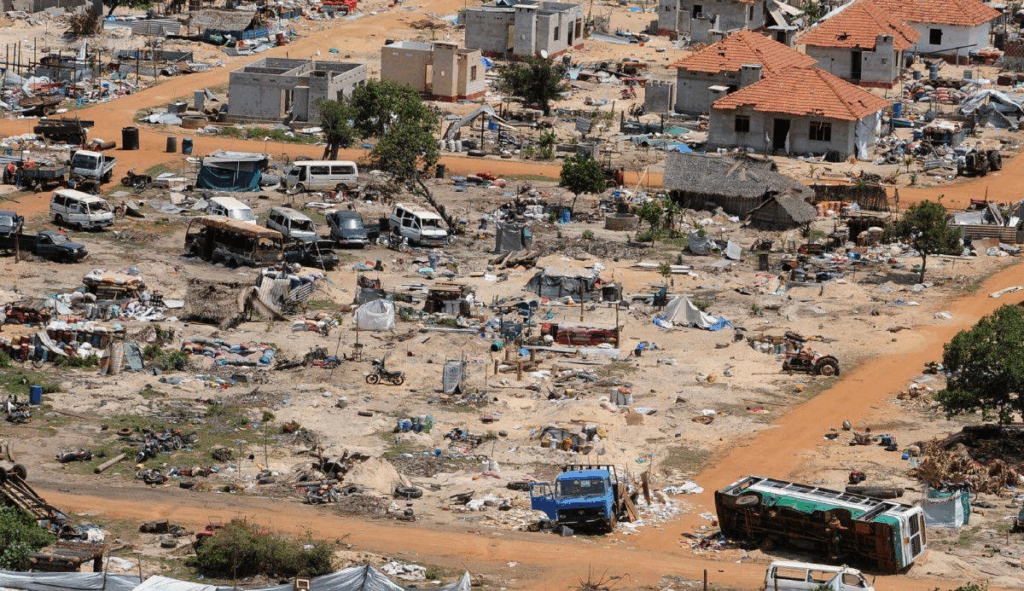
Am I talking about the current war between Hamas and Israel? No, I am quoting the outlandish interpretations of humanitarian international law which were used by the Sri Lanka government to justify estimated 40.000 civilian deaths (one of the UN estimates) during the final months of their final campaign against the Tamil Tigers in 2009. Back then the massive shelling of the last positions of the Tamil Tigers, which had consciously retreated into the densely packed no-fire zones (especially the one in Mullivaikkal) which had been declared to be safe spaces for civilians, earned the Sri Lanka government strong criticism and condemnation from the international community and human rights organisations. The UN Secretary General, the US, UK, EU, and Japan hand unsuccessfully called for a negotiated ceasefire, despite not supporting the political aims and terrorist means of the Tamil Tigers, who forced civilians to remain in the combat zone at gunpoint. The shelling of hospitals, in whose vicinity the Tamil Tigers supposedly had their positions, greatly increased the number of deaths, making it often impossible to treat the injured. Breakdown of water supplies made people die from drinking salty water. If arguments employed today with respect to the war against Hamas, whether it is by politicians, lobbying groups or media, resemble those arguments made by the Sri Lankan government back then, which are largely dismissed by the legal community, but contributed to impunity and to impeding any reconcilation in Sri Lankan society, we should be greatly worried, especially since the war has just started with fatalities growing constantly.
Humanitarian international law for the protection of civilians does not stand by itself, it must be interpreted and it must be implemented through military training and by targeting procedures for the use of heavy weapons like bombs, missiles, and mortars. These implementations influence both the likelihood of illegal attacks disproportionately harming civilians and the overall amounts of civilian casualties. The massive daily civilian casualties from Israeli currently exceed the casualty rates from airstrikes during the most intense periods of fighting against Daesh/ISIS in Syria, Iraq or the Philippines. And the percentage of civilians among the deaths seems to clearly exceed the percentage during the 2014 Gaza war, too. While comparisons are very hard to make, with all the disputed numbers, civilian daily fatalities may have very roughly reached the same order of magnitude as daily average fatalities in Mullivaikkal in 2009, with the number of civilians in Mullivaikkal back then being comparable to the number of civilians which have remained in northern Gaza strip today after the majority evacuated to the south. Several factors make the comparison difficult, like far higher population density in the last remaining no-fire zone of Mullivaikkal compared even to Gaza city now, higher precision of Israeli bombs compared to Sri Lankan mortars, more Hamas and PIJ fighters in Gaza than Tamil Tigers in the no-fire zones or stronger fortifications in Gaza requiring higher yield explosives to be destroyed. Furthermore, the specific intentions have to be considered in making moral and legal judgements. Still such comparisons may help to understand the scale of the events unfolding now.
Well documented single incidents with mass casualties (exceeding even the collateral damage which had been consciously accepted by the US in some very high-value attacks) made some experts on civilian harm in air bombing campaigns suspect that the IDF have likely greatly shifted their norms employed in the risk and legal evaluation process of targeting. This process may for example involve adhering to a fixed maximum number of expected dead civilians during a typical strike, while for high-value targets this cutoff value may be increased. If the consulting lawyer involved, using such criteria, does not approve, the commander may proceed nevertheless, but would typically not do so (in the US a higher commander is needed to overrule the legal advise, but reportedly they typically approve the requests blindly). Depending on military situations and political aims bars may be raised or lowered, as it is well documented in the case of the US. For example during a critical phase of a war greater civilian harm might be considered proportionate if it is necessary to stop an advance of the enemy, or even to stop ongoing atrocities in the case of Daesh, while at certain points for political reasons the military might be ordered to refrain from strikes with civilian deaths completely, even if they would be legal. Despite the common understanding that if Israel wants to pursue its goal of completely dismantling Hamas’ military and governing capabilities to the end, it has to be a long and slow endeavour, there seems to be a current military urge to bring rapid destruction to Hamas facilities. Furthermore there has been a surge in open expressions of disregard for Palestinian civilian lifes both by Israel politicians, in the military, and in the broader media and public. These factors make a grave shift in the target evaluation procedures very plausible.
The human, military and political costs of this shift have probably been a key issue during the visit of Secretary Blinken in Israel last Friday, besides the need of ramping up humanitarian relief in preparation for a longer military campaign. This seems to be reflected by the report about IDF Chief of Staff Halevi’s objection towards Blinken that following certain US advise may even increase casualties in Gaza. Such advise from the US also includes Democratic Senator Chris Murphy’s more explicit public statement, which affirms Israel’s right and obligation to defend itself against Hamas, but describes the “current rate of civilian death inside Gaza” as “unacceptable and unsustainable” and warns against the moral and strategic costs of the civilian harm and called Israel to “immediately reconsider its approach”, also pointing at disastrous consequences of mistakes done by the US in their war on terror strategy.
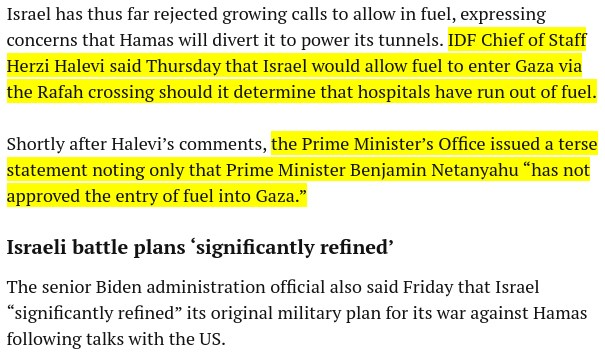
On one side we have the IDF Chief of Staff trying to communicate to the national and international public what the IDF manual of law in war prescribes as humanitarian relief in case of a hospital running out of fuel because of interrupted supplies. On the other side we have Bibi, Katz and their friends, who apparently neither coordinate with the IDF leadership nor know the manual of law in war and thereby gravely undermine whatever trust people have in the credibility of the IDF.
The government thereby apparently upholds his previous position to make this humanitarian relief conditional on the release of hostages. Just like it did with humanitarian firepauses, which would allow the safe delivery of relief as well as further evacuations of civilians, especially sick and wounded, in a separate statement after the visit by Secretary Blinken. Facilitating a firepause, as it has been demanded by the US, UK, EU and all members of the UNSC, was one of the central aims of Blinken’s visit. Instead of framing hostage release as a condition Blinken in his final speech addressed the legitimate objective of linking a possible release of hostages to a firepause. This would also make a possible release safer for the hostages—without such an agreement previous hostages had reportedly been on their own when they where released and had to find a way out. In case the Hamas still upholds its previous offer to release at least all foreigners among the hostages, this might provide a middleground for an agreement on a firepause and humanitarian relief. This situation also makes evident why hostage taking has to be considered as such a grave warcrime and immoral act, because by making the lifes of civilians a mere mean for other ends it undermines the very foundations of any even minimal moral covenant and sets the ground for a discourse in which comparable and likewise illegal actions using civilian lifes as a mean of coercion appear as legitimate to some.
Gaza’s only cancer hospital, funded by Turkey, reportedly already ran out of fuel on Wednesday and had to becry four deaths since then.
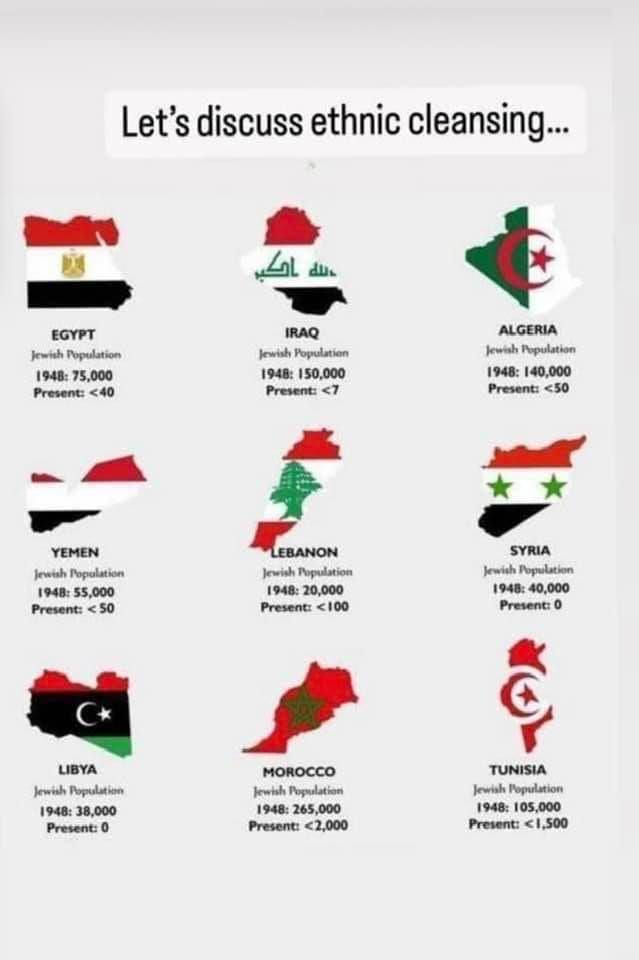
In recent days I have seen people making arguments concerning the current war refering to the Jewish exodus from Middle Eastern and North African countries. Some argued that the fear of “ethnic cleansing” of Palestinians in Gaza (based on a ministerial paper of very questionable importance) and the West Bank today and references to the displacement of hundreds of thousands of Arabs during the Nakba, with millions of Palestinians today living in both Israel and Palestine, should be put in proportion to the Jewish exodus of more than a million people, which left only few Jews behind. A contrary argument made a comparison between a coresponsibility of Israeli unlawful military action today for the rise in antisemitic attacks around the world and the Palestine civil war and War of Independence from 1947 till 1949, when instead of Zionism making the world a safer place for Jews, warcrimes and eventually the Nakba supposedly contributed to Jews being forced to leave their Arab home countries, where they were no longer safe.
How helpful are such graphics?
At the moment I just want to point at the heterogenity of the Jewish exodus from the Middle East, which one should keep in mind, before engaging in such kinds of arguments carefully:
In Egypt, Libya, Yemen, Syria, Iraq, Morocco there were pogroms making Jews flee even before 1947/1948. At least Egypt, Syria and Jordania refused to give citizenship to Jews. In Morocco however the conditions could be improved again during the decades and there is still a sizeable Jewish community today in Morocco and Morocco and Israel signed a peace agreement.
In Algeria the French played the Jews against the Muslims, giving Jews French citizenship and finally most wanted to leave or had to flee, although many had not so much to do with the French, were Arab speaking.
In Lebanon and Yemen many Jews still lived till the 70s and the civil wars.
In Iran it was there was a large Jewish community (often speaking Aramaic languages) till the Islamic revolution, when the new regime launched repeated campaigns were Jewish community leaders etc. would be denounced as “Zionist spies” and sometimes executed, when Jewish media would be shut down … hence many left after the revolution, yet there is still a sizeable population, which of course affected by the lack of political freedom in Iran.
In Sudan and Tunisia there were no big pogroms during the years preceeding 1948 of and Jews only fled from later persecution during the 1950s. From Ethiopia Jews were rescued to Israel following civil war and famine during the 1980s.
Concerning Yemen it is an notable case for many Yemenite Jews already emigrated to Palestine in late 19th century when they first heard about Zionism and became the first sizeable Mizrachi community engaged in the Zionist project, which for them could be connected with their own religious traditions (so this was even much earlier than many Arab Palestinians who moved to mandate Palestine in the 30s from Egypt). We should not forget this when people come up with cheap dichotomies between Europe and the Arab world, claiming Zionism would have been only be about the situation and ambitions of European Jews, unrelated to the Arab world.
So the Jewish exodus is really multifaceted, it is a combination of voluntary migration, migration because economic conditions and being treated as second-class compared to Muslims, fleeing because of persecution and being denied basic rights, fleeing because of pogroms and fleeing because of civil war and related catastrophes. And sometimes the antisemitism has been legitimised with antizionism and by linking Jews to Israel, but that is not everything, for example the blood libels were imported from Europe into the Middle East (by Christians), at least from 1840 on, as well as modern antisemitic conspiratorial ideology as expressed for example in the “Protocols of the Elders of Zion” and in Nazism. And of course being nonzionist usually does not help against becoming a victim of antisemitism, as we also see today.
While the controversial term “Jewish Nakba” can be a way to relate the painful historical experiences of Jews and Palestinians to each other, one should also be careful, especially when mixing up very different events like the exodus from Yemen and the displacement from Egypt, not to trivialise very specific traumatic historical experiences. At the same time the Nakba, too, has been a complex set of events, including people fleeing by themselves from the war with its changing frontlines, military evacuation orders and war crimes. In any case if one wants to use the term “ethnic cleansing” it is not enough to look at some comparisons of population numbers, but one has to look at the specific causes for the displacement of people in each case.
Was hat es mit der Sorge vor einer Vertreibung der Palästinenser aus Gaza auf sich?
Elhanan Miller:
„Gestern Abend war ich im Studio der Deutschen Welle auf Arabisch zu Gast für eine Diskussion über die Behauptung, dass Israel die massenhafte Umsiedlung von Palästinensern aus Gaza auf den Sinai plane. Ich habe gesagt, dass es sich um eine Verdrehung seitens der Hamas handelt und mein Gesprächspartner, der Sprecher der ägyptischen Regierung, diese Behauptung nur übernimmt, um die Politik der Al-Sisi-Regierung zu rechtfertigen, die bis gestern noch darin bestand niemanden aus Gaza nach Ägypten zu lassen.
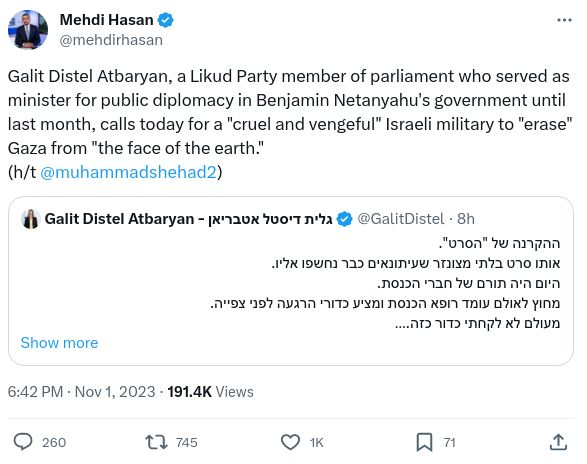
Jetzt lese ich zu meinem Erstaunen einen Tweet der früheren Öffentlichkeitsarbeitsministerin Galit Distel-Atbaryan, der genau das fordert. Mehdi Hasan – ein britisch-pakistanischer Journalist mit eineinhalb Millionen Followern und nicht gerade Anhänger des Zionismus – hat dies retweetet. Und dann stelle ich fest, dass Gila Gamliels Geheimdienstministerium ein ‚geheimes‘ Strategiepapier vorbereitet hat, das genau so eine Aktion vorschlägt.
Ich kenne viele wundervolle Aufklärungsinitiativen von aufrechten Israelis, die der Welt gegenüber unsere Perspektive vermitteln wollen. Ich sage Euch: All Eure Erklärungen sind für die Tonne, wenn Hinterbänkler unter den Abgeordneten und Ministern des Likud sich so äußern. Jeder weiß heute, dass die Medienarbeit ein integraler Teil des Kampfes ist, und mit solch katastrophalen Persönlichkeiten – denen die Likud-Basis und Vorwahlen wichtiger sind als der israelische Staat – sind wir auf sicherem Weg in die Niederlage.
Neuwahlen jetzt!“
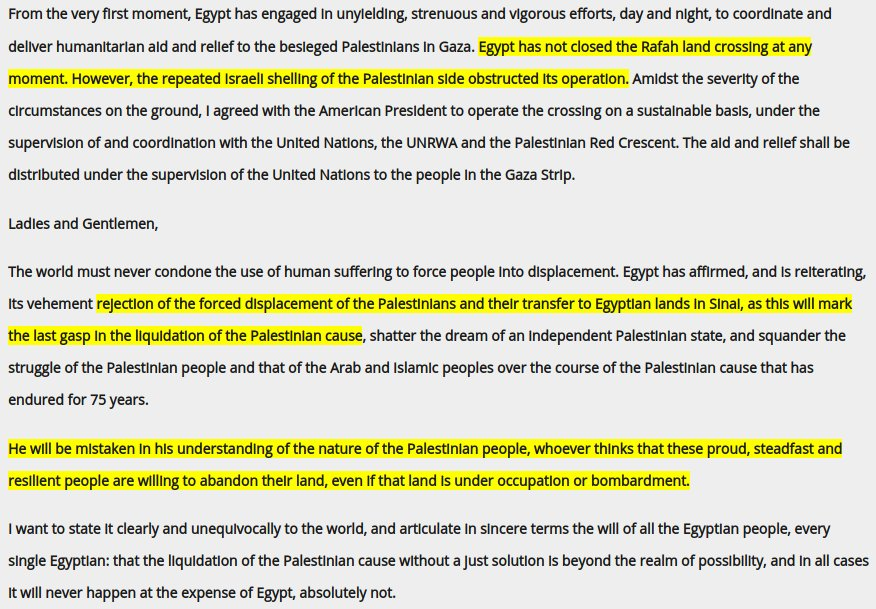
Heute konnten erstmals seit Kriegsbeginn ca. 500 Menschen mit ausländischem Pass sowie 76 Schwerverletzte am Rafah-Grenzübergang Gaza nach Ägypten hin verlassen. Die Vermittlung durch Qatar und USA zwischen Ägypten, Israel und Hamas war erfolgreich. Laut USA hatte die Hamas zuvor die Ausreise von ausländischen Staatsbürgern blockiert. Ägypten machte jedoch Schäden durch israelische Luftangriffe in den ersten Tagen des Krieges noch über Wochen für die geschlossene Grenze und auch in die umgekehrte Richtung für die nach der unter Druck der USA zwischen Ägypten und Israel erfolgten Vereinbarung noch über Tage verzögerte Lieferung von Hilfsgütern nach Gaza (womit die „vollständige Belagerung“ ein Ende fand) verantwortlich. Ohne von Israel zugesicherte humanitäre Korridore und Feuerpausen dürfte der Abtransport von Kranken und Verletzten aus dem Norden Gazas, wo sich ein Großteil der Krankenhäuser befindet und es die meisten Verletzten gibt, zudem sehr schwer bis unmöglich sein. Al-Sisi lehnt eine Ausreisemöglichkeit für eine größere Zahl an Palästinensern ab. Für ihn ist die Verhinderung der Flucht aus Gaza – offenbar auch gegen den Willen der Einzelnen – eine Frage von „Stolz, Standhaftigkeit und Widerstandsfähigkeit“ des palästinensischen Volkes. Politiker aus Netanyahus Likud-Partei brachten indes nun Vorschläge, die Palästinenser aus Gaza nach Ägypten umzusiedeln – ein schwerer Bruch humanitären Völkerrechts nach Artikel 147 der 4. Genfer Konvention und damit ein Kriegsverbrechen. Distel-Atbaryan forderte gar, dass eine grausam rächende IDF Palästinenser vor die Wahl von Flucht oder Tod stellen sollte. Distel-Atbaryan war kürzlich zum Rücktritt gedrängt und ihr Ministerium aufgelöst worden, nachdem dieses selbst nach dem Angriff durch die Hamas kaum Öffentlichkeitsarbeit geleistet und sich somit als nutzlos erwiesen hatte. Zuvor war sie besonders durch hasserfüllte Äußerungen gegenüber Gegner_innen der Justizreform aufgefallen.
Ärzte ohne Grenzen, deren 22 internationalen Mitarbeiter_innen heute Gaza verlassen konnten und die bereits mit neuem medizinischen Personal bereitstehen, forderte heute, dass auch allen Palästinenser_innen eine Ausreise aus Gaza erlaubt werden sollte, verbunden mit dem Recht, auch dorthin wieder zurückzukehren.
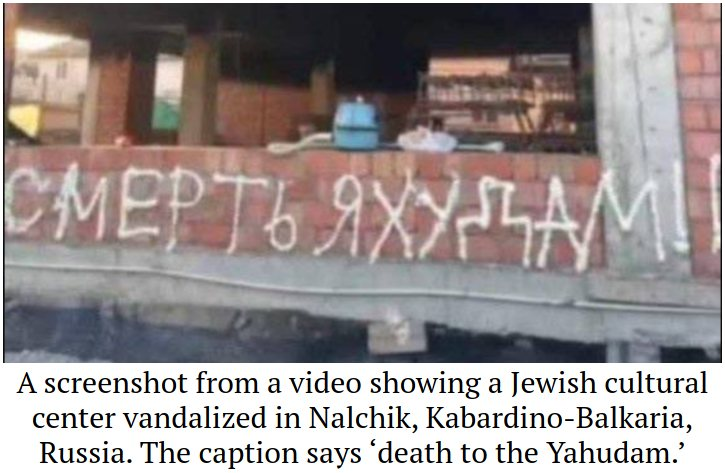
“The attacks included large crowds in the city of Hasbiurt in the Caucasian Republic of Dagestan besieging a hotel where they claimed Israelis were staying.
The mob then raided the hotel and searched for Jews, according to Yaroslav Trofimov, a reporter with the Wall Street Journal. The group dispersed when none were found.”
“Meanwhile, a Jewish cultural center was set on fire in Nalchik, the capital city of Kabardino-Balkaria, according to images posted on Telegram.
Jews have inhabited the North Caucuses for over two millennia. Around 3,000 Jews continue to live in the region, according to the Jewish Virtual Library.”
Detailed overview concerning supplies/lack of water, electricity and fuel in Gaza by “Times of Israel”, explaining what is still working and what is not. Obligations to provide fuel (which is a dual-use good) as humanitarian relief under international law are weaker than obligations to provide food, water and medication, and Hamas of course has fuel to keep its military running. However, medium-term advantages for Hamas, which will not run out of fuel quickly anyways, even without diverting humanitarian relief, and the danger of some explosives built from stolen fuel, have to be weighed against the grave immediate humanitarian impact, when hospitals are not operational, when people cannot be freed under rubble without excavators, when desalination and water pumps are only partially in service. All major allies of Israel, including the US, the UK, France and the EU have called for a humanitarian firepause, which would allow international organisations to deliver diesel, medication, food etc. safely and move some sick and injured to safer places where they can be better treated.
“Israel has insisted that it is not responsible for the provision of energy to the enemy enclave and that Hamas has stockpiled fuel to enable it to operate its tunnel network and run its war machine against the Jewish state.
IDF spokesperson Jonathan Conricus told the BBC on Thursday that Hamas has stockpiled between 850,000 to one million liters of fuel, which could be used for diesel-powered generators to operate water facilities or power hospitals. […]
Only 23 of Gaza’s 35 hospitals are currently functioning, according to the WHO’s emergency situation report on October 23, with bed occupancy above 100 percent in the seven major hospitals.
The other 12 hospitals have closed due to damage from Israeli airstrikes and fuel shortages, a WHO official said.
The official said that 1,000 patients in the territory are currently dependent on dialysis machines, along with 130 premature babies who need a range of care, and intensive care patients or those requiring surgery “who depend on a stable and uninterrupted supply of electricity to stay alive.”
‘WHO reiterates its call for safe passage for the delivery of health supplies and fuel throughout the Gaza Strip,’ the official said. […]
But Rettig said that eventually he believed Israel would have to supply diesel to avoid a humanitarian crisis in the hospitals.
‘You can say Hamas needs to provide diesel, but they won’t, so Israel will have to do so to avoid a crisis, you don’t want hospitals to run out of electricity,’ he said.”
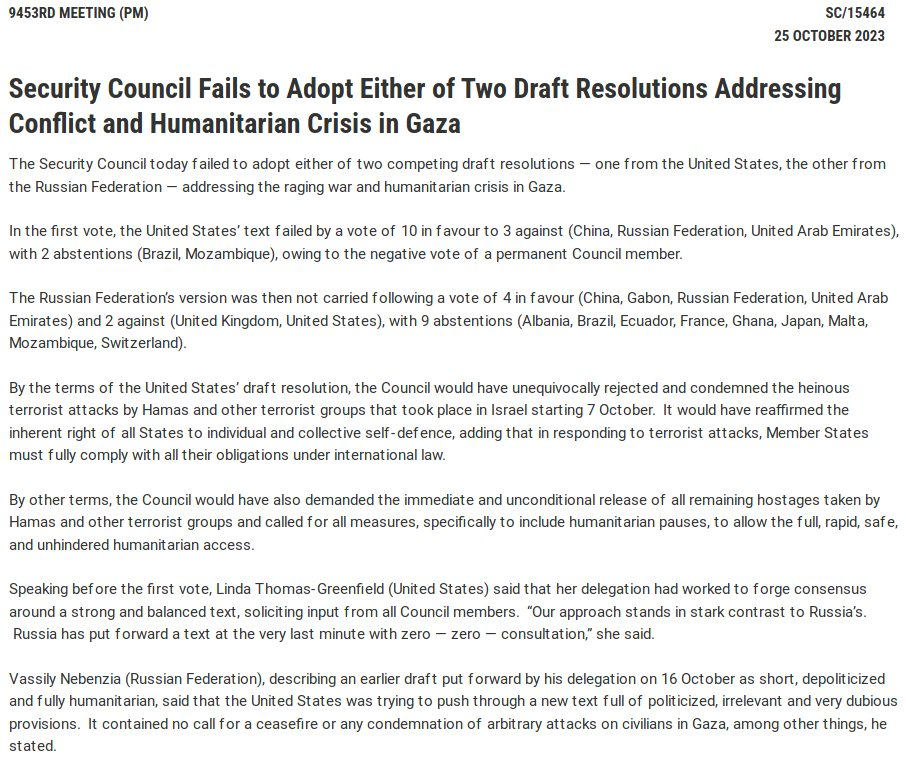
Everyone in the UN Security Council agrees that there should be firepauses in Gaza to allow for humanitarian relief, but no resolution for firepauses has been adopted, because the UNSC has been turned into a cynical circus on the back of Gazans during the last two weeks. Russia and China, supported by UAE, vetoed a carefully worded US draft resolution on Wednesday, which contained an affirmation that movement of civilians must be voluntary and safe and even refrained from mentioning the contested reference to Israel’s right to self-defense. Russia claimed that it had to veto the US draft because it did not call for a truce, despite having abstained in the vote on a previous Brasilian draft, which contained no call for a truce either. Furthermore it criticised the “politicised language” of the US draft (I cannot judge this, because the draft has not yet been published), just to put forward their own draft last-minute without previous consultation, for which it was clear that it would be vetoed (for containing a call for a truce and for a rescission of the evacuation order).
Last week’s Brasilian draft resolution—which also provided a basis for the last US draft—has been vetoed by the US for containing a call for the rescission of the evacuation order from northern Gaza, after the US had failed to engage in drafting a joint, consensual resolution. Unlike the Brasilian draft, a previous Russian draft resolution did not even contain an explicit condemnation of the Hamas attack, only condemned “all violence and hostilities directed against civilians and all acts of terrorism” and failed to get an absolute majority of votes.
While of course any UNSC resolution does not necessarily imply a swift implementation, a UNSC resolution especially for humanitarian firepauses would still be meaningful, because such resolutions are legally binding and provide a strong frame of reference for any diplomatic negotiations and for the activities of international organisations. UN General Assembly resolutions, on the conrtary, are not legally binding and countries vote there on the assumption that it will not have much consequences, so I prefer not to care too much about all the current media and diplomacy and political spectacle surrounding the UNGA vote.
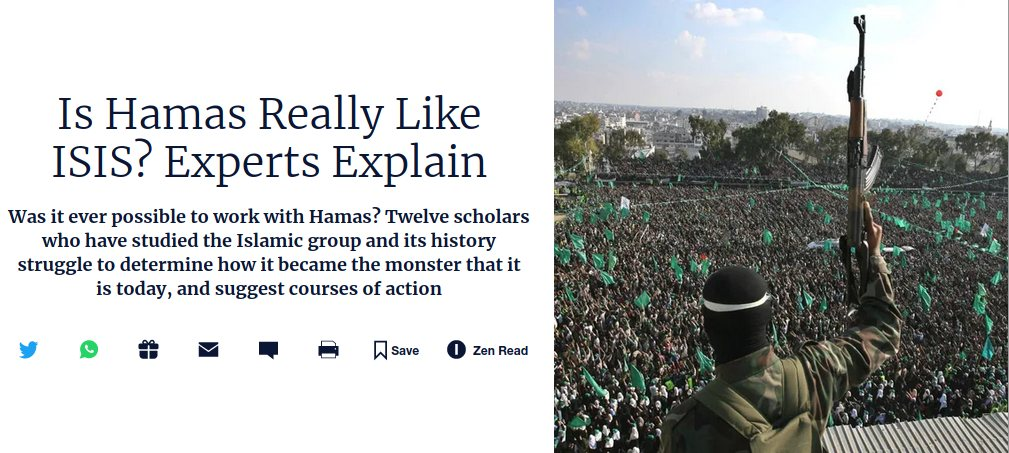
Hätte es vor einigen Jahren eine Option gegeben, die Hamas durch Versöhnung mit der PLO zu entwaffnen, oder dienten alle moderateren Töne der Hamas in Gaza letztlich nur zur Verdeckung der Kriegsvorbereitung? Wie kann eine Entmachtung der Hamas jetzt aussehen und muss sie nur entwaffnet werden oder ist es ratsam, auch zu versuchen, ihre zivilen Strukturen zu zerschlagen? Ein Artikel, der mehr Fragen aufwirft, als Antworten zu geben, aber doch sehr informativ ist.
Two days after the massacre perpetrated by Hamas in Israel, Israeli defense minister Gallant and energy minister Katz (both Likud) announced a “complete siege” of Gaza, cutting it off from water, food, fuel, and electricity until Hamas would release all hostages. Fortunately the US made their position clear and achieved that these measures have been partially lifted. After one week water pipeline supply was reestablished to southern Gaza. Since end of last week there are some humanitarian relief deliveries of food, water and medicine arriving from Egypt. Yet the consequences of lack of water and energy are still horrific. Last week UNRWA stated that they would only be able to provide 1 liter of water per day for each person sheltering in their facilities; fortunately, UNRWA seems to have fixed this, wells are operative now and basic supply with water could be restored. But still there are catastrophic hygienic conditions in the crowded shelters amplified by the lack of water with high risk of diseases spreading. Furthermore, hospitals in northern Gaza, which are overwhelmed because of all the injured anyways, have run out of fuel and can no longer run all the devices needed to treat their patients. Southern Gaza has even less medical infrastructure and transporting patients is dangerous, if not impossible.
There have been a lot of discussions concerning the legal status of these measures. I think these legal considerations are really important to understand the historical significance of the current events and their political implications, the legal notions serve as a guideline to gain a nuanced understanding of the conflicts involved and international humanitarian law also provides an important framework for the international diplomacy inevitably involved in the conflict (which will hopefully not spillover and escalate at further fronts beyond Gaza). Yet, since this legal sophistry might seem cynical, I want to quickly give my moral and political view: The measure of cutting water, which has been announced and now partially revoked, to enforce the release of hostage is utterly immoral, irrational and also a politically devastating deception of the Israeli public. Structurally this kind of measure is a case of indiscriminate, possibly lethal measure of coercion against the civilian population of the enemy to coerce him to end a (real or perceived) injustice, in these respects ressembling the taking of hostages by Hamas, despite all the other differences between the fundamental political goals of Israel and Hamas. These methods of coercion, treating civiian lifes as mere means, undermine any kind of ethical relationships. The weaponisation of humanitarian aid threatens to question all set boundaries of warfare. Early in the war the announcement of the “complete siege” set the tone for what is to follow, brutalising the discourse and framing the war as an endeavour against the general population of Gaza. Furthermore the measure cannot work, since unlike the general population of Gaza Hamas fighters will always have access to their stockpiles of food and to wells. Yes, at some points in history starvation of the general population worked as a mean of coercion, for example in the Biafra war (where starvation killed round about a million people of Biafra). Back then the progressive, separatist forces of Biafra finally capitulated. But is this to be expected from the Hamas and PIJ Jihadists? They would certainly rather start killing hostages if they would really get into trouble getting food. Thus, the message to the Israeli and world public was: We are doing something for the hostages, we stand together firmly and decidedly, applying the harshest measures of force to free the hostages, while in fact a public discussion of the hardly resolvable conflict between different objectives, freeing the hostages, protecting Israeli soldiers and weakening/defeating Hamas is avoided (while some members of government like Smotrich declared early on that the fate of the hostages should not be a priority). As an infringement of Israeli and international humanitarian law the measure already did great damage for the cooperation with international allies, it increases the risk of further escalations elsewhere than in Gaza and ultimately it weakens the rule of law in Israel and does damage to any potential future peace process. Those seeking to demonise Israel for its pursuit of legitimate military goals against tyrannical Jihadi forces in an act of self-defense against their massacres among the Israeli civilian population, should be reminded however that the “complete siege” has been partially lifted after US calls for adherence humanitarian international law and also controversy within Israeli society, and that its immediate effects have luckily been limited particularly thanks to Gaza’s own ground water supplies and UN stockpiles. But now let us look at the legal details. While not being a legal expert, I try to stay in line with general textbook opinions concerning the rules for sieges and expert opinions on the announced siege of Gaza, supplemented by some explanations and observations which might help to clear some missunderstandings which I have encountered in conversations.
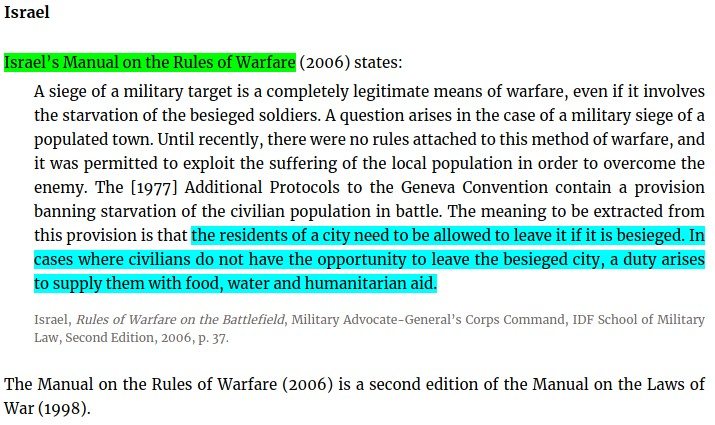
What are the legal prohibitions and obligations at stake? Let us consider the prohibitions: The one central, most relevant article is Article 54 of the First Additional Protocol to the Geneva Conventions from 1977: “Starvation of civilians as a method of warfare is prohibited.” While the article does not address medicine or energy, the Israeli Manual on the Rules of Warfare explicates concerning the application of this article to sieges: “The meaning to be extracted from this provision is that the residents of a city need to be allowed to leave it if it is besieged. In cases where civilians do not have the opportunity to leave the besieged city, a duty arises to supply them with food, water and humanitarian aid.” This provision would have been violated if the announced “complete siege” would have been carried on, without a possibility to evacuate (it does not matter that the borders are controlled jointly by Egypt and Israel and that it would be their joint decision not to let people leave). Fortunately most of the population of northern Gaza was now able to evacuate south of Wadi Gaza, where there are now at least somehow better supplies and where water is running again, luckily attempts by Hamas to prevent people from fleeing have largely not been successful, but still tens of thousands of civilians have sheltered in the north, especially at UNRWA facilities and the Shifa hospital, some of them are unable to move due to medical conditions. They require to be provided with humanitarian aid.
Other possible prohibitions arise from the prohibition of attacks not discriminating between civilians and combattants and attacks against legitimate targets but with disproportionate collateral civilian damage (Article 52 First Additional Protocol, starving the entire population would definitely be disproportionate in the long run). However, this would require a very broad understanding of the term “attack” (Article 49 First Additional Protocol: “acts of violence against the adversary, whether in offence or in defence”), the entire siege would have to be understood as one attack, which is certainly no legal consensus, despite some discussions trying to expand the traditional understanding of the word to include for example pillaging of medical facilities or cyber sabotage.
Furthermore there are some possibly relevant positive obligations in international humanitarian law: Articles 55 and 56 of the Fourth Geneva Convention and Article 69 of the Fist Additional Protocol obligate an occupying power to provide for food, water, hygiene and healthcare. However, it is legally disputed whether Gaza is to be considered as occupied by Israel. The government in Gaza is exercised by Hamas, not by Israel and unlike the West Bank it is also not jointly administered by Israel and the Palestinian Authority, thus it is not a classical example of occupation. However, first of all since Israel supported by Egypt controls the borders and airspace and has further means of influence (i. e. by controlling supplies to Gaza coming from the Palestinian Authority and third parties) there is at least some level of control, furthermore legally—as it has been confirmed by the Israeli courts—all the Palestinian territories constitute one legal entity, in which Israe exercises varying levels of control. Thus for example the UN consider these whole territories as occupied. Anyways, in the current situation of the siege another article applies, namely Article 70 of the First Additional Protocol mandating humanitarian relief in “any territory under the control of a Party to the conflict, other than occupied territory”. However, such relief is supposed to be based on joint action of the conflict parties, the article does not in all cases imply strictly unilateral obligations. Article 23 of the Fourth Geneva Convention proscribes the free passage for necessary humanitarian aid even towards the enemy (an obligation applying to both Israel and Egypt). But it also contains restrictions, namely that the deliveries can be impeded if they would be diverted to the enemy’s armed forces or would provide an advantage to the enemy. Thus it is in accordance with this rule of humanitarian international law that Israel stresses that humanitarian aid to be delivered via Egypt is conditional on guarantees that it is not diverted to Hamas. However, such guarantees can be provided by international organisations. Currently Israel refuses to give safety guarantees to the WHO for deliveries of fuel to hospitals urgenty in need in the northern part of Gaza, pointing at fuel reportedly having been stolen by Hamas from UNRWA. However, proportionality has to be met, some incidents of diverted humanitarian aid (even if it contains dual use goods like fuel) cannot give a justification for a complete blockade of deliveries by an international organisation like the WHO. Article 54 of the First Additional Protocol contains a similar provision that even infrastructure with a dual use, possibly providing both for the benefit of enemy forces and for essential needs of the civilian popuation, may only be rendered useless, if this does not need to an absolute lack of the essential needs of the civilian population. Unfortunately decades of skillful diplomacy by Arab States, which achieved to create strong anti-Israeli alliances within the UN and established institutionalised double-standards directed against Israel within UN bodies, led to a deep distrust of Israeli governments against the UN. However, there are hardly any actors more suitable than organisations like WHO and ICRC to implement the humanitarian relief.
To summarise: At least against the deprivation of the civilian popuation from food and water as a mean of warfare there is a very clear prohibition without further restrictions, as it is also recognised in the IDF’s legal manual. At this point we notice how important it is for the legal evaluation to look at the subjective intentions involved to determine the legal status of certain actions in war: Energy minister Katz explicitly declared: “Humanitarian aid to Gaza? No electric switch will be turned on, no water tap will be opened and no fuel truck will enter until the Israeli abductees are returned home.” He made it explicitly clear that the goal would be to deprive the general civilian popuation of water and electricity. It is this deliberateness which is shocking and against which one can remind everyone of the concise words of the Israeli High Court of Justice on the State’s requirement “to refrain from deliberately harming the civilian population located in the Gaza Strip”. Katz did not say that he wanted to pass on the responisbility for deliveries to Egypt (therefore it is also irrelevant whether there have been silent or explicit agreements between Israel and Egypt concerning the blockade and whether Egypt really delayed the supply because of an Israeli air attack). He explicitly declared his intention to make certain essential goods unavailable to the general population of Gaza and implemented a measure actually suitable to causally achieve this goal—for the legal (and also moral) evaluation of this intended action it does not matter that the success of his actions in achieving his goals is contingent upon other factors (for example Hamas having diverted pipes for rocket production instead of maintaining the water infrastructure, or Egypt not deivering water to Gaza). He did not say that he wanted to starve the Hamas combattants or create some situation of chaos to allow for Israeli operations. He explicitly declared that he would make humanitarian relief subject to conditions not provisioned by international humanitarian law: “Humanitarianism for humanitarianism. And no one can preach morality to us.” Thus there was a clear intention of collective punishment and intimidation directed at the civilians of Gaza (contrary to Article 33 Fourth Geneva Convention).
More precisely the announced measure of a “complete siege” has to be considered a reprisal: A reprisal is defined as an action within war which would in itself be unlawful used to force the enemy to stop his own unlawful behaviour. In this case the unlawful behaviour of the enemy is the taking of hostages (Article 34 Fourth Geneva Convention). So does this provide a legal justification? Reprisals are not outlawed by the treaties and legal according to customary international law, but subject to some limitations, which have evolved in particular since World War II, when the right of reprisals served as justification for nearly limitless suspensions of protections for civilian populations in the Hague Convention. Article 33 of the Fourth Geneva Convention outlaws reprisals against a civilian population under one’s own control. The First Additional Protocol contains a bunch of prohibitions of reprisals, for example against civilian objects, cultural heritage and infrastructure supplying essential needs of the civilian population. However, many countries have not joined the First Additional Protocol and for example Israel, while agreeing that major parts of the First Additional Protocol are customary international law, officially objects to the rules concerning prohibitions of certain reprisals. However, several institutions, including the International Federation of Red Cross and Red Crescent and the International Criminal Tribunal for Yugoslavia: “the rule which states that reprisals against the civilian population as such, or individual civilians, are prohibited in all circumstances, even when confronted by wrongful behaviour of the other party, is an integral part of customary international law and must be respected in all armed conflicts.” (Prosecutor v. Martić) “It cannot be denied that reprisals against civilians are inherently a barbarous means of seeking compliance with international law.” (Prosecutor v. Zoran Kupreškić et al.) According to this opinion legal reprisals are limited to only quite special cases, e.g. using an unlawful weapon (like chemical weapons) in case the enemy did the same to gain an advantage. One should note that if reprisals directed at the civilian population were to be considered legal, this might also be used to legitimise the indiscriminate rocket attacks on Israel by Hamas and Islamic Jihad, which are generally and in my opinion rightly considered to be war crimes. However, there are legal opinions not agreeing with this judgement, for example Christopher Greenwood argues that reprisals directed at the civilian population are not prohibited by customary international law, since both explicit objections and state practice go against this assumption. One should keep in mind that at least when a war becomes a total war on both sides and when there are no external powers capable of limiting the conflict, it seems utterly impossible to avoid reprisals (cf. my previous post concerning reprisals in the history of humanitarian international law and comparisons which have been drawn concerning the current war between Hamas and Israel). However, even if one argues that some reprisals against the civilian popuation might be legal, there is always a proportionality requirement according to customary humanitarian international law: The severity of the breach of law used as a reprisal shall not exceed the severity of the breach of law one intends to suppress by means of the reprisal. Thus as soon as the “complete siege” would have been carried on for a longer time this breach of law affecting 2 million civilians would have certainly become more severe than the taking of hostages by Hamas, thus violating proportionality. To reiterate: Fortunately this idea has now been given up by the Israeli government.
Finally a few words on the terms “war crime” and “genocide”: I only talked about a breach of international humanitarian law, because not every such breach is to be considered a war crime. War crimes are primarily defined by the Rome Statute of the International Criminal Court. The definition of a war crime in international armed conflicts is broader than the definition in non-international armed conflicts. Closely related to the issue of occupation there is also the question whether the conflict between Israel and Hamas can be considered to be international. Israel generally assumes that the whole Israeli-Palestinian conflict is of a non-international character. If one considers the conflict to be international it is easier to consider a “complete siege” to be a war crime (and also attempts or conspiracies to commit such a crime can be persecuted by the ICC), otherwise one would have to look more closely at the actual effects of the “complete siege” to decide the question. However, this question is mainly relevant for the question of criminal accountability, which is at this point unrealistic anyways and is also not the most pressing political or humanitarian issue. To avoid irrelevant discussions many diplomats and humanitarian organisations prefer to simply refer to breaches of humanitarian international law.
Concerning the term “genocide”, often used far too quickly in all kinds of conflicts nowadays, one has to remember that not any illegal, indiscriminate act against a civilian population has a genocidal intention. Legally an act of genocide requires an “intent to destroy, in whole or in part, a national, ethnical, racial or religious group, as such”. While a single, isolated military action can legally be an act of genocide, it has to be intentionally directed against the “group as such”. In the case of the massacre of Srebrenica this has been evident because of the separation of male Muslim Bosniaks to be murdered. The attempted reprisal by Gallant and Katz was directed against a besieged population and not at destroying Palestinians as a national, ethnical group. There has not been any genocide against Palestinians. However, of course there are genocidal rhetorics among right-wing Israelis, which make the current situation even more dangerous.
Concerning the antisemitic massacre perpetrated by Hamas one should differentiate between Hamas’ overall antisemitic political agenda, which includes genocidal ambitions against the Jews in Israel. Their terrorist message to the public delivered through their slaughtering of civilians might not be most adequately understood as an intention to destroy an “ethnical group in part as such”, even if this is their long term genocidal goal. Just like the antisemitic massacres perpetrated by the Ukrainian nationalist army of Petljura and by the Russian anti-revolutionary army of Denikin in the Russian civil war are seldom considered as acts of genocide. More often than not the focus on the contested concept of genocide, often quoting mainly the legal definitions, in recent years has blurred the historical, social, psychological and political understanding of ideologically motivated mass atrocities against civilians.
This might sound shallow to some, but let us avoid political cynicism and grieve the losses and still hope that it will be possible to reduce civilian deaths, and that in the end, despite all the danger, there will be an opportunity again for peace and social progress in the holy land.
Short summary concerning the forensic analyses which have been published so far concerning the horrible explosion in the parking yard of al-Ahli hospital in Gaza with approximately 100–300 deaths.
Most of the discussion concerns one flying object in question captured by different cameras flaring in the sky and then changing direction and flaring again just 3 seconds prior to a first small explosion close to the hospital and then the large blast and the fire at the hospital. While Al Jazeera English claims the object to have been a rocket shot down by the Iron Dome, the Wallstreet Journal explains that the change in direction can only be explained by a propulsion failure, not by an Iron Dome interception. Since this object changed its direction westwards this is compatible with the crater analysis by Wallstreet Journal, the doppler effect analysis on a recording from the site by Earshot and the analysis of damage of the building by Forensic Architecture. Associated Press analysis largely agrees with Wallstreet Journal but with less detail. However, unlike AJE, AP and WSJ the New York Times localises the trajectory object differently and claims that it has been a rocket launched from Israel and which might not have even entered Gaza and which was too far away (2 miles) to have been the cause for the explosion at the hospital.
I would be very grateful for any assessments why the NY Times differs so much concerning the trajectory of the object, from the analysis presented by AJE, AP, WSJ and the US administration.
A barrage of rockets fired during the preceding minute from the southwest from the hospital and which had initially been identified as the cause of the explosion by the IDF is most likely unrelated to the explosion at the hospital (because of crater, audio and building damage analysis, the direction does not match). Most of them reached Israeli airspace and were intercepted there (AJE).
Concerning the damage most analyses agree that it is not compatible with typically used Israeli bombs or missiles. The small crater followed by a huge fire make the failed rocket a very plausible explanation and even New York Times agrees with that (opening the possibility that there was yet another failed rocket not caught on camera?). Burning fuel (note that WSJ considers the rocket to have been of higher range than the typical short range rockets fired at neighbouring cities) and the explosion of a car in a crowded environment would have caused the fire with many casualties in the crowded environment (while the official Gaza health ministry/Hamas figure of 471 deaths is almost certainly very much exaggerated). However, there have been several Israel airstrikes in spatio-temporal proximity to the explosion at the hospital, but none of these known strikes happened at the precise time of the explosion.
Just on a side note: Concerning the hit at St. Prophyrios church in Gaza City, the IDF admitted that it was due to their airstrike that a hall belonging to the church/monastery next to the church building was hit, killing 20–25 Palestinians seeking shelter there (numbers according to the orthodox order running the place). Fortunately initial reports by the order estimating that 150–200 people were killed had to be corrected, all the rumours about the church being destroyed or 500 people being killed were completely false.