
“If civilians used as human shields by terrorists get killed by bombing or shelling, it is solely the responsibility of the terrorists. If civilians are killed in the vicinity of terrorists it will always be proportionate, because at least the surviving population gets liberated from the terrorists who took their own population hostage. The civilians decided to stay with the terrorists, thereby they are taking part in the conflict, they should not have special protection and not taken into account when they are in the vicinity of terrorists to be targeted. Terrorists should not be incentivised to use human shields by refraining from targeting them when civilians are around, because this will just lead to even more casualties in the future.”
Am I talking about the current war between Hamas and Israel? No, I am quoting the outlandish interpretations of humanitarian international law which were used by the Sri Lanka government to justify estimated 40.000 civilian deaths (one of the UN estimates) during the final months of their final campaign against the Tamil Tigers in 2009. Back then the massive shelling of the last positions of the Tamil Tigers, which had consciously retreated into the densely packed no-fire zones (especially the one in Mullivaikkal) which had been declared to be safe spaces for civilians, earned the Sri Lanka government strong criticism and condemnation from the international community and human rights organisations. The UN Secretary General, the US, UK, EU, and Japan hand unsuccessfully called for a negotiated ceasefire, despite not supporting the political aims and terrorist means of the Tamil Tigers, who forced civilians to remain in the combat zone at gunpoint. The shelling of hospitals, in whose vicinity the Tamil Tigers supposedly had their positions, greatly increased the number of deaths, making it often impossible to treat the injured. Breakdown of water supplies made people die from drinking salty water. If arguments employed today with respect to the war against Hamas, whether it is by politicians, lobbying groups or media, resemble those arguments made by the Sri Lankan government back then, which are largely dismissed by the legal community, but contributed to impunity and to impeding any reconcilation in Sri Lankan society, we should be greatly worried, especially since the war has just started with fatalities growing constantly.
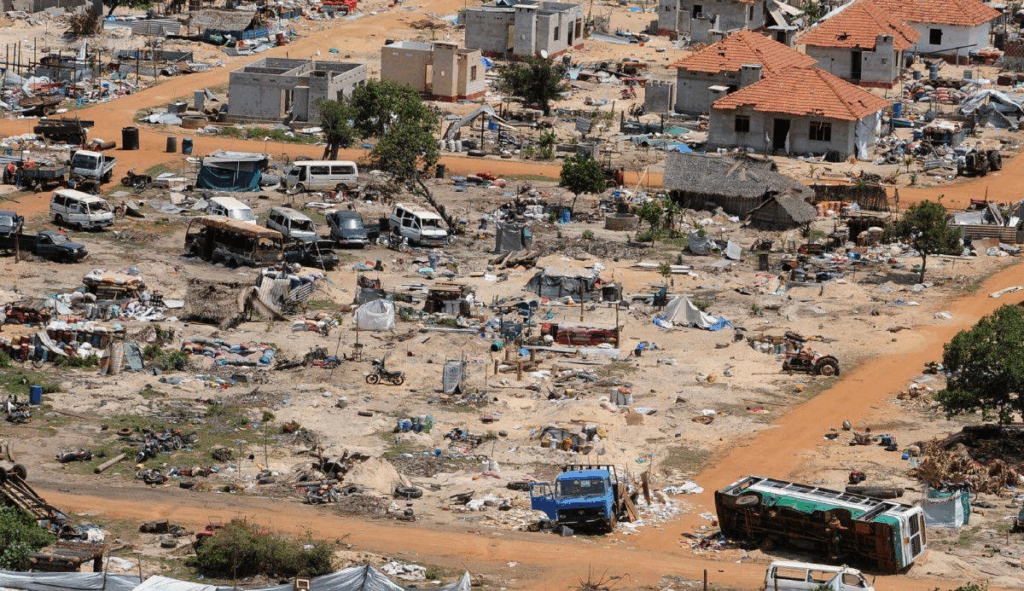
Humanitarian international law for the protection of civilians does not stand by itself, it must be interpreted and it must be implemented through military training and by targeting procedures for the use of heavy weapons like bombs, missiles, and mortars. These implementations influence both the likelihood of illegal attacks disproportionately harming civilians and the overall amounts of civilian casualties. The massive daily civilian casualties from Israeli currently exceed the casualty rates from airstrikes during the most intense periods of fighting against Daesh/ISIS in Syria, Iraq or the Philippines. And the percentage of civilians among the deaths seems to clearly exceed the percentage during the 2014 Gaza war, too. While comparisons are very hard to make, with all the disputed numbers, civilian daily fatalities may have very roughly reached the same order of magnitude as daily average fatalities in Mullivaikkal in 2009, with the number of civilians in Mullivaikkal back then being comparable to the number of civilians which have remained in northern Gaza strip today after the majority evacuated to the south. Several factors make the comparison difficult, like far higher population density in the last remaining no-fire zone of Mullivaikkal compared even to Gaza city now, higher precision of Israeli bombs compared to Sri Lankan mortars, more Hamas and PIJ fighters in Gaza than Tamil Tigers in the no-fire zones or stronger fortifications in Gaza requiring higher yield explosives to be destroyed. Furthermore, the specific intentions have to be considered in making moral and legal judgements. Still such comparisons may help to understand the scale of the events unfolding now.
Well documented single incidents with mass casualties (exceeding even the collateral damage which had been consciously accepted by the US in some very high-value attacks) made some experts on civilian harm in air bombing campaigns suspect that the IDF have likely greatly shifted their norms employed in the risk and legal evaluation process of targeting. This process may for example involve adhering to a fixed maximum number of expected dead civilians during a typical strike, while for high-value targets this cutoff value may be increased. If the consulting lawyer involved, using such criteria, does not approve, the commander may proceed nevertheless, but would typically not do so (in the US a higher commander is needed to overrule the legal advise, but reportedly they typically approve the requests blindly). Depending on military situations and political aims bars may be raised or lowered, as it is well documented in the case of the US. For example during a critical phase of a war greater civilian harm might be considered proportionate if it is necessary to stop an advance of the enemy, or even to stop ongoing atrocities in the case of Daesh, while at certain points for political reasons the military might be ordered to refrain from strikes with civilian deaths completely, even if they would be legal. Despite the common understanding that if Israel wants to pursue its goal of completely dismantling Hamas’ military and governing capabilities to the end, it has to be a long and slow endeavour, there seems to be a current military urge to bring rapid destruction to Hamas facilities. Furthermore there has been a surge in open expressions of disregard for Palestinian civilian lifes both by Israel politicians, in the military, and in the broader media and public. These factors make a grave shift in the target evaluation procedures very plausible.
The human, military and political costs of this shift have probably been a key issue during the visit of Secretary Blinken in Israel last Friday, besides the need of ramping up humanitarian relief in preparation for a longer military campaign. This seems to be reflected by the report about IDF Chief of Staff Halevi’s objection towards Blinken that following certain US advise may even increase casualties in Gaza. Such advise from the US also includes Democratic Senator Chris Murphy’s more explicit public statement, which affirms Israel’s right and obligation to defend itself against Hamas, but describes the “current rate of civilian death inside Gaza” as “unacceptable and unsustainable” and warns against the moral and strategic costs of the civilian harm and called Israel to “immediately reconsider its approach”, also pointing at disastrous consequences of mistakes done by the US in their war on terror strategy.
Leave a Reply