
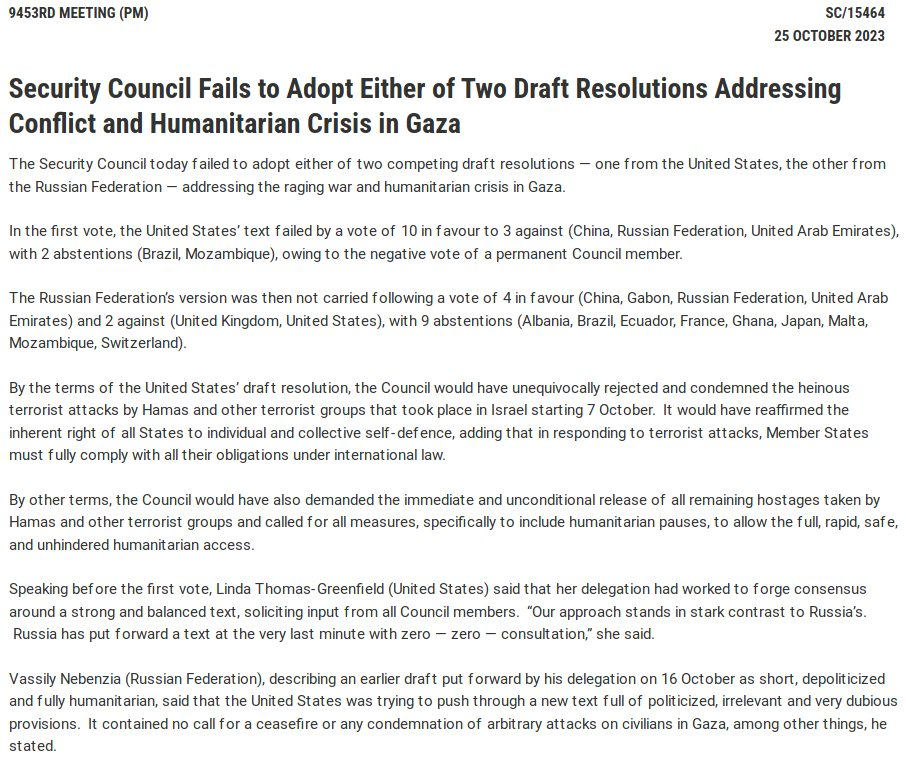
Everyone in the UN Security Council agrees that there should be firepauses in Gaza to allow for humanitarian relief, but no resolution for firepauses has been adopted, because the UNSC has been turned into a cynical circus on the back of Gazans during the last two weeks. Russia and China, supported by UAE, vetoed a carefully worded US draft resolution on Wednesday, which contained an affirmation that movement of civilians must be voluntary and safe and even refrained from mentioning the contested reference to Israel’s right to self-defense. Russia claimed that it had to veto the US draft because it did not call for a truce, despite having abstained in the vote on a previous Brasilian draft, which contained no call for a truce either. Furthermore it criticised the “politicised language” of the US draft (I cannot judge this, because the draft has not yet been published), just to put forward their own draft last-minute without previous consultation, for which it was clear that it would be vetoed (for containing a call for a truce and for a rescission of the evacuation order).
Last week’s Brasilian draft resolution—which also provided a basis for the last US draft—has been vetoed by the US for containing a call for the rescission of the evacuation order from northern Gaza, after the US had failed to engage in drafting a joint, consensual resolution. Unlike the Brasilian draft, a previous Russian draft resolution did not even contain an explicit condemnation of the Hamas attack, only condemned “all violence and hostilities directed against civilians and all acts of terrorism” and failed to get an absolute majority of votes.
While of course any UNSC resolution does not necessarily imply a swift implementation, a UNSC resolution especially for humanitarian firepauses would still be meaningful, because such resolutions are legally binding and provide a strong frame of reference for any diplomatic negotiations and for the activities of international organisations. UN General Assembly resolutions, on the conrtary, are not legally binding and countries vote there on the assumption that it will not have much consequences, so I prefer not to care too much about all the current media and diplomacy and political spectacle surrounding the UNGA vote.
Leave a Reply