Hamas speaker Khaled Mashal, when facing critical questions by YouTuber Amar Takei, justified hiding behind civilians by characterising Hamas’ war against Israel as defensive jihad, jihad al-dafa’a. Unlike in offensive jihad, jihad al-talab, in defensive jihad there would be a duty for every Muslim to participate. This seems to imply, for example, that families are told by Hamas not to evacuate when being advised so by Israeli forces as a measure of precaution, because it would be the duty for all these civilians (even small children?) to participate in the defensive jihad in this way.
For context: defensive jihad is a widely accepted Muslim concept which can also be likened to the notion of defensive war in international law and to Jewish, Aristotelian or Christian notions of defensive war. Sayyid Qutb, one of the ideological fathers of Hamas and many strains of modern Jihadism, strongly defended the notion that offensive jihad—without excluding the methods of the sword, and when religious leaders neglect offensive jihad, even without permission from the leaders—is also of key importance, while at the same time ambiguously trying to expand the notion of defensive jihad to the fight against all kinds of “tyrannies” which would impede the spreading of Islam by peaceful means. While Daesh/ISIS strongly appeals to offensive jihad lead by their “Caliph”, both Hamas but also al-Qaeda seem to emphasise their inflated notions of self-defense, such that even indiscriminate, murderous acts against civilians like the October 7th or September 11th attacks are understood to be part of defensive jihad.
By the way religious Jewish Israelis have also been discussing the war in Gaza in religious terms, as a milchemet hovah, an obligatory war, which unlike the milchemet reshut, a discretionary war, does not require authorisation by the no longer existing Sanhedrin court (while Muslims are lacking a Caliph which could order offensive jihad).
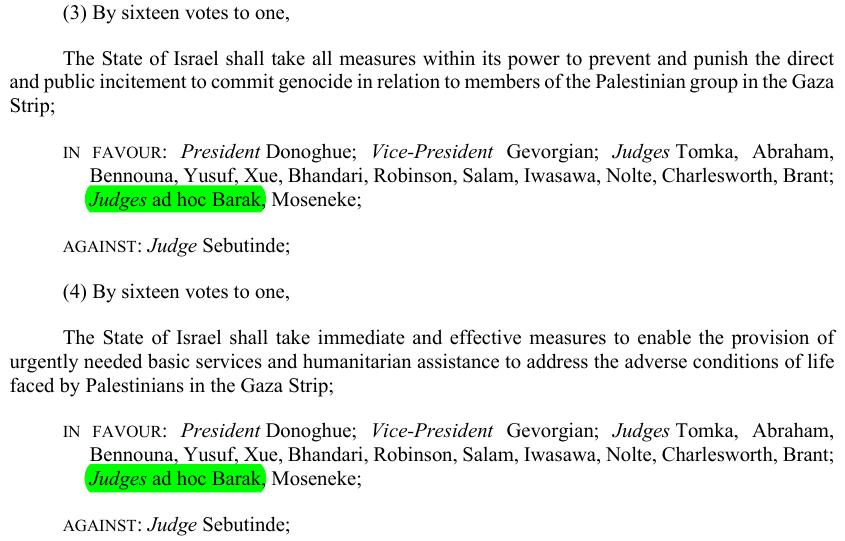
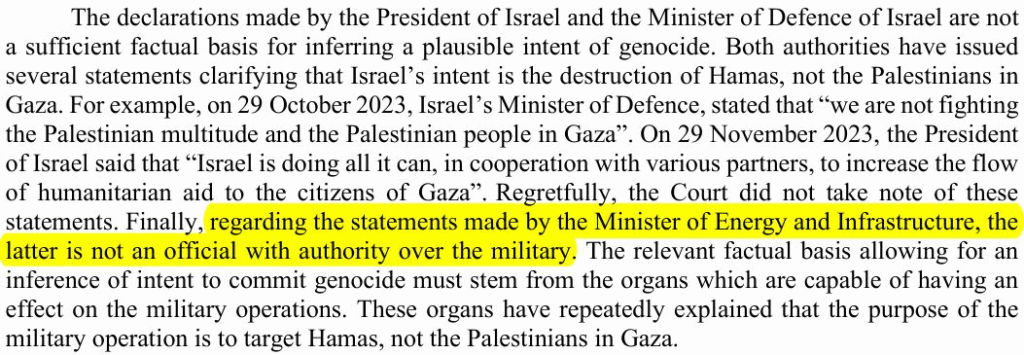
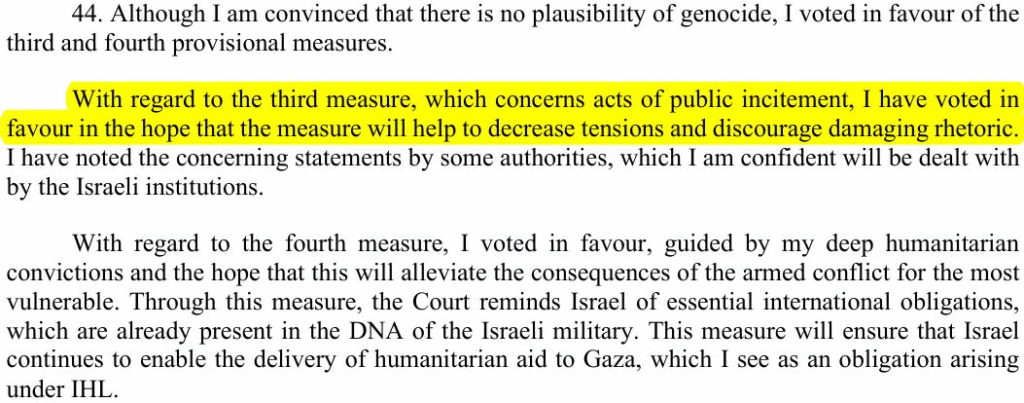
Thank you, ad-hoc judge Aharon Barak! While the former Chief Justice at the Israeli Supreme Court (and survivor of the Kovno Ghetto), appointed by Israel to the ICJ, reaffirms the necessity for Israel to defend itself, he shows great integrity by supporting two of the provisional measures ordered on Israel by the ICJ, namely concerning the duty to persecute genocidal incitements and concerning the duty to provide adequate humanitarian relief for Gaza. In his separate opinion he makes clear that while South Africa’s diplomatic behaviour towards Israel was unfortunate, this does not in itself impede jurisdiction of the ICJ concerning the dispute which undoubtedly exists. Unlike his Ugandan colleague Julia Sebutinde he thinks that there is a sufficiently plausible case that rights of the Palestinian people under the Genocide Convention are affected, e.g. protection from genocidal incitements. However, since he does not see plausibility for genocidal intent behind the Israeli military actions, he voted against the other provisional measures. He emphasises that in his opinion the actions of the Israeli military shall be judged under the Geneva Conventions and not under the Genocide Convention—however, for breaches of humanitarian international law under the Geneva Conventions there is no jurisdiction of the ICJ in the present case which is limited to the application of the Genocide Convention. Concerning the quoted statement by then-energy minist Israel Katz announcing the use of depravation of water as a mean of coercion in Gaza (which in my opinion constitutes a crime against humanity) Barak seems to condemn the statement, however, I cannot follow his argument that this statement would be irrelevant because Katz had no authority over the military. In fact Katz was responsible as a minister for the supply of water to Gaza and following his orders water supply was indeed shut down, and the northern pipeline out of the three fresh-water pipelines towards Gaza has never resumed service since then. Clearly, if civilian authorities are involved in implementing illegal means of warfare, this certainly does not reduce responsibility.
The Ugandan judge Julia Sebutinde opposed the entire order and wrote a dissent. She diverges from both the majority decision and Barak by claiming that “there are also no indicators of incitement to commit genocide” (I cannot see how she could arrive at this view, despite the evidence for example from certain chants of IDF soldiers or the speeches delivered by Ezra Yachin, veteran of the Lehi militia/terror group, to the IDF). In her opinion because of the lack of genocidal intent there is no plausible case to be made for violations of the Genocide Convention. However, she too acknowledges that there would be cases to be made concerning violations of the Geneva Conventions, i.e. war crimes and crimes against humanity committed by both sides.
The German judge Georg Nolte—son of the influential far-right revisionist historian Ernst Nolte—also sees no plausible case to be made for genocidal intent behind the Israeli methods of warfare. However, like Barak he agrees that there are plausible cases of incitement, including by Israeli government officials, which might not be sufficiently persecuted in Israel, such that the ICJ potentially has jurisdiction to judge on violations of Israel’s duties to prevent and persecute these incitements.
Concerning the majority opinion there is an interesting point to be made. Paragraph 51 of the decision reads:
“The Court considers that, by their very nature, at least some of the provisional measures sought by South Africa are aimed at preserving the plausible rights it asserts on the basis of the Genocide Convention in the present case, namely the right of the Palestinians in Gaza to be protected from acts of genocide and related prohibited acts mentioned in Article III [i.e. incitement and conspiracy for genocide etc.] […]”
The choice of words is not very clear, it only collectively affirms a right of the Palestinians in Gaza to be protected both from acts of genocides and from incitements for genocide, without separating between a right of being protected from acts of genocide and a right of being protected from incitements for genocide. The court found sufficient plausibility for the claim that this general right (in singular) of the Palestinian people is affected by Israeli actions, however, it does not explicitly state whether there is plausibility for acts of genocide being attempted or committed. Probably this wording is the result of some kind of compromise. From the perspective of procedural law this is a bit unsatisfactory. However, the wording is satisfactory to serve its purpose, namely to let the process continue.
The statement by the Chinese judge Xue Hanqin has a slight leaning to emphasise the suffering and the rights of the Palestinians more strongly. But her core objective seems to be the affirmation of the interpretation of the Genocide Convention as an erga omnes partes law, i.e. that every UN member State is allowed to sue another for violations of this law, even without being itself affected.
The Indian judge Dalveer Bhandari delivered a statement which seems to falsely imply that fatality numbers published by the Palestinians would only include civilians.
All judges clearly condemned the murder of civilians by Hamas/PIJ and demanded the unconditional release of all hostages.
Overall I am very content about the ICJ ruling. The ICJ could make a valuable contribution towards bringing peace between Israel and Palestine using international diplomacy.
The debate on the Gaza case at the International Court of Justice has been focussed too much on the question whether Israel has been committing acts of genocide in Gaza or not. Statements by the US and German top government officials dismissing the case as “meritless” are disingenuous, since they reduce the matter of the dispute to this question. Likewise many pro-Palestinian with their black-and-white thinking either expect an outright condemnation of Israel’s alleged genocide or consider any failure to do so as a symptom of evil western hegemony in international institutions. Only seeing an evil anti-Palestinian motive as the primary cause behind Israeli policies help them in their nationalist framing of the multi-dimensional conflict.
However, South Africa has made it very clear that the provisional measures cannot be based on some final judgement concerning events which are still unfolding as being acts of genocide or attempted acts of genocide or not. Rather South Africa has addressed a wide range of issues falling under the Convention on the Prevention and Punishment of the Crime of Genocide, namely failures by Israel to prevent and to persecute incitements and conspiracies to commit genocide. For these claims there is far stronger evidence (just think about all the statements by government officials and the lack of disciplinary measures within the army following cases of collective incitement not to distinguish between combattants and non-combattants) than for certain genocidal incitements in Israel actually being the motivation for deadly military policies or for certain war crimes actually aiming at the destruction of Palestinians of Gaza *as part of an ethnic group*.
I personally do not think that the connection between the expressions of genocidal intentions by some actors and concrete policies and actions leading to horrible levels of death and unsustainable living conditions among the civilian population of Gaza is strong enough to constitute acts of genocide. South Africa has nevertheless made maximalist accusations and some of their means of presenting their case have to be rejected. For example South Africa weakened its own case concerning the extremely high numbers of civilian fatalities in Gaza by not even addressing the issues of numbers of combattants killed or numbers of civilians killed by Hamas/PIJ themselves. I do not see how South Africa can claim that even in the face of an attack like on October 7th there would be no Israeli right of self-defence, just because of a supposed status of occupation concerning the whole Palestinian territories. And Ramaphosa’s equation between Gaza and Nazi concentration camps is utterly wrong and shows a despicable level of wilful ignorance concerning the destruction of European Jewry. At the same time the Israeli defence during the oral proceedings was partly not very confident and competent and driven by a bad propagandistic strategy. Instead of keeping the arguments focussed on how the great civilian fatalities are to be explained without any genocidal intentions and maybe (it is doubtful, but they could have tried it more) even despite respecting military necessity, proportionality and precaution, a lot of time was wasted with blame games, claiming that in fact all the actual or alleged Hamas supporters in the international community are the true violators of the genocide convention (however, this would be a separate court case and Israel has not decided to pursue such a case).
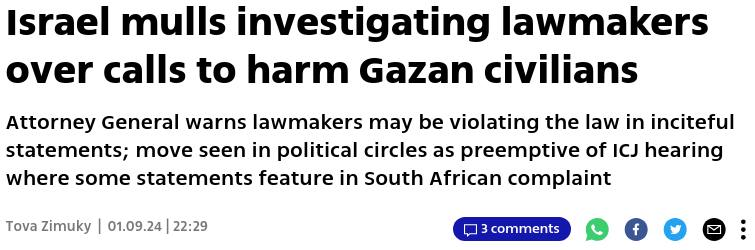
In any case the ICJ case already had some very positive effects: Public criticism concerning genocidal incitements in Israel has become stronger. Even the general attorney has pledged to persecute these incitements more rigorously. The Israeli lawyers at the ICJ themselves have made clear that Israel must respect the fundamental principle that the enemy’s violations of humanitarian international law provide no excuse for breaching duties under humanitarian international law oneself—while the Israeli government itself has again and again justified e.g. the deprivation of water and the blockade of humanitarian relief as a mean of coercion to force Hamas to end their war-crimes and crimes against humanity (these kinds of reprisals directed against the civilian population constitute war-crimes and possibly crimes against humanity themselves). While representing Israel the lawyers have publicly dismissed statements by government members and other high-ranking politicians as contrary to Israeli obligations, as merely emotional and to be dismissed, thereby also making clear what to think about the behaviour of these politicians. Furthermore Aharon Barak, the former Chief Justice at the Israeli Supreme Court, has now become ad hoc justice at the ICJ, delivering an Israeli perspective within the college of justices, while the Supreme Court has been under heavy attacks from the Israeli right-wing in their judicial overhaul campaign, but also already before.
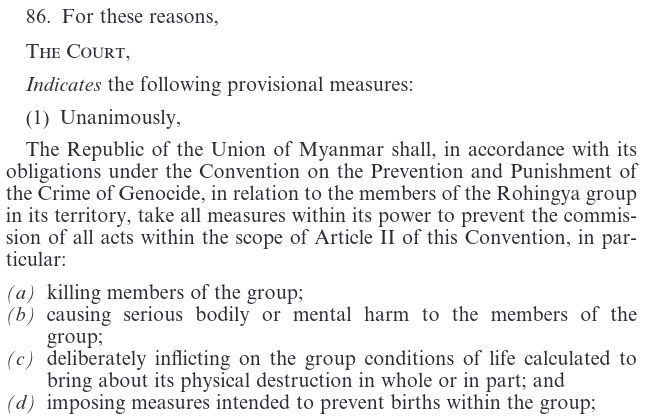
While of course the political motivations behind the South African move have to be questioned and while on should think about other paradigms than the notion of genocide to think about the politics of the current war on all sides and about the crimes committed during this war, there are also good reasons why South Africa chose to make a case at the ICJ based on the genocide convention: First of all unlike the Geneva Conventions the genocide convention contains farer-reaching State obligations concerning prevention and punishment not just of acts of genocide themselves, but also of attempts, preparations, conspiracies and incitements for genocide. For grave breaches of humanitarian international law as defined by the Geneva Conventions (which automatically constitute war crimes, and sometimes crimes against humanity as defined by international criminal law). Furthermore there is the issue of jurisdiction. The State of Palestine is no member of the United Nations, it cannot sue Israel for violations of the Geneva Conventions on its territory as it was done for example by the Democratic Republic of Congo against Rwanda or by Nicaragua against the United States. In principle third parties could also hold a State accountable for violations of certain provisions of the Geneva Conventions, as long as they are erga omnes partes. However, concerning genocide international law assumes a more definitve joint responsibility of the international community to prevent this crime. Therefore Gambia was able to sue Myanmar for its actions of persecuting, killing and displacing Rohingya people in 2019 based on the genocide convention.
Given the merits of parts of the case made by South Africa it is likely that the ICJ will today proceed similarly as it did in 2020 concerning Myanmar: It will remind Israel of its obligations and impose a duty to regularly report on its efforts to prevent genocide, maybe it will even name some concrete likely violations of the genocide convention, without claiming that there were ongoing or completed acts of genocide in Gaza.
I hope that the ICJ will release an order today and that any provisional measures ordered and the further process will help to improve accountability and provide some viable bottom lines for the further progress in international diplomacy. However, there will not be provisional measures to stop the war or to declare some other abrupt change of course. Furthermore we should not forget the limits of the applications of the genocide convention. The ICJ case (unlike the current ICC investigations) will not be able to address war crimes and crimes against humanity committed by Hamas and by Israel more broadly. And the legal processes in any case cannot replace the political and moral discussions concerning the means of warfare employed and their disastrous consequences.
What to think about the allegations of genocide both against Hamas/PIJ and Israeli government/IDF?
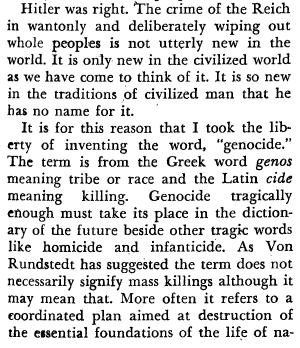
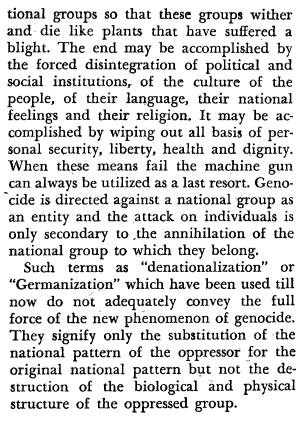
First a few general words concerning the term ‘genocide’: From the beginning ‘genocide’ has been envisaged to be a legal term, denoting actions for whose prevention there shall be a liability of States under international law (realised through the Genocide Convention) and which shall be persecuted on an individual basis under international penal law (realised through the Rome Statute of the International Criminal Court). However, starting with Lemkin the term has always been embedded into a certain theory of how modern mass violence emerges and how the refusal of self-determination and dignity of ethnic groups can turn into policies of either relatively slow annihilation or outright mass murder. The term ‘genocide’ has shaped our views of how we understand the crimes committed by various regimes during various wars and it has become a political tool: Its inflatory use has been driven by its proneness to serve the causes of national struggles (while allegations of war crimes against the enemy have always been used to fostern national unity, the term ‘genocide’ directly addresses the national unity as the victim of the crime), but also by its perceived particular capability of appealing to universal justice, of not allowing anybody in the world to remain uninvolved (which includes the calls to international courts and third countries to exercise universal jurisdiction against those responsible for genocide and even sometimes the idea that a genocide taking place would constitute an obligation for a humanitarian military intervention by third countries). Subsequently especially since the 90s and the court ruling on the massacre of Srebrenica constituting an act of genocide competition for recognition of genocides spread internationally. One should always keep in mind that there is a difference between using the term ‘genocide’ to explain some historic development or events or State policies and using the term ‘genocide’ or more precisely ‘act of genocide’ to denote an individual responsibility of some actors constituting a punishable crime.
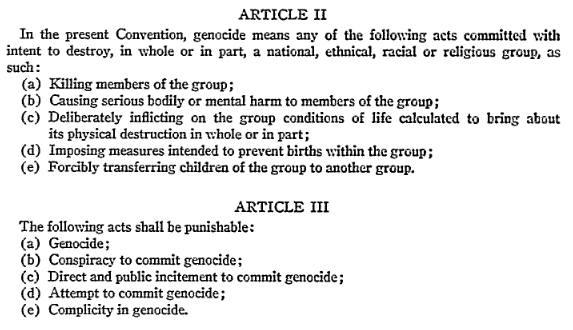
For the sake of determinateness we will focus on the legal definition of genocide, the relevant passages read that we have to check whether we are dealing with an act “committed with
intent to destroy in part a national or ethnic group” by “killing members of the group” or by “deliberately inflicting on the group conditions of life calculated to bring about its physical destruction in part”.
Now concerning Israel—let us check the strongest arguments for Israeli acts of genocide as they are expounded by some legal and genocide scholars (not the usual allegations where every case of carelessly inflicted collateral damage is called “genocide”). Then we notice that two things are true:
1) High-profile Israeli politicians including members of the government, some high-ranking officers, some Israeli media, cultural figures like pop singers, and parts of the general population including in social media use genocidal rhetorics or express genocidal wishes, i.e. demands for the partial or entire annihilation of Palestinians in Gaza. Most often these rhetorics are based on deliberately blurring the lines between combattants and non-combattants (beyond the objective difficulties of discrimination) combined with totalising figures of speech.
2) Israel is causing non-combattant deaths in Gaza at an extraordinary scale and pace. The massive bombing campaign—regardless of which aspects of it are legal or not—displays a greater neglect for civilian survival than during previous Israeli wars and asymmetrical wars around the world in recent decades (maybe comparable to Russian bombings of Grozny (1999/2000) and Mariupol (2022) or to the indiscriminate shelling of Tamil Tigers combattants and civilians by the Sri Lankan army in Mullaitivu in 2009). Furthermore there are instances where Israeli government and members of the IDF commit undoubtedly illegal acts resulting in the killing of civilians (like shooting unarmed people with a white flag) or the deprivation of the Gazan population of its condition of life (i.e. using depravation of water as a mean of coercion).
Now people argue: Both the subjective elements of the crime (intent) and the objective elements of the crime (killing or destruction of conditions of life) are present. However, this argument is weak due to the lack of evidence that the genocidal rhetorics and demands (1) are actually part of the determining underlying motivations for the acts (2). To the contrary, there is clear evidence that the acts (2) have to be explained differently: The deprivation of water has been justified as a mean of coercion for the liberation of hostages (which constitutes an (ineffective) reprisal gravely breaching humanitarian international law and therefore a war crime, but the motivation was not genocidal). The intensity of the bombing is partly to be explained by military necessities—Hamas underground fortifications and the general troubles of urban warfare—and partly by factors like the urge to proceed as quickly as possible with very limited intelligence, to possibly disproportionately spare lifes of IDF soldiers which would be risked while fighting in houses and to intimidate the civilian population of Gaza. Furthermore there is certainly no general policy of indiscriminately shooting everyone moving.
While the arguments for genocide are weak, this does not imply that everyone making this accusation would apply double-standards against Israel. Rather the accusations can also be explained as the results of good-faith attempts to apply a certain wide-spread teleological approach of genocide research which considers genocide as the archetype of the ultimate crime, which is gradually approached by a spiral of rhetorics and deeds, amplifying each other, following a certain regular pattern described by genocide theories. Therefore for example the Center for Constitutional Rights in its October analysis was also careful to make no determinate allegation of genocide, but to leave the option open that we would be dealing only with an unfolding “attempt of genocide” (wish is already punishable under international law).
For a political analysis the not sufficiently founded allegation of genocide is not helpful. Of course certain extreme-right politicians with their openly genocidal rhetorics are a factor for understanding Netanyahu. And of course a society where certain rhetorics (for example of blurring the lines between combattants and non-combattants) have been normalised to a degree unseen in the years before October 7th will also have an impact on the decisions of certain military commanders. However, I fear that for saving lifes of Gazan civilians it would be far more important to counter for example the ruthless calls from the right to bomb every house before entering it to spare lifes of IDF soldiers and to talk about targetting practices and the humanitarian situation than to get fixated on certain rhetorics. Concerning persecution of individuals under international penal law by universal jurisdiction it is illusory that one would be able to prove the individual guilt of some commanders, since even if they expound genocidal opinions it will always be doubtful that they would have been decisive, while persecuting war crimes like the use of deprivation of water as a mean of coercion—or potentially even crimes against humanity—would be an option. Concerning State liability under the genocide convention there is of course a lesser burden of proof, for example if liabilities of genocide prevention are not met even if the government itself is not committing genocide, still without an actual case of genocide it seems to be far fetched that legal actions like those by South Africa against Israel in the International Court of Justice or by the CCR against the US administration in US courts may lead to any success and are a meaningful contribution to the political process towards alleviation of civilian suffering and ultimately peace.
Now concerning Hamas/PIJ: The overall agenda of Hamas and Palestinian Islamic Jihad can certainly justly be described as genocidal: They reject the right of Jews to live in the region and to self-determination. And since decades they made clear by their terrorist attacks that they consider virtually any Jewish Israeli a legitimate target by calling them “Zionist settlers”. Likewise in the unlikely case of a collapse of the Israeli State every Jewish civilian not being able to flee would have to fear for their life under the threat of Hamas and PIJ. These ultimately genocidal intentions also have some level of support in parts of the Palestinian population, manifested for example by the not that rare adoration of Hitler for his genocide against the Jews. However, do the attacks from October 7th constitute an act of genocide? First we should recognise the other motivations involved: Hamas continued its agenda of sabotaging the cooperation between the Palestinian Authority and Israel, the normalisation between Israel and Saudi Arabia and any potential future renewed peace process between Palestinians and Israel. This allowed Hamas also to progress towards hegemony in more regions of the West Bank. Furthermore, according to Khaled Mashal, it tried to force Israel to engage in a perpetuated state of war with the hope of other forces like Hezbollah joining till the conflict would escalate into a regional war in which Israel’s existence would be seriously at risk. The war criminal mass murder of civilians—most likely a crime against humanity—has been instrumental for definitely effectuating this level of escalation. Furthermore the murder of some 800 civilians on October 7th conveys the message that no Jewish Israeli shall have the right to be let alone living in peace in their home. This has strong parallels to the massacres against civilians during previous wars defined by ethnic conflicts, for example consider the Oran massacre against civilians of European descent perpetrated by the Algerian National Liberation Army in 1962 aiming at the expulsion of Europeans and pied-noirs from Algeria the pogroms against the Jews of Cairo in 1945 and 1948 accompanied by the exclusion of Jews from Egyptian citizenship and ultimately leading to the forced exodus of all Jews from Egypt, or the Deir Yasin massacre perpetrated by Irgun and Lechi during the Nakba as part of efforts to expell/reduce the Arab population, or think of massacres along ethnic lines not only committed by Serbs, but also Croats and Kosovans during the Yugoslavian wars and persecuted as crimes against humanity, not as acts of genocide. One should also note that the killings by Hamas and PIJ members were not everywhere equally systematic, for example they do not reach the degree of organisation and systematicity of the German Einsatzgruppen in their execution of the genocide, also I do not see efforts of separation of victims along ethnic lines, which would make the genocidal intention clearer (such separation was crucial for the ruling on the Srebrenica massacre). The written instructions for the Hamas attack published by the Israeli authorities only contain an ambiguous allusion to the indiscriminate murder of civilians, some reports published by the Israeli authorities also indicate that Hamas terrorists sometimes had no clear vision what to do and stopped after killing some civilians. Of course also the conflicting goals of taking hostages, returning to Gaza and damaging and pillaging Israeli military facilities put some limits on the massacre, and only a part of the Hamas forces was engaged with the murder of civilians. Overall the massacre is also smaller than all the pogroms carried out by the Ukrainian nationalists under Petljura and the White Army of Denikin during the Russian civil war—and these pogroms are seldom called genocide. However, the legal understanding of genocide has evolved, the murder of 8,000 male Bosniaks and Srebrenica, involving a process of separation by identify the Bosniaks, has been determined to be an act of genocide—even if it has been limited in scope to a single Serbian military operation, the siege of Srebrenica, while no other military actions nor the overall policies of the Serbian leadership have been identified as acts of genocide. Given the genocidal intentions of Hamas and the size of the massacres, still somebody may try to make the case in court for the massacre at the Nova festival or for example the massacre in the Kibbutz Be’eri to be acts of genocide rather than simply crimes against humanity and the court might rule this way or that way—however, with a few hundred victims these would be the smallest acts of genocide ever asserted by a court.
In my opinion the allegations of genocide rather illustrate the shortcomings of certain paradigms of genocide research and of genocide recognition politics, which have been criticised already before. The fixation on the genocide paradigm does more damage then good. Given the development of international law one has to understand that an act of genocide in the legal sense is not necessarily worse than some other crime against humanity. Instead of helping to understand the unfolding of mass violence it rather forecludes the understanding and reimposes nationalist reductionist views of conflicts (be it in the current war betwen Israel and Hamas/PIJ, between Turkey and leftist Kurdish and Yazidi movements for self-determination, between Russia and Ukraine or in the Soviet Union during the 1932 famine…).
Finally one remark concerning freedom of speech: Given the intricacies of these kinds of discussion it should be clear that it will never be a good idea to try to resolve these questions of interpretation of events by means of censorship, disciplinary actions in universities or criminal persecution of voicing certain opinions about these issues.
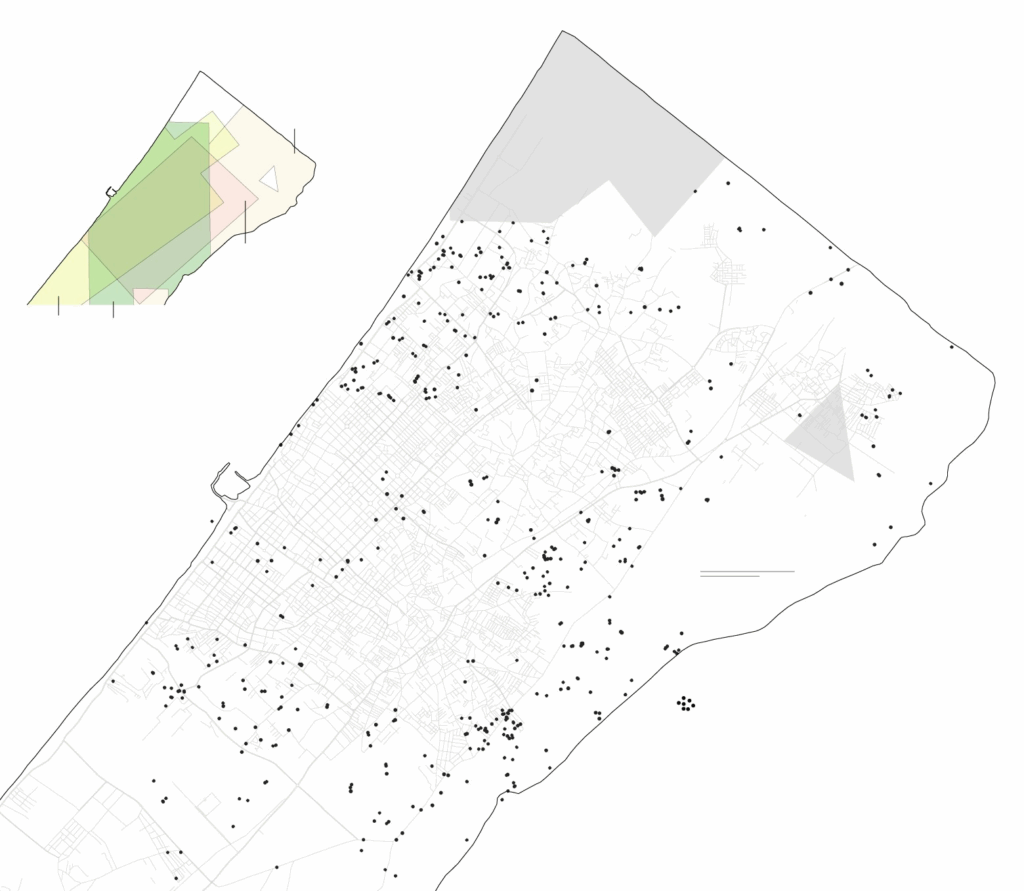
CNN published their investigation concerning the IDF’s use of 2,000 pound bombs in northern Gaza as a possible explanation for high Palestinian civilian fatalities. For just the first month of the war more than 500 likely impact sites of 2,000 pound bombs have been identified. These kinds of bombs are usually not used at all by the US in urban areas, such a bomb has been used only once during the campaign to liberate Raqqa, the then capital of the Daesh “Caliphate”. In one strike on Jabalya with two of these bombs alone at least 126 civilians including 69 minors (source: Airwars) have been killed as collateral damage for killing approximately 12 to 24 Hamas aligned combattants and destroying some underground Hamas facility. There has also been an impact of such a massive bomb less than hundred meters away from a hospital which was back then still operationg until it had to close down because of the fights and the lack of fuel.
Israel had taken some precautions, like ordering the evacuation of northern Gaza, however, fleeing northern Gaza was not feasible for everyone (especially people in hospitals and hospital staff, ), some were impeded by Hamas from fleeing, and some unfortunately stayed for whatever reasons (resignation close to suicidality, stubbornness, belief in having to be “steadfast”, fear about what will be the situation in southern Gaza with densely crowded shelters or sleeping on the streets, while it was clear that eventually the fighting would also intensify there). Furthermore at least during the first month these kinds of bombs have not been used in the entire area of northern Gaza, but especially along the frontline when trying to encircle Gaza city. Still this type of bombing is beliefed to have largely contributed to the high number of civilian fatalities.
One reason for these kinds of bombings is probably the unwillingness of risking more Israeli fatalities (till now 154 IDF soldiers have been killed during the offensive on Gaza). Today Likud economy minister even blamed the IDF for taking too much risk by entering houses which have not been bombed before, effectively calling for a strategy leading to an even more complete destruction of Gaza. We have to assume that these kinds of internal discussions have lead to the already very high level of destruction and civilian fatalities. A second reason are of course underground structures. However, given the large number of 2,000 pound bombs used probably in most cases there was not any Hamas underground facility targetted by the strikes. A third reason is the Israeli belief that one has to proceed as quickly as possible. In fact sometimes risking more collateral damage to achieve a goal more quickly can indeed lead to less civilian victims in the medium term. However, given the still huge fatality rates, such a justification seems to be questionable and the speed of the offensive also prevents other precaution measures (observing civilian life patterns, evacuating hospitals…). On a more macroscopic level Israeli politics is driven by the fear that mounting diplomatic pressure, especially from the US, might limit the timeframe for any war against Gaza. However, this calculations seems to have been unfounded: While US support by preventing spillovers and escalations at other fronts and by delivering weapons has remained reliable (also due to lack of alternatives to supporting Israel till victory; Macron’s proposal of an international mission against Hamas and PIJ never had much support), the urge to proceed quickly seems to backfire and in fact damages Israel’s diplomatic relationships. A fourth reason is that the IDF pursues a doctrine of prefering to destroy so called “power targets” (e.g. public or government institutions or high buildings) for their high symbolic value and their effect of intimidation among the Gazan civilian population—a practice which undermines proportionality checks based on assessments of concrete military advantages and probably lead to the deaths of more civilians
Disregard for the civilian population in the enemy controlled area is of course nothing new. We all know for example how unequally human lifes were valued during NATO missions in Afghanistan with many instances of NATO forces prefering to quickly do some bombing without risking one’s own life at all and with high non-combattant casualties instead of waiting to get information from local forces and proceeding carefully. Yet the use of 2,000 pound bombs seems to be outstanding (the US typically used at most 500 pound bombs in campaigns against Daesh). The rate of civilian fatalities per time and population of the area and in comparison to enemy combattants killed far surpasses the rates in the liberations of Raqqa, Mosul or Marawi from Daesh. One would wish that instead of blaming the IDF for too much precaution concerning Gazan civilians Israeli government would instead advocate for the same kind of heroism of risking one’s own life to spare civilians, for the same level of precaution and restraint which have been exhibitted for example by Kurdish soldiers in Syria, Shiite soldiers in Iraq or Christian soldiers on the Philippines when trying to minimize casualties among the Sunni civilians under Daesh rule.
Meanwhile in its public diplomacy the Israeli government seems to be more interested in playing blame games than in explaining concretely their rationale for example for using these kinds of bombs which the US would not use in a similar situation. The Netanyahu led government thereby undermines any prospects for a joint vision among Israel and its allies concerning the fight against Hamas and the future for Gaza.
There are also some unclear or possibly misleading aspects of the CNN investigation: The relevance of the lethal fragmentation radius (that means the maximum distance where at average there will be on average at least one lethal fragment flying per square meter) within an area covered by building is unclear to me (of course the bomb fragments do not pass through blocks of concrete buildings). Schools close impact sites are mentioned without telling whether there were any people sheltering in these schools. The article also repeats the questionable statement that “the population of Gaza is packed together much more tightly than almost anywhere else on earth”—while in deed Gaza is very densely populated, but for sure there are many more densely populated urban areas in the world. Furthermore the statement that one would have go back to the Vietnam war to find other examples for such an intensity of destruction seems to refer only to wars involving the US. Levels of destruction during Russian bombing campaigns against Grozny or Mariupol or the Sri Lankan campaign against Mullaitivu (using artillery rather than bombs) might be quite similar depending on your measures of comparison.
Very important article in New York Times concerning the civilian fatality rates in Gaza, key takeaways:
The daily civilian fatality rates far exceed the fatalities during sieges and bombings of cities held by Daesh/Islamic State.
Instead of smaller yield precision guided munition Israel has extensively used high-yield bombs (including 2,000 pound bombs)
Israel’s urge to make quick advances made assessments of civilian paterns of life impossible (i.e. observing how many civilians would walk in and out from a house), hence Israel had less precise estimates for expected non-combattant harm.
While the IDF reports that they cancelled numerous bombings because of their assessments of expected non-combattant harm using their usual procedures, these assessments are probably much more imprecise than during previous wars, and given the strategic importance of destroying underground structures and maybe other factors like the perception of the importance of the war and a changed perception of the enemy’s civilian population the bar has been significantly raised for civilian harm to be considered inadmissible.
The rationale for trying to proceed quickly is probably the anticipation of growing diplomatic pressure for a ceasefire during the prolonged campaign. However, we have to question whether this strategy actually worked out well. Closest allies deplore the far too high fatalities. While territorial advances have indeed been rapid, the number of enemy combattants (Hamas, PIJ) killed seems to be modest: even according to IDF numbers only about 3.000 terrorists as of one and a half weeks ago, with still tens of thousands enemy combattants left (even if we account for casualties with might be higher than fatalities, but have not been reported by IDF sources).
The statements by weapons experts concerning the very liberal use of high-yield bombs seem to confirm that the comparison with the siege of the tiny coastal strip at Mullivaikkal by the Sri Lankan army in their final campaign against the Tamil Tigers in early 2009 has some merit: In both cases relatively imprecise weapons with high collateral damage have been used in densely populated areas where civilians were used as human shields. In the Sri Lankan case instead of high-yield bombs very imprecise mortar grenades have been used in an even more densely crowded area than northern Gaza, also because the Sri Lankan army unlike the IDF had no advanced precision-guided weapons systems available.
Now that there is a four days ceasefire these observations should make us worry even more about what is yet to come: Hamas and PIJ might very well use the ceasefire, during which the IDF downs their observation drones, to retreat a significant amount of their fighters into the now even more crowded southern part of Gaza and their tunnel systems there.
How is all this supposed to end, without opportunities of temporary evacuation from the combat zones for the vast majority of Gazans?
Haaretz reported few days ago that according to an IDF source 3.000 Hamas/PIJ enemy combattants have been killed during the campaign on Gaza (not including the 1100 terrorists killed on October 7th). Such numbers have very rarely been reported on. How does this help us to put the civilian costs of the war into context?
If we take the Palestinian Health Ministry numbers, then there are not much more men killed than women. A possible explanation would be that Hamas is not reporting all of their killed fighters to Ramallah’s population registry, because this information might be valuable for Israel. So let us say the 11.000 killed (and the US administration reportedly agrees that this shall be a lower bound) do not include all the terrorists. Then maybe the 3.000 killed combattants would be 25% of all fatalities. This would mean that the portion of civilians among those killed (75%) would still be higher than Hamas estimates for the rate of civilians killed in the 2014 war, and much higher than UN and IDF estimates in previous Gaza wars. It has always been contested how many civilians there were among those dead. If among these 3.000 which the IDF claims to be combattants include a significant percentage of Hamas civilian administration workers or some young men who were suspiciously running around (because typically in war times it is young men who take the risks of running around to get some stuff or whatever), then it might as well be 90% civilians.
Both the daily mortality rates and the estimated percentage of civilians among the dead are significantly higher than during the campaigns against Daesh in Iraq, Syria or on the Philippines, including sieges liberating cities from Daesh. The best comparison would probably be Mosul in Iraq. In the old city in western Mosul during the first months of the siege there were still 600,000 civilians trapped, used by Daesh (which also used hospitals) as human shields and held off from evacuating, so this provides a good comparison to northern Gaza were there are maybe some 300,000 civilians still staying. Yet only around 10,000 civilians were killed over all the months in Mosul, while the majority of those killed were Daesh combattants. The mortality rates and the percentage of civilians killed seem to be more comparable to what happened in north eastern Sri Lanka during the final military campaign against the Tamil Tigers or the siege of Mariupol. A key difference is that Hamas and PIJ have much more fighters than Tamil Tigers in Mullivaikkal or Ukraine in Mariupol.
The large number of Hamas/PIJ fighters might be a crucial reason why the IDF had the urge to proceed that quickly and with that high intensity. However, it also implies that the campaign must not go on like this, if an even larger human catastrophe is to be avoided. Unfortunately the Netanyahu government has shown that it cannot be trusted concerning the humanitarian restraints, as it has openly announced grave breaches of humanitarian international law (using the denial of water as mean of coercion), as it has deceptively appealed to the worries about the fate of the hostages to obfuscate its war objectives and as it has denied the IDF command to execute their humanitarian relief plans.
– I support Israel’s right to use disproportionate power to overwhelm Hamas once and for all.
– I support the IAF who dropped leaflets and made phone calls to tell Gazans to flea South.
– I support Israel’s right – during war time – to drop a bomb at a military target even if there might be civilians killed.
– I support the IAF who when they dropped their 7,000th bomb in Gaza there were only 7,000 dead in Gaza. (That means one person per bomb. Those are pretty good numbers and I’m going to guess – and I hope – the majority of them were Hamas terrorists. There are about 30,000 of them.)
HOWEVER…
– However children are innocent, even if they are Palestinian, and great care – GREATER CARE – needs to be taken NOT to kill them.
– However it is hard for me to imagine that Israeli intelligence had so much sigint and humint in Gaza that it had more than 10,000 valid military targets in its bank of targets yet it missed the intelligence bit about the attack on Oct 7th.
– I feel extremely uncomfortable and suspicious when Bibi talks about the purpose of this war as PAYBACK for Oct 7 as opposed to the purpose being to PREVENT another Oct 7 from ever happening again.
– I feel extremely uncomfortable and suspicious when Bibi refers to Hamas as Amalek, a biblical nation who Jews are commanded to commit genocide and kill them all: men women and children.
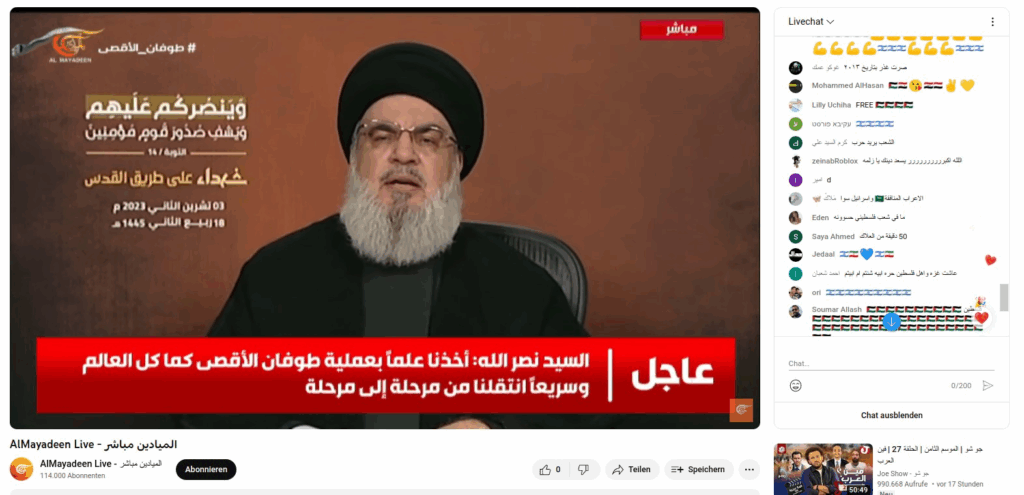
When watching the long awaited first public speech of Hezbollah leader Nasrallah last week I tried to follow the Arabic YouTube comments on the Al Mayadeen livestream. Unsurprisingly a large portion of the audience of a Hezbollah affiliated TV station were impatient to hear when he would finally declare an all-out war (and got disappointed). Others gave some generic religious phrases of praise, waved Palestinian flags, thanked the “Sheikh” for his prudence and wisdom or complained about the Israeli YouTubers with their Hebrew “Am Yisrael Chai” comments. Some called for friendship with Israel or warned against the destruction Nasrallah might bring. What I enjoyed most were the comments pointing at the fact that judging from Hezbollah’s deeds he is much more interested in killing children in Syria than caring about the children being killed in Gaza. One listener did not fail to notice that for Nasrallah the path towards the liberation of Jerusalem leads through Aleppo and Idlib, a strange detour geographically speaking, which, however, can certainly be explained by the Sheikh’s supreme wisdom. Of course there were also people just making fun of his look. There was broad interfactional agreement that the 1½ hours speech was for too long, too much talk about nothing, with all the tiring theatrical alternation between serenity of the wise man and angry shouting. Luckily he had a glass of water for his refreshment.
Concerning the content of his speech: He tried to justify Hezbollah’s actions against criticism from all directions. Against those blaming Hezbolla for not going into an all-out war he said that Hezbollah has been at war since October 8th, that they have to be careful, but also that this is not just some confrontation as usual and that he is hopeful that further escalation will lead to a decisive war against Israel. Against those Lebanese warning against risks for Lebanon which he causes he tried to pose as a considerate defender of the Lebanese border. Concerning October 7th he denied that Hamas murdered civilians and stressed that the Hamas attack had been planned in secrecy without his knowledge, but that they welcomed the attack by Hamas and fully agree with Hamas’ decision to have prepared it in secrecy even towards its allies. Otherwise not that interesting.
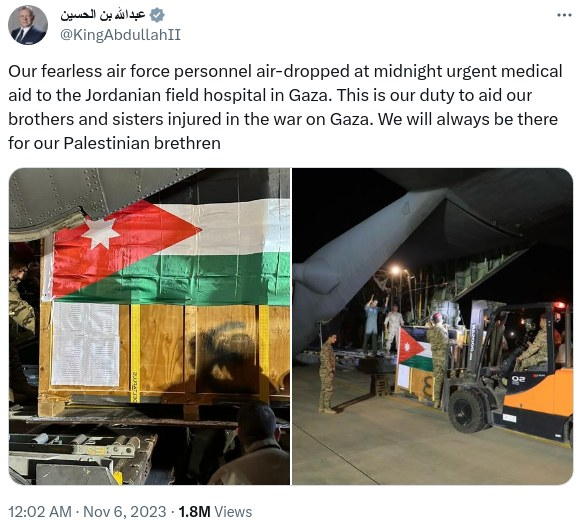
Thank you, Jordan. Medical supplies were air-dropped to a hospital in Gaza by the Jordanian air force. The IDF now confirmed this coordinated effort. Humanitarian relief must be enabled even under harshest circumstances. It is possible, if nations and aid organisations work together instead of turning humanitarian relief into a political bargaining chip. Only 21 out of 35 hospitals in Gaza are still functioning.