
The debate on the Gaza case at the International Court of Justice has been focussed too much on the question whether Israel has been committing acts of genocide in Gaza or not. Statements by the US and German top government officials dismissing the case as “meritless” are disingenuous, since they reduce the matter of the dispute to this question. Likewise many pro-Palestinian with their black-and-white thinking either expect an outright condemnation of Israel’s alleged genocide or consider any failure to do so as a symptom of evil western hegemony in international institutions. Only seeing an evil anti-Palestinian motive as the primary cause behind Israeli policies help them in their nationalist framing of the multi-dimensional conflict.
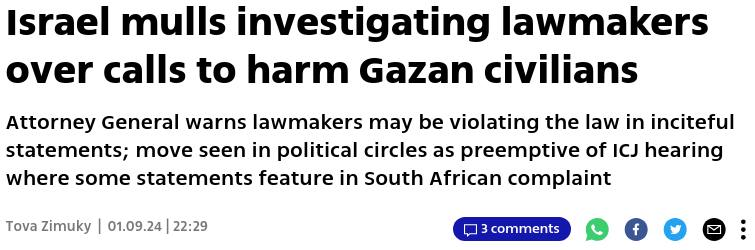
However, South Africa has made it very clear that the provisional measures cannot be based on some final judgement concerning events which are still unfolding as being acts of genocide or attempted acts of genocide or not. Rather South Africa has addressed a wide range of issues falling under the Convention on the Prevention and Punishment of the Crime of Genocide, namely failures by Israel to prevent and to persecute incitements and conspiracies to commit genocide. For these claims there is far stronger evidence (just think about all the statements by government officials and the lack of disciplinary measures within the army following cases of collective incitement not to distinguish between combattants and non-combattants) than for certain genocidal incitements in Israel actually being the motivation for deadly military policies or for certain war crimes actually aiming at the destruction of Palestinians of Gaza *as part of an ethnic group*.
I personally do not think that the connection between the expressions of genocidal intentions by some actors and concrete policies and actions leading to horrible levels of death and unsustainable living conditions among the civilian population of Gaza is strong enough to constitute acts of genocide. South Africa has nevertheless made maximalist accusations and some of their means of presenting their case have to be rejected. For example South Africa weakened its own case concerning the extremely high numbers of civilian fatalities in Gaza by not even addressing the issues of numbers of combattants killed or numbers of civilians killed by Hamas/PIJ themselves. I do not see how South Africa can claim that even in the face of an attack like on October 7th there would be no Israeli right of self-defence, just because of a supposed status of occupation concerning the whole Palestinian territories. And Ramaphosa’s equation between Gaza and Nazi concentration camps is utterly wrong and shows a despicable level of wilful ignorance concerning the destruction of European Jewry. At the same time the Israeli defence during the oral proceedings was partly not very confident and competent and driven by a bad propagandistic strategy. Instead of keeping the arguments focussed on how the great civilian fatalities are to be explained without any genocidal intentions and maybe (it is doubtful, but they could have tried it more) even despite respecting military necessity, proportionality and precaution, a lot of time was wasted with blame games, claiming that in fact all the actual or alleged Hamas supporters in the international community are the true violators of the genocide convention (however, this would be a separate court case and Israel has not decided to pursue such a case).
In any case the ICJ case already had some very positive effects: Public criticism concerning genocidal incitements in Israel has become stronger. Even the general attorney has pledged to persecute these incitements more rigorously. The Israeli lawyers at the ICJ themselves have made clear that Israel must respect the fundamental principle that the enemy’s violations of humanitarian international law provide no excuse for breaching duties under humanitarian international law oneself—while the Israeli government itself has again and again justified e.g. the deprivation of water and the blockade of humanitarian relief as a mean of coercion to force Hamas to end their war-crimes and crimes against humanity (these kinds of reprisals directed against the civilian population constitute war-crimes and possibly crimes against humanity themselves). While representing Israel the lawyers have publicly dismissed statements by government members and other high-ranking politicians as contrary to Israeli obligations, as merely emotional and to be dismissed, thereby also making clear what to think about the behaviour of these politicians. Furthermore Aharon Barak, the former Chief Justice at the Israeli Supreme Court, has now become ad hoc justice at the ICJ, delivering an Israeli perspective within the college of justices, while the Supreme Court has been under heavy attacks from the Israeli right-wing in their judicial overhaul campaign, but also already before.
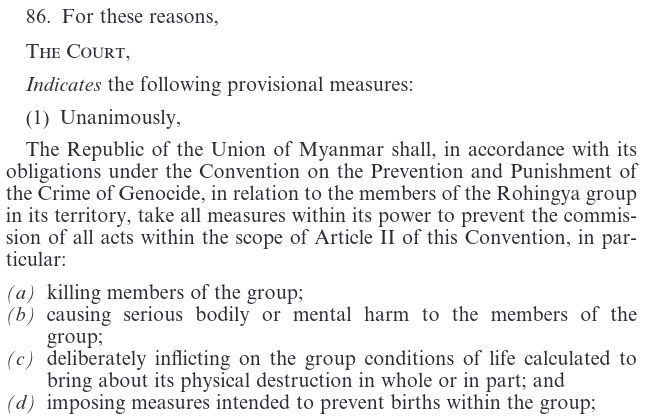
While of course the political motivations behind the South African move have to be questioned and while on should think about other paradigms than the notion of genocide to think about the politics of the current war on all sides and about the crimes committed during this war, there are also good reasons why South Africa chose to make a case at the ICJ based on the genocide convention: First of all unlike the Geneva Conventions the genocide convention contains farer-reaching State obligations concerning prevention and punishment not just of acts of genocide themselves, but also of attempts, preparations, conspiracies and incitements for genocide. For grave breaches of humanitarian international law as defined by the Geneva Conventions (which automatically constitute war crimes, and sometimes crimes against humanity as defined by international criminal law). Furthermore there is the issue of jurisdiction. The State of Palestine is no member of the United Nations, it cannot sue Israel for violations of the Geneva Conventions on its territory as it was done for example by the Democratic Republic of Congo against Rwanda or by Nicaragua against the United States. In principle third parties could also hold a State accountable for violations of certain provisions of the Geneva Conventions, as long as they are erga omnes partes. However, concerning genocide international law assumes a more definitve joint responsibility of the international community to prevent this crime. Therefore Gambia was able to sue Myanmar for its actions of persecuting, killing and displacing Rohingya people in 2019 based on the genocide convention.
Given the merits of parts of the case made by South Africa it is likely that the ICJ will today proceed similarly as it did in 2020 concerning Myanmar: It will remind Israel of its obligations and impose a duty to regularly report on its efforts to prevent genocide, maybe it will even name some concrete likely violations of the genocide convention, without claiming that there were ongoing or completed acts of genocide in Gaza.
I hope that the ICJ will release an order today and that any provisional measures ordered and the further process will help to improve accountability and provide some viable bottom lines for the further progress in international diplomacy. However, there will not be provisional measures to stop the war or to declare some other abrupt change of course. Furthermore we should not forget the limits of the applications of the genocide convention. The ICJ case (unlike the current ICC investigations) will not be able to address war crimes and crimes against humanity committed by Hamas and by Israel more broadly. And the legal processes in any case cannot replace the political and moral discussions concerning the means of warfare employed and their disastrous consequences.
Leave a Reply