
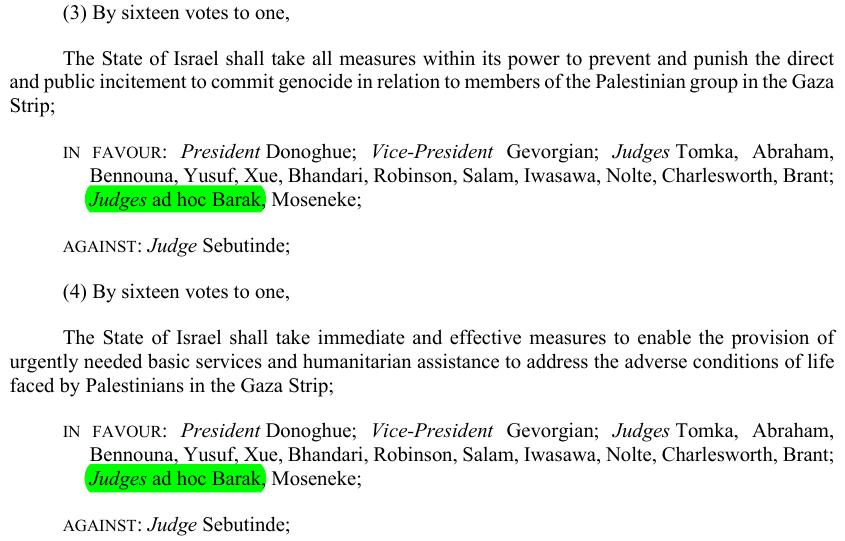
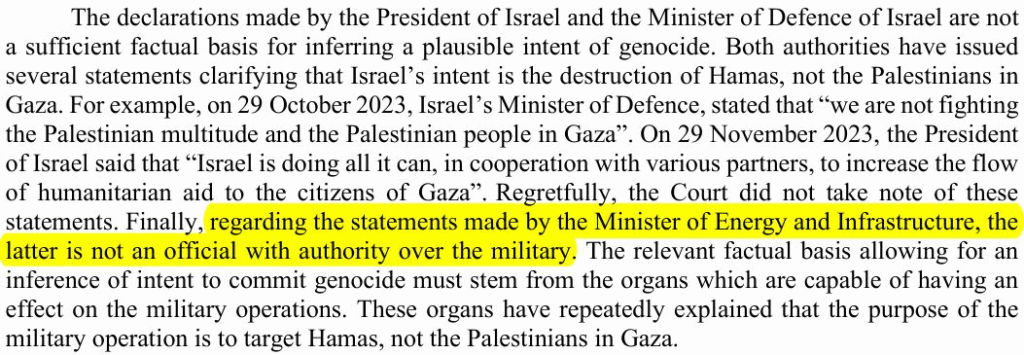
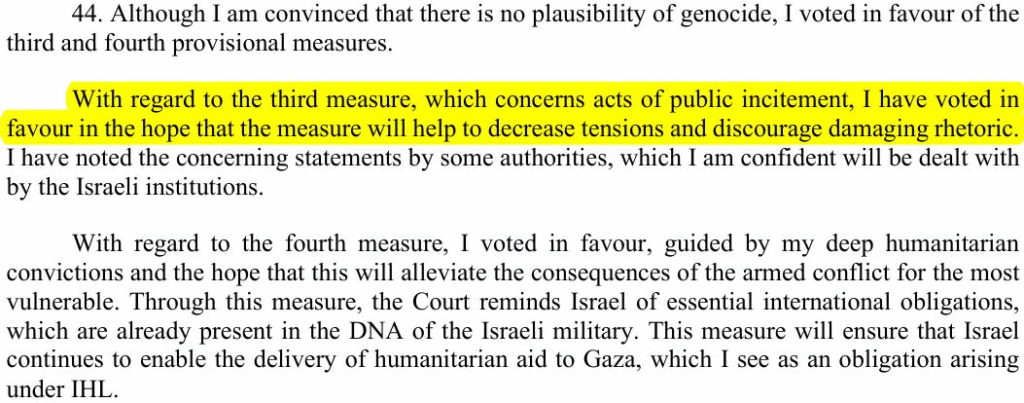
Thank you, ad-hoc judge Aharon Barak! While the former Chief Justice at the Israeli Supreme Court (and survivor of the Kovno Ghetto), appointed by Israel to the ICJ, reaffirms the necessity for Israel to defend itself, he shows great integrity by supporting two of the provisional measures ordered on Israel by the ICJ, namely concerning the duty to persecute genocidal incitements and concerning the duty to provide adequate humanitarian relief for Gaza. In his separate opinion he makes clear that while South Africa’s diplomatic behaviour towards Israel was unfortunate, this does not in itself impede jurisdiction of the ICJ concerning the dispute which undoubtedly exists. Unlike his Ugandan colleague Julia Sebutinde he thinks that there is a sufficiently plausible case that rights of the Palestinian people under the Genocide Convention are affected, e.g. protection from genocidal incitements. However, since he does not see plausibility for genocidal intent behind the Israeli military actions, he voted against the other provisional measures. He emphasises that in his opinion the actions of the Israeli military shall be judged under the Geneva Conventions and not under the Genocide Convention—however, for breaches of humanitarian international law under the Geneva Conventions there is no jurisdiction of the ICJ in the present case which is limited to the application of the Genocide Convention. Concerning the quoted statement by then-energy minist Israel Katz announcing the use of depravation of water as a mean of coercion in Gaza (which in my opinion constitutes a crime against humanity) Barak seems to condemn the statement, however, I cannot follow his argument that this statement would be irrelevant because Katz had no authority over the military. In fact Katz was responsible as a minister for the supply of water to Gaza and following his orders water supply was indeed shut down, and the northern pipeline out of the three fresh-water pipelines towards Gaza has never resumed service since then. Clearly, if civilian authorities are involved in implementing illegal means of warfare, this certainly does not reduce responsibility.
The Ugandan judge Julia Sebutinde opposed the entire order and wrote a dissent. She diverges from both the majority decision and Barak by claiming that “there are also no indicators of incitement to commit genocide” (I cannot see how she could arrive at this view, despite the evidence for example from certain chants of IDF soldiers or the speeches delivered by Ezra Yachin, veteran of the Lehi militia/terror group, to the IDF). In her opinion because of the lack of genocidal intent there is no plausible case to be made for violations of the Genocide Convention. However, she too acknowledges that there would be cases to be made concerning violations of the Geneva Conventions, i.e. war crimes and crimes against humanity committed by both sides.
The German judge Georg Nolte—son of the influential far-right revisionist historian Ernst Nolte—also sees no plausible case to be made for genocidal intent behind the Israeli methods of warfare. However, like Barak he agrees that there are plausible cases of incitement, including by Israeli government officials, which might not be sufficiently persecuted in Israel, such that the ICJ potentially has jurisdiction to judge on violations of Israel’s duties to prevent and persecute these incitements.
Concerning the majority opinion there is an interesting point to be made. Paragraph 51 of the decision reads:
“The Court considers that, by their very nature, at least some of the provisional measures sought by South Africa are aimed at preserving the plausible rights it asserts on the basis of the Genocide Convention in the present case, namely the right of the Palestinians in Gaza to be protected from acts of genocide and related prohibited acts mentioned in Article III [i.e. incitement and conspiracy for genocide etc.] […]”
The choice of words is not very clear, it only collectively affirms a right of the Palestinians in Gaza to be protected both from acts of genocides and from incitements for genocide, without separating between a right of being protected from acts of genocide and a right of being protected from incitements for genocide. The court found sufficient plausibility for the claim that this general right (in singular) of the Palestinian people is affected by Israeli actions, however, it does not explicitly state whether there is plausibility for acts of genocide being attempted or committed. Probably this wording is the result of some kind of compromise. From the perspective of procedural law this is a bit unsatisfactory. However, the wording is satisfactory to serve its purpose, namely to let the process continue.
The statement by the Chinese judge Xue Hanqin has a slight leaning to emphasise the suffering and the rights of the Palestinians more strongly. But her core objective seems to be the affirmation of the interpretation of the Genocide Convention as an erga omnes partes law, i.e. that every UN member State is allowed to sue another for violations of this law, even without being itself affected.
The Indian judge Dalveer Bhandari delivered a statement which seems to falsely imply that fatality numbers published by the Palestinians would only include civilians.
All judges clearly condemned the murder of civilians by Hamas/PIJ and demanded the unconditional release of all hostages.
Overall I am very content about the ICJ ruling. The ICJ could make a valuable contribution towards bringing peace between Israel and Palestine using international diplomacy.

Leave a Reply