
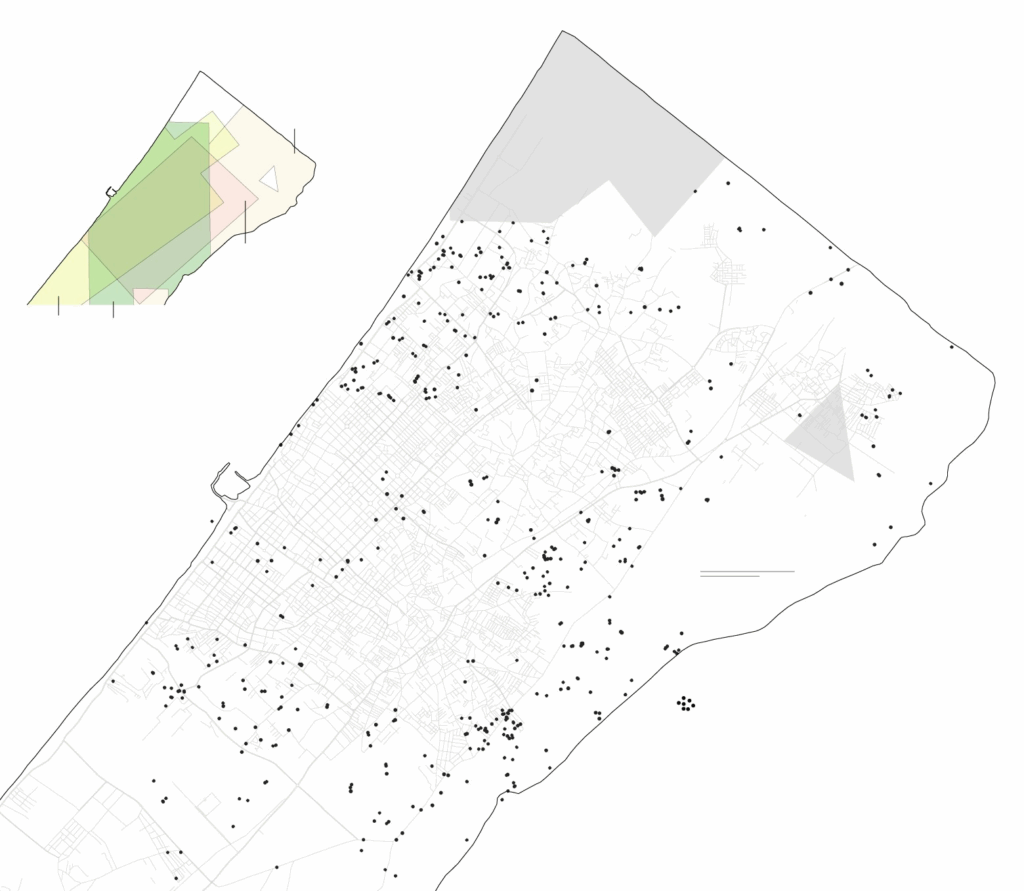
CNN published their investigation concerning the IDF’s use of 2,000 pound bombs in northern Gaza as a possible explanation for high Palestinian civilian fatalities. For just the first month of the war more than 500 likely impact sites of 2,000 pound bombs have been identified. These kinds of bombs are usually not used at all by the US in urban areas, such a bomb has been used only once during the campaign to liberate Raqqa, the then capital of the Daesh “Caliphate”. In one strike on Jabalya with two of these bombs alone at least 126 civilians including 69 minors (source: Airwars) have been killed as collateral damage for killing approximately 12 to 24 Hamas aligned combattants and destroying some underground Hamas facility. There has also been an impact of such a massive bomb less than hundred meters away from a hospital which was back then still operationg until it had to close down because of the fights and the lack of fuel.
Israel had taken some precautions, like ordering the evacuation of northern Gaza, however, fleeing northern Gaza was not feasible for everyone (especially people in hospitals and hospital staff, ), some were impeded by Hamas from fleeing, and some unfortunately stayed for whatever reasons (resignation close to suicidality, stubbornness, belief in having to be “steadfast”, fear about what will be the situation in southern Gaza with densely crowded shelters or sleeping on the streets, while it was clear that eventually the fighting would also intensify there). Furthermore at least during the first month these kinds of bombs have not been used in the entire area of northern Gaza, but especially along the frontline when trying to encircle Gaza city. Still this type of bombing is beliefed to have largely contributed to the high number of civilian fatalities.
One reason for these kinds of bombings is probably the unwillingness of risking more Israeli fatalities (till now 154 IDF soldiers have been killed during the offensive on Gaza). Today Likud economy minister even blamed the IDF for taking too much risk by entering houses which have not been bombed before, effectively calling for a strategy leading to an even more complete destruction of Gaza. We have to assume that these kinds of internal discussions have lead to the already very high level of destruction and civilian fatalities. A second reason are of course underground structures. However, given the large number of 2,000 pound bombs used probably in most cases there was not any Hamas underground facility targetted by the strikes. A third reason is the Israeli belief that one has to proceed as quickly as possible. In fact sometimes risking more collateral damage to achieve a goal more quickly can indeed lead to less civilian victims in the medium term. However, given the still huge fatality rates, such a justification seems to be questionable and the speed of the offensive also prevents other precaution measures (observing civilian life patterns, evacuating hospitals…). On a more macroscopic level Israeli politics is driven by the fear that mounting diplomatic pressure, especially from the US, might limit the timeframe for any war against Gaza. However, this calculations seems to have been unfounded: While US support by preventing spillovers and escalations at other fronts and by delivering weapons has remained reliable (also due to lack of alternatives to supporting Israel till victory; Macron’s proposal of an international mission against Hamas and PIJ never had much support), the urge to proceed quickly seems to backfire and in fact damages Israel’s diplomatic relationships. A fourth reason is that the IDF pursues a doctrine of prefering to destroy so called “power targets” (e.g. public or government institutions or high buildings) for their high symbolic value and their effect of intimidation among the Gazan civilian population—a practice which undermines proportionality checks based on assessments of concrete military advantages and probably lead to the deaths of more civilians
Disregard for the civilian population in the enemy controlled area is of course nothing new. We all know for example how unequally human lifes were valued during NATO missions in Afghanistan with many instances of NATO forces prefering to quickly do some bombing without risking one’s own life at all and with high non-combattant casualties instead of waiting to get information from local forces and proceeding carefully. Yet the use of 2,000 pound bombs seems to be outstanding (the US typically used at most 500 pound bombs in campaigns against Daesh). The rate of civilian fatalities per time and population of the area and in comparison to enemy combattants killed far surpasses the rates in the liberations of Raqqa, Mosul or Marawi from Daesh. One would wish that instead of blaming the IDF for too much precaution concerning Gazan civilians Israeli government would instead advocate for the same kind of heroism of risking one’s own life to spare civilians, for the same level of precaution and restraint which have been exhibitted for example by Kurdish soldiers in Syria, Shiite soldiers in Iraq or Christian soldiers on the Philippines when trying to minimize casualties among the Sunni civilians under Daesh rule.
Meanwhile in its public diplomacy the Israeli government seems to be more interested in playing blame games than in explaining concretely their rationale for example for using these kinds of bombs which the US would not use in a similar situation. The Netanyahu led government thereby undermines any prospects for a joint vision among Israel and its allies concerning the fight against Hamas and the future for Gaza.
There are also some unclear or possibly misleading aspects of the CNN investigation: The relevance of the lethal fragmentation radius (that means the maximum distance where at average there will be on average at least one lethal fragment flying per square meter) within an area covered by building is unclear to me (of course the bomb fragments do not pass through blocks of concrete buildings). Schools close impact sites are mentioned without telling whether there were any people sheltering in these schools. The article also repeats the questionable statement that “the population of Gaza is packed together much more tightly than almost anywhere else on earth”—while in deed Gaza is very densely populated, but for sure there are many more densely populated urban areas in the world. Furthermore the statement that one would have go back to the Vietnam war to find other examples for such an intensity of destruction seems to refer only to wars involving the US. Levels of destruction during Russian bombing campaigns against Grozny or Mariupol or the Sri Lankan campaign against Mullaitivu (using artillery rather than bombs) might be quite similar depending on your measures of comparison.
Leave a Reply