
What to make of the slogans “never again” and “never again is now” from a historical perspective? Following Omri Boehm’s critique of a contemporary discourse making a simple opposition between a “never again” and a “never again to us” in his canceled speech that was supposed to take place in Buchenwald, I want to consider the ambiguity and overdetermination of the phrase more historically. Unfortunately there is a lot of confusion in the public discourse concerning the origins of the phrase, and while even several books have been written concerning memory politics including the phrase even in its title, very often we do not get a history so much of the phrase itself, but rather only a history of certain selectively considered uses of the phrase in memory politics and memory culture.
First a general remark: The phrase “never again…” (and its equivalent in various languages, nie wieder, jamais plus, nikogda bol’she, keynmol mer nisht…) is not particularly complex, it has often been employed spontaneously, with a pathetic value, in various political contexts. Methodologically it is not permissible to pick some prominent occurence in a saying, in a poem, a booktitle or a movie and then to claim that this must be “the” origin, because it also fits semantically (as it is done in a 2017 article “What Is the Source of the Phrase ‘Never Again’?” that made its way into Wikipedia and into the general toxic discourse). Even if someone is aware of previous uses and uses the combination of words, it might often not be adequate to call it even a quotation.
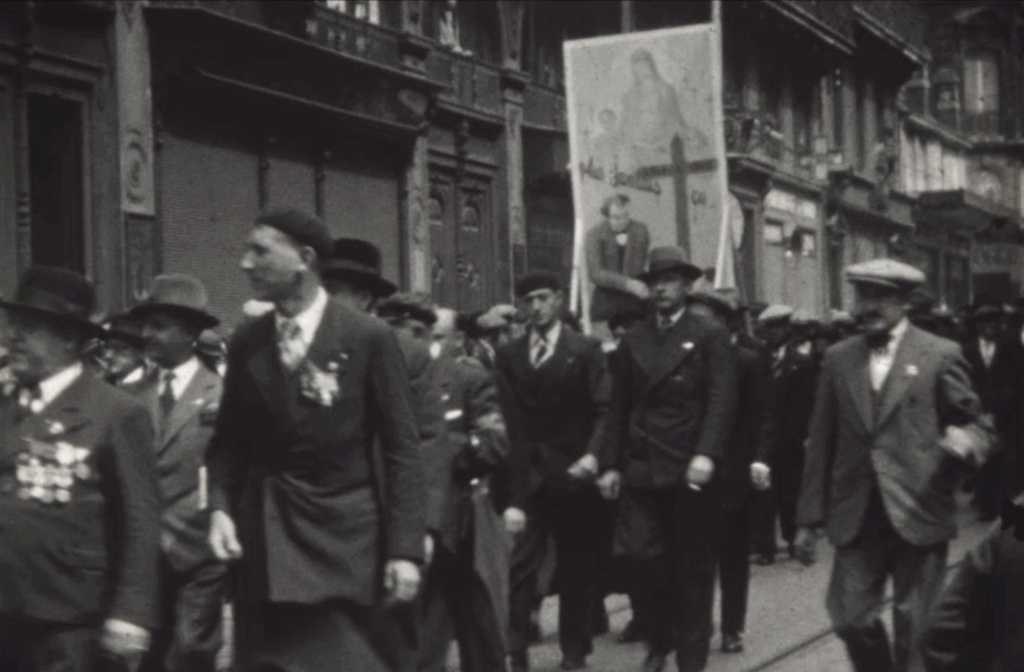
So instead we have to look first on when the phrase has been used in an organised political context, as a deliberate rallying cry. The first such use that I could discern (after trying to disprove my hypothesis with a very insufficient methodology: searching Google Books in various languages—which is however sufficient to disprove many of the claims from public discourse and the literature) is the pacifist, anti-war movement in Germany starting in 1920 when organisations like the „Friedensbund der Kriegsteilnehmer“ and its successors organised campaigns and mass demonstrations, including veterans, supported by communists, social democrats, liberals, and trade unions, under the slogan „Nie wieder Krieg!“ (“never again war”—see the famous Käthe Kollwitz print from 1925). At the latest in the 1930s the slogan «plus jamais ça» (“never again this”, already with an undetermined «ça») was used in the French anti-war movement (see the photo of a “popular front” demonstration of veterans and communists in 1937 using this slogan).
The systematic, organised use of the phrase “never again” regarding the horrors of Nazism, can and usually is traced back to the organised resistance within the Buchenwald concentration camp that played a crucial role for establishing the memorialisation of Nazi crimes after 1945. However, the written version of the “oath of Buchenwald” (calling for the destruction of Nazism and a new “world of freedom and peace”) and the “Buchenwald manifesto” (calling for the destruction of “fascism and militarism” in Germany), their most famous initial declarations, do not explicitly contain the phrase. Nevertheless even the specific phrase „Nie wieder Krieg! Nie wieder Faschismus!“ (“Never again war! Never again fascism!”) has been tied to these declarations at the time of the liberation of Buchenwald, with the VVN publication „Buchenwald: ein Konzentrationslager“ even claiming the phrase would have been part of the “oath of Buchenwald”, which, however, can be explained by memories having been overshadowed by the later ritualised use of the specific phrase. However, also Raul Hilberg in his final 2007 interview traces back the phrase “never again” to hand-made signs used by Buchenwald prisoners at their liberation (the claim is often quoted, but I could not find Hilberg’s primary source anywhere).
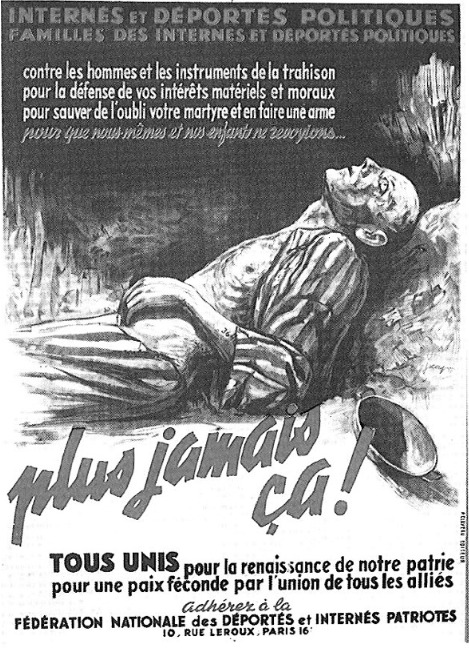
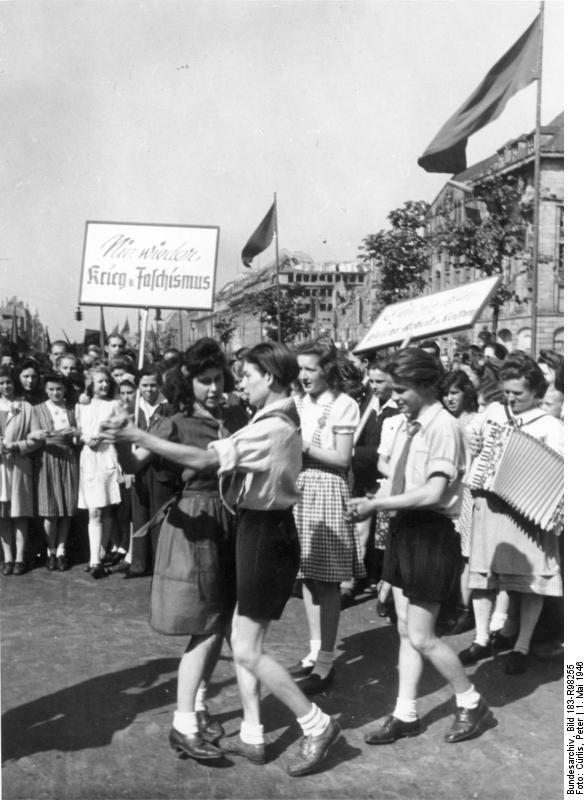
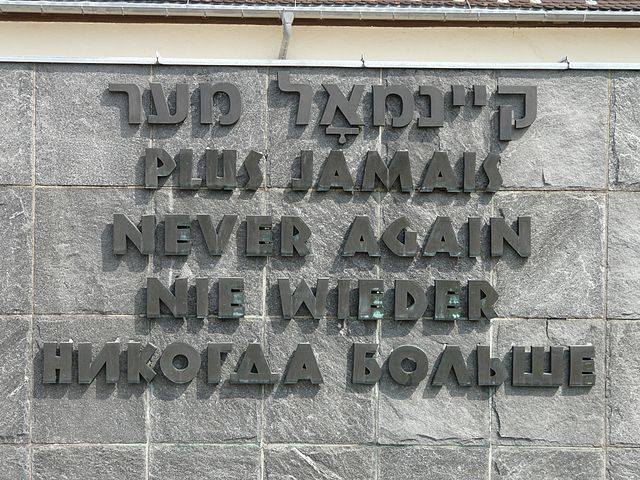
This now leads me to my first central historical observation concerning the ambiguity of the phrase “never again”: While contemporary debates center around conflicting readings as “never again to anyone” or “never again to the Jews”, a distinction between crimes against different groups of victims was not so much even the question in the 1940s and 1950s. If there is a contradiction between universalism and particularism at play here, it is rather only concerning the question if “never again” refers only to Germany and Nazism and the threat of the reemergence of a Nazi Germany or to the world more generally. The resistance in Buchenwald was dominated by communists and social-democrats (some of them Jews), who, however, adhered to the popular front strategy against fascism. So while socialism was declared as their ultimate goal in the “Buchenwald manifesto”, that would also put an end to the possibility of fascism and wars, they were also sincerely calling for a new peaceful and democratic world order as a formula of agreement between all the allied forces (the Trotskyites prisoners in Buchenwald, who rejected the popular front strategy and were convinced—as Trotskyites are today—that only the direct fight against the capitalist state will prevent fascism had their own “never again” in their manifesto, they declared on April 20 1945, after having been freed by the army of a capitalist state: “Nie wieder einen 9. November 1918!”—that means: never again shall the social-democracy collaborate with the capitalist state, as indeed the collaboration of the majority of social-democrats with the military elites and proto-fascist militias to quell revolution in Germany laid a groundwork for the rise of Nazism). However, beyond Buchenwald, in 1945 phrases containing “never again” began to be used by various associations of survivors of the concentration camps and the victims of Nazi persecution and resistance fighters more generally (see the 1945 poster by the French association FNDIRP writing «plus jamais ça»). Henning Fauser („Gegenseitige Hilfe und politische Grabenkämpfe“, p. 199sq.) claims that the slogan has been copied from the French anti-war movement, given the background of the political prisoners in Buchenwald and elsewhere, we have to assume that they had the 1920 German slogan in mind as well. Among German communists and particularly in the official memory politics of East Germany the phrase „Nie wieder Krieg! Nie wieder Faschismus!“ became central (see the photo of a demonstration in Berlin in 1946). While this slogan conveys a message beyond Germany and its allies, at the same time there were also versions of the slogan particularly aiming at Germany. This includes „Niemals ein SS-Europa“ (“never SS Europe”), that has been used in the GDR in the 1950s regarding Buchenwald. While some of the associations of survivors were to a degree dominated by communists and socialists (including the FNDIRP and the VVN) who also understood the “never again” according to their understanding of fascism and anti-fascist strategy, „Nie wieder“ was for example also for the memorialisation in Dachau under the anti-communist auspices of the Bavarian government already in 1950 (cf. the photo of one of the monuments in Dachau). Here we have to remember that the combination of words “never again” was of course also used spontaneously even in the context of the fight against Nazism, independently of the aforementioned organised efforts. Zionist rabbi and civil-rights activist Stephen Wise published a collected volume titled “Never again!” already in 1943 (“what has happened under Hitler shall never occur again”, “we shall never again be complacent in the face of persecution and exploitation of our fellow men”—it was about the crimes of Nazism in its entirety)—certainly unrelated to the Buchenwald resistance group. Further random results give an impression why we cannot say that a certain quote must be the origin of the slogan, even if it refers to what we expect: Dorothy Funn from the National Negro Congress declared in 1945 in front of Congress (demanding the arming of all Americans as a “reserve citizens’ army”): “We Negro Americans can see the necessity of guaranteeing that never again will an aggressor, Fascist nation, steeped in the theories of racial superiority and world conquest, arise to threaten our country and our lives”. The anti-German US organisation “Prevent World-War III” also used “never again” particularly refering to German militarism somehow prominently in a 1951 publication. Even Schwerin von Krosigk, minister of finance during the Nazi regime, used the phrase pathetically in his defense during the Nuremberg trial, distancing himself from Hitler, while at the same time reaffirming his anti-communism (“never again a Hitler. Never again a dictatorship, nor any dictatorship of a class or of a political party” in English translation).
Sometimes it is claimed that after the war there would have been an opposition between a Jewish use of “never again” as refering to the Holocaust and another, somehow more general use. I strongly suspect that this opposition is rather an artifact created by later debates that distort the perception of the use of the phrase back then. Of course Jews used phrases like that to refer to the extermination of Jew. But first of all even Jews outside of the socialist spectrum used the phrase with a much more general meaning, second of all there is so much further variety in the use of the slogan that this opposition is not really helpful. Particularly the slogan “Never again Auschwitz” and the use of “never again” already in the years immediately after the war by the International Auschwitz Committee and at the memorial site in Auschwitz cannot be separated from the Shoa. It is rather with the emergence of a memory culture concerning particularly the Shoa (separated from other Nazi crimes, persecutions, and the war) that “never again”/„nie wieder“ was also more often understood as refering to the Shoa in particular. While of course in a Jewish context the Shoa was always of central importance, and while the singling out of a group of victims was suppressed in the Soviet union, for example even in Western Germany it took decades till a view of the Shoa as a singular crime gained some prominence over other forms of public memorialisation of Nazi persecution and the war.
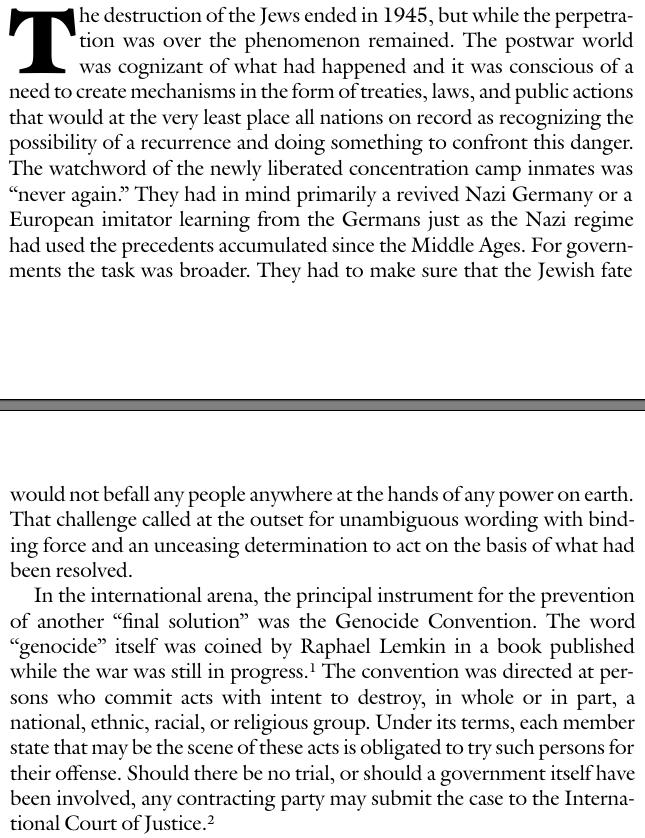
Raul Hilberg, in his groundbreaking 1961 work “The Destruction of the European Jews”, is the earliest prominent voice I know that linked the slogan “never again” particularly to theh crime of genocide. For Hilberg it was no question that “never again” refers to any genocide (not just against the Jews) and he considered the establishment of the UN Convention on the Prevention of Genocide, initiated by Raphael Lemkin, as the legal consequence of the slogan “never again” as it has been used by the survivors of the camps (although he might not have anticipated all the consequences of this convention, including the inflation of the use of the term “genocide” particularly since the ICJ and ICTY rulings concerning the massacre of Srebrenica that have led to the bizarre situation where crimes of a much smaller scale and much less systematic quality than certain other, non-genocidal crimes against humanity are called genocide, allegedly the “crime of crimes”). What is rather peculiar about Hilberg is that he linked the “never again” to the crime of genocide in particular.
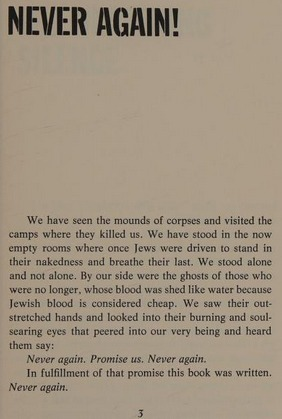
The religious-Zionist, fascist terrorist Meir Kahane published a book titled “Never again” in 1971 and used this slogan more frequently, refering particularly to the Shoa and the killing of Jews more in general (see a page from his book). Whether the claim by the Mosaic magazine that it was Kahane who popularised the slogan at least in the US, I currently cannot judge. For Germany it is certainly not true that he played any relevant role and it is rather the general shift in memory culture that created the association of „Nie wieder” to the Shoa. Within certain parts of the political and cultural spectrum of Germany we also have to mention the influence of Theodor W. Adorno here, who formulated a negative categorical imperative, imposed upon humanity by Hitler, namely „die Forderung, daß Auschwitz nicht noch einmal sei“ (“the demand that Auschwitz shall not occur again”). While particulary later discourses emphasised the unprecedented, singular character of the Shoa that has been established by comparison to other forms of mass and the central role of antisemitism to understand the peculiarity of Nazism and Adorno has been read through this lens, we have to keep in mind that even Adorno used Auschwitz as a synecdoche for crimes beyond the historical place, beyond the Shoa and sometimes even beyond Nazi crimes. In the US context we should also mention the 2003 book by ADL head Abraham Foxman “Never Again? The Threat of the New Anti-Semitism” linking “never again” particularly to the persecution of Jews. However, confronted with the use of “never again” in 9/11 memorialisation, Foxman also clarified that there is certainly no Jewish “copyright” regarding this phrase.
From a historical perspective we have to assert that allegations in the current political discourse that using the phrase “never again” to refer to warnings against fascism in general or crimes committed against other groups than Jews would in itself somehow desecrate the peculiar memory of the Shoa as crime against the Jews are just as unfounded as the claims that the use of “never again” to warn against crimes against Jews that fall short of the Shoa or an accomplished genocide would in itself be a relativisation of the Shoa. Concerning the former allegation just one explanation: One might criticise a lot about the lack of attention that was given to the Shoa by parts of anti-fascist memorialisation, however, the original use of the slogan “never again” by concentration camp survivors was very often precisely linked to a more general demand along the lines of “never again fascism”.
However, I would like to ask everyone that they shall not only think about which crimes and which perpetrators and which victims they refer to when saying “never again” (and better be specific) but also to think about the view on history you convey by using the slogan. Considering the Chinese civil war with further millions of deaths and the colonial wars in Indochina and Indonesia with hundreds of thousands of deaths immediately following 1945, there was already a contradiction in the slogan “never again” in the 1940s, when we take the broad sense in which it was used not just refering to Germany and not just refering to genocide serious (the nationalist writer Walter von Molo already commented cynically in 1923: „Nie wieder Krieg, nie wieder Erdbeben!“—“Never again war, never again earthquakes!”). However, at the time it was more or less clear that “never again” refered to the lasting supression of Nazism as a concrete political force that had committed crimes unprecedented in history and this supression was tied to the hope to create a new world order that would prevent these kinds of crimes in the future (whether the hope was for socialism or for something more moderate along the lines of the ideas of the United Nations). When “never again” is used today without such a concrete hope for the creation of a new global order out of more or less global ruins, just refering to particular contexts, problems arise concerning the view on history conveyed by the slogan. This is particularly the case when it is used not just as an appeal for the future, but also as an assertion concerning the nature of the present: Particularly “never again is now” refering to the October 7th attack used in a global context outside Israel and outside the Jewish communities insinuates that because of the quality of that ethnic massacre against Jews there would be a historic rupture at the current moment, although all the crimes against humanity since 1945, all the ethnic massacres with thousands of deaths that have been perpetrated every other year throughout the last decades (El Geneina, Camp Speicher, numerous occasions in Kivu, bombings of Hazara institutions in Afghanistan, the Yazidi genocide, Srebrenica) were now rupture in the continuity of historical time and while even in the context of the very same Middle-East conflict crimes of a similar quality have been committed earlier like the massacre in Sabra and Shatila in 1982 (preceded by the Karantina and the Damour massacre in 1976, I refer to the article by Tom Würdemann in Zeitgeschichte-online). Although extremely vague and worn out by all the crimes and massacres and reappearances of fascism and aggressive wars throughout the decades, the simpler slogan “never again” at least does not have the problem of singling out the current moment in history. It is only against the backdrop of the understanding of Nazism as a rupture within world history—in contrast for example to a rupture in Israeli history—that “never again” has been used beyond its reference to Germany, as a call to create a new world order, it is against this backdrop that Adorno even conceived of a new negative categorical imperative.
Even in the narrow Hilbergian sense of “never again genocide”, the slogan has clearly lost its original sense in 1994 with the genocide in Rwanda, a systematic killing clearly fitting all definitions and understandings of genocide, it has become hard to make an innocent use of it without obliterating the failure to prevent the genocide in Rwanda. Yet, the genocide in Rwanda was still conceived as a rupture, as the singular occurence of what was not supposed to happen again and so the slogan “never again” was still used with regards to Rwanda. If there is no suggestion for global change to prevent further genocides, then even the specific “never again genocides” just sounds helpless. The lower the bar for which crimes to consider, the more questionable claims of “never again is now” become.
Just concerning the German context, till recently the message of “never again” was at least somehow clear—precisely because in Germany the slogan could build upon the particularist version of the original use that just refered to the threat of Nazi Germany arising anew (and not to other threats around the world). While Germany has participated in wars in Serbia (without UN mandate) and Afghanistan (with UN mandate, but in the end disastrous), at least—unlike other countries since 1945—it has not become fascist and it has not committed genocides, so at least concerning these objectives “never again” preserved its meaning since 1945 to warn against possible reemergences that have not yet happened. However, at the current moment the use of the slogan even in Germany can hardly be separated from its “globalisation” that has made its address either hopelessly general or—if the relation to the reemergence of only particular perpetrators is to be preserved—subject to very conflictual deliberations who on earth the “true heirs of the Nazi Germany” are.
I would be happy about any historical corrections!
Leave a Reply