(German below) Finally Israel seems to put an end to the strategic and moral madness of trying to fight a guerilla merely by scaled-up anti-terror methods, without isolating the insurgents from the civilian population. After 1½ years during which civilians were called to evacuate into ostensible humanitarian zones that were, however, unprotected against infiltration by al-Qassam and al-Quds Brigades and therefore inevitably turned into combat zones and targets for bombardments themselves, supposedly the preparation for an IDP camp in Rafah governorate under IDF control have begun according to yesterday’s report by Kan 11. Civilians entering will be checked to be unarmed. US private security companies shall provide safety for the distribution of food and aid within the tent city that is to be built.
Already at the beginning of this war the Israeli leadership rejected US proposals to follow the model of the liberation of Mosul from the “Islamic State” for the dismantling of Hamas rule in Gaza—in Mosul, too, every civilian that was able to flee the besieged city was allowed into IDP camps. By delaying this step for over a year and not immediately starting to create an actual humanitarian zone for civilians at the latest when the IDF had operational freedom in large parts of Gaza, a million minors got trapped in combat zones, civilians had to evacuate again and again, tens of thousands of lifes were extinguished by the IDF that might have been saved. Due to the combination of a maximalist war aim of dismantling Hamas’ military and governing capacities with a strategy unfit for reaching this goal, at least legally, a strong motivation for the Israeli government to resort to the criminal mean of starvation again was created (the hostage situation also plays a role here of course, but I leave that out in the context of this post). Meanwhile even Donald Trump has protested against the starvation policy.
Early on in the war already, international humanitarian organisations refused to cooperate with Israel an the establishment of the ostensible humanitarian zones (especially in al-Mawasi)—precisely because they did not want to participate in luring civilians into another, only more crowded combat zone, as it had also happened with the so-called “humanitarian zones” in 2009 in Mullaitivu in Sri Lanka during the final military offensive against the Tamil Tigers. The fears of those UN and non-governmental organisations turned out to be justified. At the same time due to its own strategic choice Israel was unable to prevent Hamas from diverting humanitarian goods. Precisely these diversions served as the (false) justification for limiting and finally entirely blocking humanitarian relief for Gaza. At the same time, through repeated attacks at Hamas police forces and Gazan civil defense (which are not automatically combatants and thereby legitimate targets, although some of them certainly also were Qassam members), in line with its goal of dismantling Hamas’ governing capabilities, at many points during the war zones of total lawlessness were created, in which humanitarian organisations could not operate or refused to operate due to their own safety concerns or became targets for looters.
The establishment of the new humanitarian zone under IDF control is good news—I hope the current preparations are not a smoke screen for carrying out only half-way measures and I hope this step will not be sabotaged by other conflicting aims for example of not wanting to become obliged to supply Gazans or of wanting to “encourage” them to leave the country permanently. Even with very tough conditions in an IDP camp, even if we have to fear wide-spread abuse there, the situation can hardly become worse than under the current starvation policy.
DEUTSCH
Endlich beendet Israel seinen strategischen und moralischen Irrsinn, eine Guerilla mit hochskalierten Antiterrormethoden bekämpfen zu wollen, ohne sie von der Zivilbevölkerung zu isolieren. Nachdem über 1½ Jahre Zivilisten in angebliche humanitäre Zonen evakuiert wurden, die allerdings nicht vor Infiltration durch Al-Qassam- und Al-Quds-Brigaden geschützt waren und stets selbst zu Kampfzonen und Ziel des Bombardements wurden, soll jetzt ein IDP-Camp in Rafah errichtet werden – die Vorbereitungen haben bereits begonnen, berichtete gestern Kanal 11. An Checkpoints entlang des „Morag-Korridors“ würden Zivilisten auf Bewaffnung überprüft. US-Sicherheitsfirmen sollen die Versorgung innerhalb des IDP-Camps übernehmen.
Bereits zu Beginn des Krieges hatte die israelische Führung amerikanische Vorschläge, sich bei der Zerschlagung der Hamas an der Befreiung Mosuls – wo diejenigen, denen die Flucht aus der Stadt gelangt, ebenfalls in IDP-Camps untergebracht wurden – zu orientieren, in den Wind geschlagen. Womöglich wurden zehntausende Menschenleben aufgrund der Verzögerung dieses Schrittes sinnlos ausgelöscht. Die Verbindung eines Maximalziels der völligen Entwaffnung und Zerschlagung der Regierungsfähigkeit der Hamas mit einer dazu innerhalb eines legalen Rahmens ungeeigneten Strategie, motivierte die israelische Regierung zugleich den dadurch entstehenden Anschein der Machtlosigkeit durch die verbrecherische Methode des Aushungerns zu kompensieren – gegen die mittlerweile sogar Trump protestiert hat.
Internationale humanitäre Organisationen hatten zuvor eine Zusammenarbeit mit Israel für die Errichtung einer angeblichen humanitäre Zone in Al-Mawasi verweigert – eben weil sie fürchteten, dass sie Zivilisten bloß in eine weitere, noch beengtere Kampfzone locken würden. Ganz ähnlich war dies 2009 in den sogenannten „humanitären Zonen“ von Mullaitivu in Sri Lanka während der finalen Millitäroffensive gegen die Tamil Tigers geschehen. Die Befürchtung bewahrheitete sich auch in Gaza. Gleichzeitig konnte Israel so auch die Veruntreuung von Hilfsgütern durch die Hamas nicht unterbinden. Da Israel zugleich Hamas-Polizeikräfte angriff, aber keine eigene Kontrolle übernahm (um eine Versorgungspflicht zu vermeiden), wurden zudem Zonen völliger Gesetzlosigkeit geschaffen, in denen humanitäre Organisationen teilweise überhaupt nicht operieren konnten bzw. wollten und teilweise zum Ziel von Plünderern wurden.
Die Errichtung der neuen humanitären Zone unter IDF-Kontrolle ist eine gute Nachricht. Ich hoffe sehr, dass der Strategiewechsel nicht auf halber Strecke stehenbleibt, die Vorbereitungen nicht zum Deckmantel für ein weitere Verlängerung der Katastrophe werden. Und ich hoffe, dass nicht konfligierende Ziele – etwa, dass man nicht für die Versorgung von Palästinensern selbst zuständig sein will oder dass man sie dazu „ermuntern“ möchte, das Land zu verlassen – den Strategiewechsel sabotieren werden. Selbst unter sehr harten Bedingungen, selbst wenn wir mit Misshandlungen bereits rechnen müssen, kann die neue humanitäre Zone im Vergleich zur aktuellen Aushungerungspolitik nur eine Verbesserung sein.
What to make of the slogans “never again” and “never again is now” from a historical perspective? Following Omri Boehm’s critique of a contemporary discourse making a simple opposition between a “never again” and a “never again to us” in his canceled speech that was supposed to take place in Buchenwald, I want to consider the ambiguity and overdetermination of the phrase more historically. Unfortunately there is a lot of confusion in the public discourse concerning the origins of the phrase, and while even several books have been written concerning memory politics including the phrase even in its title, very often we do not get a history so much of the phrase itself, but rather only a history of certain selectively considered uses of the phrase in memory politics and memory culture.
First a general remark: The phrase “never again…” (and its equivalent in various languages, nie wieder, jamais plus, nikogda bol’she, keynmol mer nisht…) is not particularly complex, it has often been employed spontaneously, with a pathetic value, in various political contexts. Methodologically it is not permissible to pick some prominent occurence in a saying, in a poem, a booktitle or a movie and then to claim that this must be “the” origin, because it also fits semantically (as it is done in a 2017 article “What Is the Source of the Phrase ‘Never Again’?” that made its way into Wikipedia and into the general toxic discourse). Even if someone is aware of previous uses and uses the combination of words, it might often not be adequate to call it even a quotation.
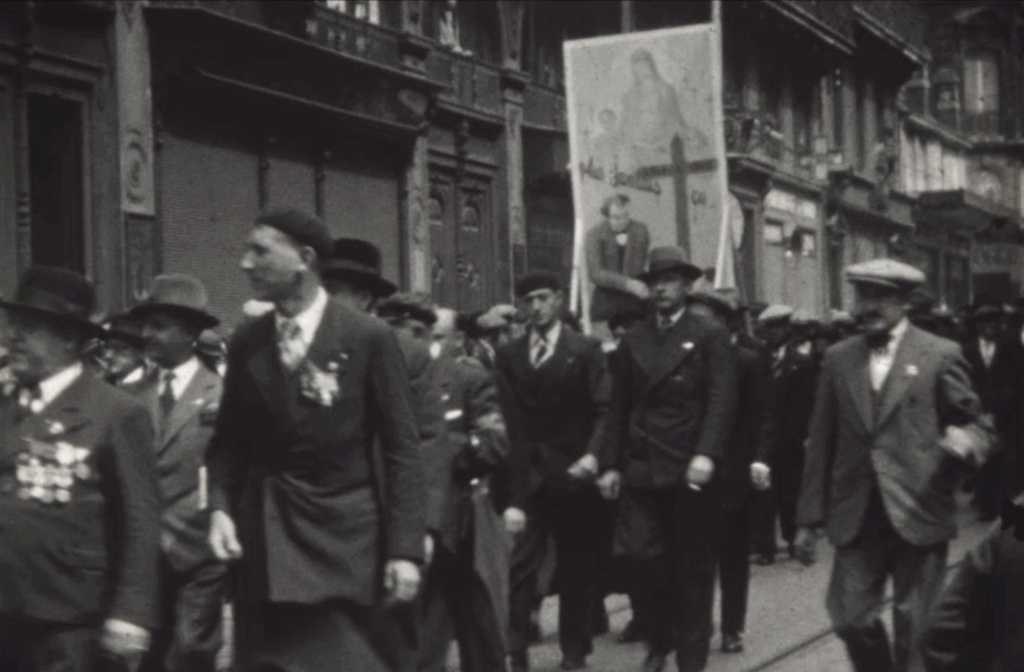
So instead we have to look first on when the phrase has been used in an organised political context, as a deliberate rallying cry. The first such use that I could discern (after trying to disprove my hypothesis with a very insufficient methodology: searching Google Books in various languages—which is however sufficient to disprove many of the claims from public discourse and the literature) is the pacifist, anti-war movement in Germany starting in 1920 when organisations like the „Friedensbund der Kriegsteilnehmer“ and its successors organised campaigns and mass demonstrations, including veterans, supported by communists, social democrats, liberals, and trade unions, under the slogan „Nie wieder Krieg!“ (“never again war”—see the famous Käthe Kollwitz print from 1925). At the latest in the 1930s the slogan «plus jamais ça» (“never again this”, already with an undetermined «ça») was used in the French anti-war movement (see the photo of a “popular front” demonstration of veterans and communists in 1937 using this slogan).
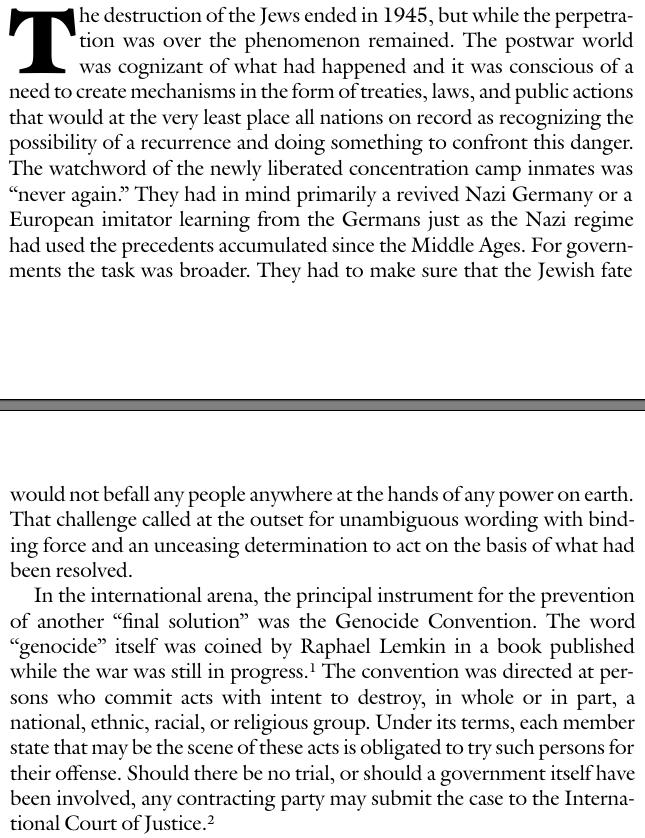
The systematic, organised use of the phrase “never again” regarding the horrors of Nazism, can and usually is traced back to the organised resistance within the Buchenwald concentration camp that played a crucial role for establishing the memorialisation of Nazi crimes after 1945. However, the written version of the “oath of Buchenwald” (calling for the destruction of Nazism and a new “world of freedom and peace”) and the “Buchenwald manifesto” (calling for the destruction of “fascism and militarism” in Germany), their most famous initial declarations, do not explicitly contain the phrase. Nevertheless even the specific phrase „Nie wieder Krieg! Nie wieder Faschismus!“ (“Never again war! Never again fascism!”) has been tied to these declarations at the time of the liberation of Buchenwald, with the VVN publication „Buchenwald: ein Konzentrationslager“ even claiming the phrase would have been part of the “oath of Buchenwald”, which, however, can be explained by memories having been overshadowed by the later ritualised use of the specific phrase. However, also Raul Hilberg in his final 2007 interview traces back the phrase “never again” to hand-made signs used by Buchenwald prisoners at their liberation (the claim is often quoted, but I could not find Hilberg’s primary source anywhere).
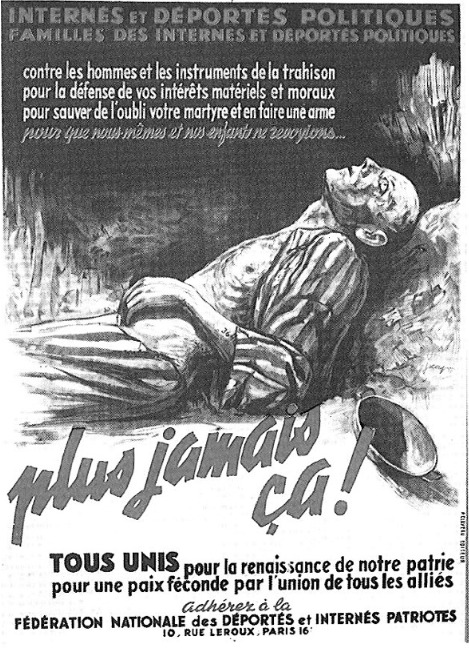
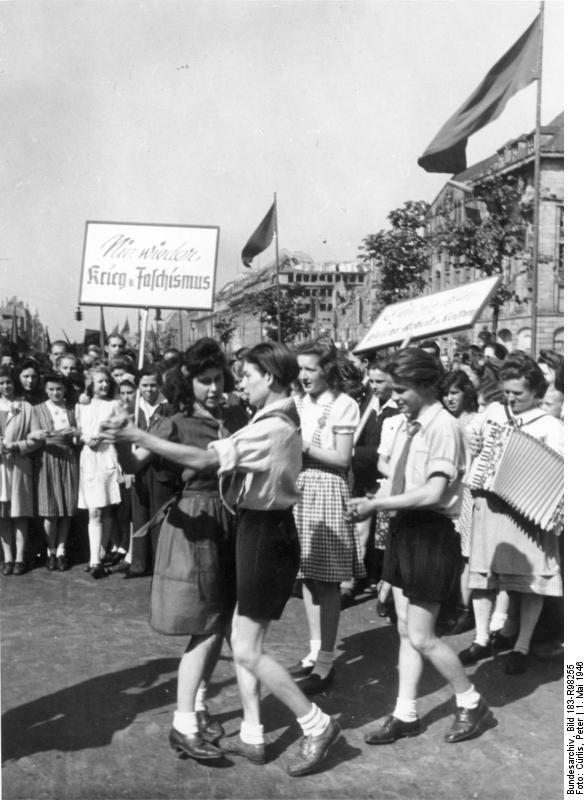
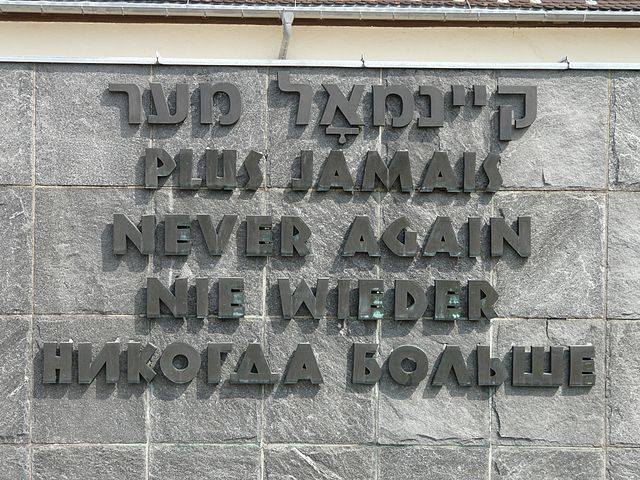
This now leads me to my first central historical observation concerning the ambiguity of the phrase “never again”: While contemporary debates center around conflicting readings as “never again to anyone” or “never again to the Jews”, a distinction between crimes against different groups of victims was not so much even the question in the 1940s and 1950s. If there is a contradiction between universalism and particularism at play here, it is rather only concerning the question if “never again” refers only to Germany and Nazism and the threat of the reemergence of a Nazi Germany or to the world more generally. The resistance in Buchenwald was dominated by communists and social-democrats (some of them Jews), who, however, adhered to the popular front strategy against fascism. So while socialism was declared as their ultimate goal in the “Buchenwald manifesto”, that would also put an end to the possibility of fascism and wars, they were also sincerely calling for a new peaceful and democratic world order as a formula of agreement between all the allied forces (the Trotskyites prisoners in Buchenwald, who rejected the popular front strategy and were convinced—as Trotskyites are today—that only the direct fight against the capitalist state will prevent fascism had their own “never again” in their manifesto, they declared on April 20 1945, after having been freed by the army of a capitalist state: “Nie wieder einen 9. November 1918!”—that means: never again shall the social-democracy collaborate with the capitalist state, as indeed the collaboration of the majority of social-democrats with the military elites and proto-fascist militias to quell revolution in Germany laid a groundwork for the rise of Nazism). However, beyond Buchenwald, in 1945 phrases containing “never again” began to be used by various associations of survivors of the concentration camps and the victims of Nazi persecution and resistance fighters more generally (see the 1945 poster by the French association FNDIRP writing «plus jamais ça»). Henning Fauser („Gegenseitige Hilfe und politische Grabenkämpfe“, p. 199sq.) claims that the slogan has been copied from the French anti-war movement, given the background of the political prisoners in Buchenwald and elsewhere, we have to assume that they had the 1920 German slogan in mind as well. Among German communists and particularly in the official memory politics of East Germany the phrase „Nie wieder Krieg! Nie wieder Faschismus!“ became central (see the photo of a demonstration in Berlin in 1946). While this slogan conveys a message beyond Germany and its allies, at the same time there were also versions of the slogan particularly aiming at Germany. This includes „Niemals ein SS-Europa“ (“never SS Europe”), that has been used in the GDR in the 1950s regarding Buchenwald. While some of the associations of survivors were to a degree dominated by communists and socialists (including the FNDIRP and the VVN) who also understood the “never again” according to their understanding of fascism and anti-fascist strategy, „Nie wieder“ was for example also for the memorialisation in Dachau under the anti-communist auspices of the Bavarian government already in 1950 (cf. the photo of one of the monuments in Dachau). Here we have to remember that the combination of words “never again” was of course also used spontaneously even in the context of the fight against Nazism, independently of the aforementioned organised efforts. Zionist rabbi and civil-rights activist Stephen Wise published a collected volume titled “Never again!” already in 1943 (“what has happened under Hitler shall never occur again”, “we shall never again be complacent in the face of persecution and exploitation of our fellow men”—it was about the crimes of Nazism in its entirety)—certainly unrelated to the Buchenwald resistance group. Further random results give an impression why we cannot say that a certain quote must be the origin of the slogan, even if it refers to what we expect: Dorothy Funn from the National Negro Congress declared in 1945 in front of Congress (demanding the arming of all Americans as a “reserve citizens’ army”): “We Negro Americans can see the necessity of guaranteeing that never again will an aggressor, Fascist nation, steeped in the theories of racial superiority and world conquest, arise to threaten our country and our lives”. The anti-German US organisation “Prevent World-War III” also used “never again” particularly refering to German militarism somehow prominently in a 1951 publication. Even Schwerin von Krosigk, minister of finance during the Nazi regime, used the phrase pathetically in his defense during the Nuremberg trial, distancing himself from Hitler, while at the same time reaffirming his anti-communism (“never again a Hitler. Never again a dictatorship, nor any dictatorship of a class or of a political party” in English translation).
Sometimes it is claimed that after the war there would have been an opposition between a Jewish use of “never again” as refering to the Holocaust and another, somehow more general use. I strongly suspect that this opposition is rather an artifact created by later debates that distort the perception of the use of the phrase back then. Of course Jews used phrases like that to refer to the extermination of Jew. But first of all even Jews outside of the socialist spectrum used the phrase with a much more general meaning, second of all there is so much further variety in the use of the slogan that this opposition is not really helpful. Particularly the slogan “Never again Auschwitz” and the use of “never again” already in the years immediately after the war by the International Auschwitz Committee and at the memorial site in Auschwitz cannot be separated from the Shoa. It is rather with the emergence of a memory culture concerning particularly the Shoa (separated from other Nazi crimes, persecutions, and the war) that “never again”/„nie wieder“ was also more often understood as refering to the Shoa in particular. While of course in a Jewish context the Shoa was always of central importance, and while the singling out of a group of victims was suppressed in the Soviet union, for example even in Western Germany it took decades till a view of the Shoa as a singular crime gained some prominence over other forms of public memorialisation of Nazi persecution and the war.
Raul Hilberg, in his groundbreaking 1961 work “The Destruction of the European Jews”, is the earliest prominent voice I know that linked the slogan “never again” particularly to theh crime of genocide. For Hilberg it was no question that “never again” refers to any genocide (not just against the Jews) and he considered the establishment of the UN Convention on the Prevention of Genocide, initiated by Raphael Lemkin, as the legal consequence of the slogan “never again” as it has been used by the survivors of the camps (although he might not have anticipated all the consequences of this convention, including the inflation of the use of the term “genocide” particularly since the ICJ and ICTY rulings concerning the massacre of Srebrenica that have led to the bizarre situation where crimes of a much smaller scale and much less systematic quality than certain other, non-genocidal crimes against humanity are called genocide, allegedly the “crime of crimes”). What is rather peculiar about Hilberg is that he linked the “never again” to the crime of genocide in particular.
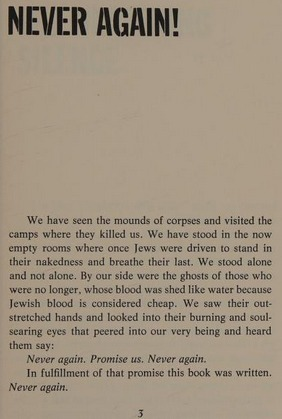
The religious-Zionist, fascist terrorist Meir Kahane published a book titled “Never again” in 1971 and used this slogan more frequently, refering particularly to the Shoa and the killing of Jews more in general (see a page from his book). Whether the claim by the Mosaic magazine that it was Kahane who popularised the slogan at least in the US, I currently cannot judge. For Germany it is certainly not true that he played any relevant role and it is rather the general shift in memory culture that created the association of „Nie wieder” to the Shoa. Within certain parts of the political and cultural spectrum of Germany we also have to mention the influence of Theodor W. Adorno here, who formulated a negative categorical imperative, imposed upon humanity by Hitler, namely „die Forderung, daß Auschwitz nicht noch einmal sei“ (“the demand that Auschwitz shall not occur again”). While particulary later discourses emphasised the unprecedented, singular character of the Shoa that has been established by comparison to other forms of mass and the central role of antisemitism to understand the peculiarity of Nazism and Adorno has been read through this lens, we have to keep in mind that even Adorno used Auschwitz as a synecdoche for crimes beyond the historical place, beyond the Shoa and sometimes even beyond Nazi crimes. In the US context we should also mention the 2003 book by ADL head Abraham Foxman “Never Again? The Threat of the New Anti-Semitism” linking “never again” particularly to the persecution of Jews. However, confronted with the use of “never again” in 9/11 memorialisation, Foxman also clarified that there is certainly no Jewish “copyright” regarding this phrase.
From a historical perspective we have to assert that allegations in the current political discourse that using the phrase “never again” to refer to warnings against fascism in general or crimes committed against other groups than Jews would in itself somehow desecrate the peculiar memory of the Shoa as crime against the Jews are just as unfounded as the claims that the use of “never again” to warn against crimes against Jews that fall short of the Shoa or an accomplished genocide would in itself be a relativisation of the Shoa. Concerning the former allegation just one explanation: One might criticise a lot about the lack of attention that was given to the Shoa by parts of anti-fascist memorialisation, however, the original use of the slogan “never again” by concentration camp survivors was very often precisely linked to a more general demand along the lines of “never again fascism”.
However, I would like to ask everyone that they shall not only think about which crimes and which perpetrators and which victims they refer to when saying “never again” (and better be specific) but also to think about the view on history you convey by using the slogan. Considering the Chinese civil war with further millions of deaths and the colonial wars in Indochina and Indonesia with hundreds of thousands of deaths immediately following 1945, there was already a contradiction in the slogan “never again” in the 1940s, when we take the broad sense in which it was used not just refering to Germany and not just refering to genocide serious (the nationalist writer Walter von Molo already commented cynically in 1923: „Nie wieder Krieg, nie wieder Erdbeben!“—“Never again war, never again earthquakes!”). However, at the time it was more or less clear that “never again” refered to the lasting supression of Nazism as a concrete political force that had committed crimes unprecedented in history and this supression was tied to the hope to create a new world order that would prevent these kinds of crimes in the future (whether the hope was for socialism or for something more moderate along the lines of the ideas of the United Nations). When “never again” is used today without such a concrete hope for the creation of a new global order out of more or less global ruins, just refering to particular contexts, problems arise concerning the view on history conveyed by the slogan. This is particularly the case when it is used not just as an appeal for the future, but also as an assertion concerning the nature of the present: Particularly “never again is now” refering to the October 7th attack used in a global context outside Israel and outside the Jewish communities insinuates that because of the quality of that ethnic massacre against Jews there would be a historic rupture at the current moment, although all the crimes against humanity since 1945, all the ethnic massacres with thousands of deaths that have been perpetrated every other year throughout the last decades (El Geneina, Camp Speicher, numerous occasions in Kivu, bombings of Hazara institutions in Afghanistan, the Yazidi genocide, Srebrenica) were now rupture in the continuity of historical time and while even in the context of the very same Middle-East conflict crimes of a similar quality have been committed earlier like the massacre in Sabra and Shatila in 1982 (preceded by the Karantina and the Damour massacre in 1976, I refer to the article by Tom Würdemann in Zeitgeschichte-online). Although extremely vague and worn out by all the crimes and massacres and reappearances of fascism and aggressive wars throughout the decades, the simpler slogan “never again” at least does not have the problem of singling out the current moment in history. It is only against the backdrop of the understanding of Nazism as a rupture within world history—in contrast for example to a rupture in Israeli history—that “never again” has been used beyond its reference to Germany, as a call to create a new world order, it is against this backdrop that Adorno even conceived of a new negative categorical imperative.
Even in the narrow Hilbergian sense of “never again genocide”, the slogan has clearly lost its original sense in 1994 with the genocide in Rwanda, a systematic killing clearly fitting all definitions and understandings of genocide, it has become hard to make an innocent use of it without obliterating the failure to prevent the genocide in Rwanda. Yet, the genocide in Rwanda was still conceived as a rupture, as the singular occurence of what was not supposed to happen again and so the slogan “never again” was still used with regards to Rwanda. If there is no suggestion for global change to prevent further genocides, then even the specific “never again genocides” just sounds helpless. The lower the bar for which crimes to consider, the more questionable claims of “never again is now” become.
Just concerning the German context, till recently the message of “never again” was at least somehow clear—precisely because in Germany the slogan could build upon the particularist version of the original use that just refered to the threat of Nazi Germany arising anew (and not to other threats around the world). While Germany has participated in wars in Serbia (without UN mandate) and Afghanistan (with UN mandate, but in the end disastrous), at least—unlike other countries since 1945—it has not become fascist and it has not committed genocides, so at least concerning these objectives “never again” preserved its meaning since 1945 to warn against possible reemergences that have not yet happened. However, at the current moment the use of the slogan even in Germany can hardly be separated from its “globalisation” that has made its address either hopelessly general or—if the relation to the reemergence of only particular perpetrators is to be preserved—subject to very conflictual deliberations who on earth the “true heirs of the Nazi Germany” are.
I would be happy about any historical corrections!
„Angesichts des Holocaust, den die Geiseln in den Händen der Palästinenser durchmachen, ist JEDER Tag, der ihre Freilassung verzögert, ein Verbrechen, das nicht gesühnt werden kann.“
Angesichts des in Deutschland besonders starken Diskursphänomens, falsche Holocaustvergleiche politisch und moralisch zu ächten, erstaunt es dann doch, wie man ausgerechnet vom Antideutschen nach dem 7. Oktober zum regelmäßigen Holocaustrelativierer wird. Gut, versuchen wir trotzdem, den hier vorliegenden intellektuellen, politischen und moralischen Bankrott nachzuvollziehen: Hintergrund des Ganzen ist ein vulgärintentionalistisches Verständnis der Shoah, des Versuchs der „Endlösung der Judenfrage“ durch das nationalsozialistische Deutschland. Vokabular vom „Vernichtungsantisemitismus“ und dem „Tätervolk“, das zu Zeiten der Goldhagendebatte einige Popularität erlangte. Da in Deutschland sich einige rechte Geschichtsrevisionisten etc. aus den falschen Gründen auf Goldhagen stürzten, konnten in der polemischen Auseinandersetzung solche Goldhagen’schen Begriffe auch in der Linken verfangen. Die Erkenntnisse der akademischen Geschichtswissenschaft etwa über die Rolle der Strukturen des NS-Staates und der Ausweitung des Krieges für den Schritt zur „Endlösung“ wie auch für die anderen Vernichtungspolitiken werden von entsprechenden Vulgärintentionalisten – die allein auf den „Vernichtungsantisemitismus“ als Ideologie der Täter abzielen – ebenso mit dem Bade ausgeschüttet wie etwa sozialpsychologische und psychoanalytische Untersuchungen der Tätergruppen und eben auch die Dialektik der Aufklärung und an sie anschließende Ansätze, welche das nationalsozialistische Projekt der Vernichtung der Juden nicht als bloßen ideologischen Sonderweg, sondern gerade im größeren Zusammenhang der kapitalistischen Zivilisation und ausgehend von Deutschlands Stellung als einer der höchst entwickelten imperialistischen Mächte zu verstehen suchten.
Innerhalb eines solchen gänzlich idealistischen Geschichtsbilds können die Palästinenser dann mittels Ideologemvergleichs und ideologie-genealogischer Forschung (Import europäischer antisemitischer Ideologie durch Husseini und seine Vorgänger) als Ersatztätervolk identifiziert werden. Nachdem für die deutsche faschistische Rechte mittlerweile das Dresden-Gedenken keine derartig zentrale Rolle für die Mobilisierung mehr spielt, suchen sich auch die aus den Antifa-Gegenmobilisierungen gewonnenen Slogans und Formeln (“Bomber Harris, do it again”) – die schon im Dresden-Kontext zwar polemisch die Richtigen getroffen haben, aber kaum auf einer Analyse der widersprüchlichen Strategien der Alliierten im Hinblick auf die deutsche Zivilbevölkerung beruhten – die Palästinenser als Ersatzobjekt. Die Übernahme von Dresden-Slogans für Palästina ersetzt historische Kenntnis und Analyse des Nahostkonflikts und erspart auch eine Beschäftigung mit den Lehren, die im Völkerrecht nach dem Zweiten Weltkrieg gerade aus den Erfahrungen mit dem Nationalsozialismus und dem Fehlen ausreichender Rechtsnormen für den Luftkrieg gezogen worden sind.
Da allein das vermeintlich distinkte Ideologem – außerhalb jeder Geschichte und konkreter Gesellschaftsanalyse – nun zur Identifikation eines Verbrechens mit der Shoah ausreicht, ist es nur konsequent, dass sich der zitierte Postantideutsche nicht wie so viele andere damit begnügt, das Hamas-Massaker vom 7. Oktober 2023 mit dem geschichtsvergessenen Slogan „Nie wieder ist jetzt“ völlig außerhalb der Reihe anderer ethnischer Massaker etwas größerer oder etwas kleinerer Größenordnung (ob etwa in El Geneina, Camp Speicher, Kivu, Srebrenica oder Sabra und Schatila) zu setzen und zu exzeptionalisieren, sondern gleich eine Massengeiselnahme – wo sie eben nicht in Iran, Libanon, Russland, Mexiko oder Nigeria stattfindet –, ja jeden einzelnen Tag der Geiselnahme mit dem Holocaust gleichzusetzen. Wer hätte das gedacht, dass gerade von antideutscher Seite mit 25 Jahren Verzögerung der Joschka Fischer wiederholt wird?
This morning the Israeli parliament adopted a law to take away the veto power of the Supreme Court judges concerning the appointment of new judges. Unfortunately there is a lot of confusion, both concerning the content of the new law and concerning its impact on democracy, also in comparison to rules for appointing judges in other countries around the world.
Given the current events in Turkey where last week judges have been willing to back the move of arresting the expected opposition candidate for the next presidential elections and to remove him from office as mayor of İstanbul, partly based on completely bogus charges of terrorism support, we might use this comparison to illustrate the threats to democracy in Israel related to the independence of the judiciary. The political system in Israel has some crucial similarities to Turkey: We have a centralised State without any kind of federalism and a unicameral parliament without any checks and balances derived from regional authorities or an upper house. Until the constitutional reform from 2017/18 (introducing a Presidential system) in Turkey the majority of the members of the Supreme Board of Judges and Prosecutors, responsible for the appointment and oversight of judges, was selected by the judges themselves. In 2010 an AKP led constitution reform even limited the influence of the minister of justice on the board, strengthening the independence of the judiciary. Following the coup attempt in 2016 related to the Gülen organisation the board already supervised a purge within the judiciary removing people from office suspected of affiliations with Gülen. However, the the relationship between the executive and the judiciary was completely changed in 2018 based on the (likely rigged) results of the 2017 constitutional referendum: From now on the President and the government have been able to determine the majority within the Council of Judges and Prosecutors. Based on the different appointment rules for the Constitutional Court and the other top courts of Turkey and based on this majority, the government has since had the power to determine on its own who is appointed as a new judge in the top courts.
Till 2017 the situation in Turkey had actually been very similar to Israel given the power of the judges and attorneys to effectively appoint the top judges potentially even against the government. While this situation is rather rare in democratic countries (it is also similar to Greece), with most countries allowing the elected legislature and the executive to determine appointments of top judges in the last instance, other countries have a more intricate system of checks and balances, think of the Senate representing the States, which has to confirm nominations of Supreme Court justices in the US, or think of formal supermajority rules for the appointment of judges at the Constitutional Court in Germany. An Israeli right-wing think tank, the Kohelet Policy Forum, criticised the old Israeli system for appointing judges based on this comparison to Turkey: Look, their is little trust in democracy in Turkey despite the independence of the judiciary when selecting judges. However, the study the by Kohelet Policy Forum in fact completely ignores the power given to the government by the 2018 constitutional reform.
In fact the reform for the appointment of judges (not just the judges at the Supreme Court) planned by Netanyahu’s government in 2023 and finally stopped based on popular resistance, mass protests, strikes (even within the military), and international criticism was very similar to the 2018 reform in Turkey considering the appointment of judges. The proposed draft law, if enacted, would have allowed the government to determine the majority in the Judicial Selection Committee and to use this simple majority even to appoint new Supreme Court justices. Another commonality that might aggravate the risks for democracy stemming from a very much government-controlled judiciary lies in the fact that like in Turkey in Israel, too, certain kinds of bogus allegations of supporting terrorism are very likely to receive wide support from State institutions and the population (see the suspension of Knesset member Ofer Cassif—the persecution of HDP politicians in Turkey on the basis of such allegations has of course been severe for years, but now the more centrist opposition gets targeted too).
The law enacted this morning, however, is a watered down version of the 2023 draft. Most crucially the Supreme Court justices will no longer be able to veto the appointments of their new colleagues. However, a vote from a committee member selected by the opposition in the Knesset will be needed to appoint a new Supreme Court justice such that the government coalition will not have total control over the appointments once the law becomes effective (with the beginning of the next legislature). Instead of a 7/9 supermajority, only a 5/9 majority vote will be needed for the appointments. This is supposed to solve the current deadlock where vacant seats of judges do not get filled. Because of the rule requiring one vote from an opposition-appointed committee member, and also requiring one vote from a judge for decisions besides the appointments of Supreme Court justices, the new law will not give the government immediate complete control over the selection of justices. However, given the fractured nature of the Israeli opposition we will have to fear that a future Likud-led government would still be able to push through with very questionable personnel decisions for the courts. Given how the pro-Bibi Israeli right considers the judiciary as their political enemy, as a “left-wing deep-State” (copying MAGA rhetorics, which in turn also copy some of Erdoǧan’s rhetorics, with the crucial difference that “deep state” structures capable e.g. of carrying out military coups have been more of a reality, a real threat to democracy and not just a phantasy in Turkey), and how they show contempt for basic principles of the rule of law (like the principle of reasonableness of executive actions, excluding arbitrariness), we have to fear a further erosion of the Supreme Court’s capability of being a check on government actions.
Opposition leaders announced that if they will win the next election they will immediately reverse the reform and strengthen the independence of the judiciary again.
Israel, controlling all borders, is now stopping all humanitarian relief from entering the Gaza strip. This constitutes a grave breach of international humanitarian law as well as of Israel’s own Manual on the Rules of Warfare, if this blockade continues it will be a crime against humanity. The obligation to allow the passage of humanitarian relief is completely unrelated to the obligation of Hamas to unconditionally release all civilian hostages. Using the entire Gazan population of over two million people as a token to make the enemy comply with one’s demand of releasing civilian hostages and captured IDF soldiers, is in no way better than the hostage taking in the first case, morally speaking the logic is the same: turning civilian lifes into mere means for your warfare. By not even trying to give any kind of security justification for restrictions on humanitarian relief Netanyahu and Katz once more openly proclaim their contempt for international humanitarian law as well as the lifes of Gazan civilians. Due to its disastrous military strategy Israel has been unable to remove Hamas from power. Emboldened by Trump’s contempt for international law, now the Israeli government once again assumes the warcriminal strongman pose, to cover up its own failures in front of the Israel population. Ordinary Gazans must not pay the price for Israel’s failure during this war.
Concerning the legal details, I have already comprehensively explained everything concerning the illegality of this kind of action at the beginning of this war.
Gestern wurde zum ersten Mal in seinem 42-jährigen Bestehen der Educational Bookshop (zwei Geschäfte) in Ostjerusalem von der Polizei durchsucht, die beiden Betreiber wurden festgenommen. Offenbar wusste die Polizei selbst nicht, wonach sie eigentlich suchen sollte. Mit Google Translate bewaffnet pickte sie ca. 100 verdächtig wirkende Bücher (Stichwörter, palästinensische Fahnen) aus den Regalen. Alle bis auf acht wurden zwischenzeitig zurückgegeben. Der Haftrichter lehnte den Antrag der Polizei ab, die beiden Betreiber für acht Tage in Haft zu behalten, um in dieser Zeit die Bücher durchlesen und auf Volksverhetzung überprüfen zu können. Da die Polizei auch gar keine Befugnis hat, eigenmächtig eine Verfolgung wegen Volksverhetzung einzuleiten, wurde den Besitzern bloß die vage Störung der öffentlichen Ordnung vorgeworfen. Das schwerwiegendste Beweisstück, das am Ende vorgelegt wurde, war ein englischsprachiges Ausmalbuch (!) aus Südafrika mit dem Titel “From the River to the Sea” – ausgehend von dem, was ich vom Inhalt gesehen habe, handelt es sich eben um einigen palästinensisch-befreiungsnationalistischen Kitsch. Das Buch hatte zuvor den Zoll passiert, der verbotene Bücher herausfischt.
Der Educational Bookshop bedient vor allem eine internationale Kundschaft sowie jüdische Israelis, die Arabisch lernen möchten, zudem wird die Nachbarschaft mit Schulbedarf versorgt. Ein Großteil der verkauften Bücher sind englischsprachige Bücher, die mehr oder weniger mit dem Israeli-Palästina-Konflikt zu tun haben – zumeist eben aus einer palästinensischen oder pro-palästinensischen Perspektive. Sprich Pappé, Segev und Khalidi werden verkauft, aber eben eher nicht Benny Morris. Palästinensisch-nationalistische Klassiker wie Kanafani, Darwish und Said stehen natürlich bereit. Der eine Betreiber Mahmoud Mouna hat jüngst eine Sammlung von Stimmen aus Gaza herausgebracht, in der Kritik an Hamas-Verbrechen sicher nicht im Vordergrund steht. Man findet aber auch Einführungen zu al-Ghazali und Ibn Arabi ebenso wie die Memoiren von Angela Merkel im Sortiment. Abgesehen davon, dass die Polizeiaktion einen schwerwiegenden Angriff auf politische Freiheitsrechte darstellt (soll die Zeit zurückgedreht werden zur militärischen Zensur arabischer Communities vor 1967 bzw. in der West Bank vor dem Oslo-Abkommen?), war es auch ausgesprochen dumm, gerade einen Laden anzugreifen, der z.B. auch von Heerscharen ausländischer Diplomaten etc. frequentiert wird. Offenbar geht es auch ohne Ben Gvir mit einigen in der israelischen Polizei völlig durch.
Does this sound absurd to you? After I have again been repeatedly exposed to Amjad Taha’s vitriolic content again during the last days, after an Israeli personally sent me this on particular video-clip by him that went viral, being scandalised by it how Palestine supporters ignore the suffering of the population in Sudan, I now have to write something about it.
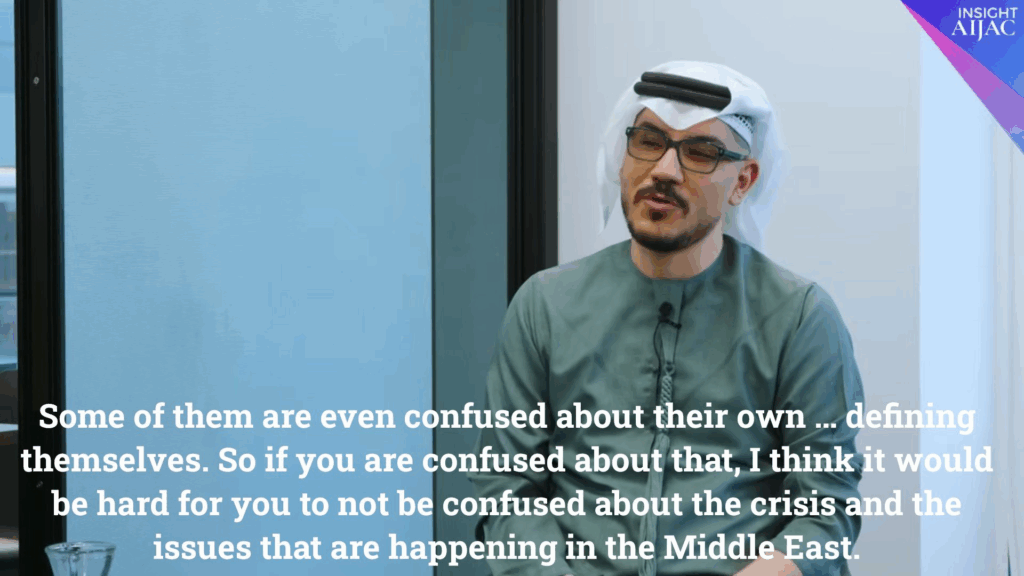
Last November the Bahraini-Emirati-British “analyst”/social media personality Amjad Taha was interviewed by the Australia Israel & Jewish Affairs Council (an Australian analogue of AIPAC). During this interview Taha (rightly) points at the grossly disproportional attention given to the Israeli-Palestinian conflict amongst all conflicts in the world by western student activists. Yet he is not ashamed to use this opportunity to insert most vile propaganda for Emirati interests, for which he apparently wants to get support from the pro-Israel audience: Since the Sudan war between the Sudanese army and the Rapid Support Forces erupted in 2023, the United Arab Emirates have been the main backer of the RSF, supplying them with arms, ignoring the UN arms embargo on Sudan. The Rapid Support Forces are the successor organisation of those paramilitaries that were already executing the crimes against humanity / genocidal atrocities against minorities during the Darfur war, and the RSF have likewise massacred tens of thousand civilians from non-Arab, non-Muslim and Black communities in Darfur, in the west of the country, during the current war, most notably in the El Geneina massacre in summer 2023. The Sudanese army on the other hand, after for a long time not having been able to stabilise front lines and stop the RSF from taking over more and more territory (including the capital Khartoum), has been largely relying on its advantage in air power, disproportionately and indiscriminately killing probably tens of thousand of civilians together with RSF soldiers. While Taha is of course giving a carte blanche for however disproportionate airstrikes on Gaza by Israel, he now presents the war in Sudan as a tale of evil from just one side, the Sudanese army bombing 80.000 civilians to death, allegedly in a plot by the Muslim Brotherhood allegedly controlling the Sudanese army—in reality Egyptian President Sisi, not precisely a friend of the Muslim Brotherhood, is the most important ally of Burhan’s military regime in Sudan, with Egypt probably having stepped up his direct support for the Sudanese army countering the Emirati support for the RSF, with both the Emirati and the Egyptian support fueling the conflict and leading to more and more intense fighting and more and more civilian suffering. Now allegedly the pro-Palestinian protesters in the west do not know and do not care about these victims. If “caring about Sudan”, however, means taking Taha’s position, then I clearly prefer people (whether they are “pro-Palestine” or “pro-Israel”) just admitting their ignorance concerning the suffering of millions of civilians in Iran, the crushing of the democratic and women’s revolution through the military and the RSF and simply remaining silent and not taking sides.
Amjad Taha is not an “analyst”, he is a vile propagandist for Emirati interests, who sells his very cheap takes on the Israeli-Palestinian conflict while wearing some Arab garment.
The AIJAC apparently did not care. The host did not pose any critical question to Taha during the interview. Even worse, AIJAC even selected precisely the passage from the interview where Taha advertises his RSF friends with their crimes against humanity to create a small clip about “bias against Israel” that went viral and has been watched tens of thousand of times by Israelis and Israel supporters.
I have already contacted the Australia Israel & Jewish Affairs Council more than two months ago right after this interview with Taha came out, but never received a response to my very polite, non-confrontational, carefully written e-mail. The AIJAC – Australia/Israel & Jewish Affairs Council even published an article on their website titled “West ignores the Sudan war at its peril” pointing out the grave crimes on both sides of the war in Sudan, including the ethnic massacres committed by the RSF. But apparently nothing matters, if your cheap “pro-Israel” (but in reality pro-RSF) clip goes viral, pleasing the self-righteousness of its audience. It is horriffying how support for Israel’s self-defence is turned into such a nihilistic endeavour, and unfortunately with Trump’s outright attacks on any kind of rules-based international order we will see more of this kind of vile opportunism, not just in the propaganda, but also in deeds, and few will care.
(Just to mention it, Taha also makes an anti-LGBTQ remark claiming that people who are not sure about their own (probably sexual and gender) identity are thereby unable to make judgements on the Israeli-Palestinian conflict)
Manchmal ist es wirklich zum Fremdschämen, wie sich Wissenschaftler_innen in Empörung verlieren können, ohne auch nur zu versuchen irgendetwas zu verstehen oder zu erklären.
Ja, es ist politisch motiviert, dass Südafrika Israel vor den IGH gebracht hat. Und? Ist immer so im Recht, dass das politisch, ideologisch, sozial, ökonomisch und sonstwie motiviert ist, warum manche Taten zu Justizfällen werden und manche nicht. 90% (so jedenfalls eine populäre Zahl) der Vergewaltigungen werden nicht angezeigt, vor allem nicht die durch Partner. Frauen in ökonomisch prekären Situationen oder mit schlechten Polizeierfahrungen bringen Vergewaltigungen seltener zur Anzeige. Man könnte von Diskriminierung gegen die häufiger angezeigten Vergewaltiger im Park sprechen. Womöglich ebenso Diskriminierung gegen männliche Vergewaltiger, weil vmtl. die paar wenigen Vergewaltigerinnen allerdings auch seltener angezeigt werden. Das alles sind absurde und geschmacklose Überlegungen, die nicht weiter helfen zu entscheiden, ob der jeweilige Vergewaltigungsverdächtige tatsächlich schuldig ist oder nicht. Bloß warum diskutiert Illouz nicht an einer einzigen Stelle die einzig rechtlich maßgebliche Frage, nämlich die nach der Rolle genozidaler Absicht in Israels Kriegsführung? Dann könnte man sehen, dass sich sowohl legale als auch verbrecherische und moralisch verwerfliche, aber rechtlich im Graubereich befindliche Aspekte der israelischen Kriegsführung auch ohne genozidale Absichten gut erklären lassen und das genozidale Geschrei eben nur eine Nebenrolle spielt. Stattdessen verliert sich Illouz in eine lange Kette rhetorischer Fragen, die nichts bzgl. des Genozidvorwurfs klären, aber irgendwelchen Bias gegen Israel nachweisen sollen, wobei meist nicht ganz klar ist, bei wem der Bias jetzt liegt – in Institutionen, in bestimmten einzelnen Akteuren, in der Weltgesellschaft. Da hier wild hin und hergesprungen wird, wird zum Verständnis von antiisraelischem Bias auch kein Beitrag geleistet.
Ich gehe nur auf ein paar weitere Fragen, die Illouz aufwirft, ein:
„Ist es ein Genozid oder ein Krieg?“
Falsche Dichotomie, rechtlich belanglos.
Warum wurde Assad nicht wegen Genozid angezeigt? Ja, weil sich sein Massakrieren offensichtlich nicht gegen eine ethnische Gruppe richtete. Fall erledigt. Was soll man sagen. Es gibt eine Genozidkonvention, aber keine Verbrechen-gegen-die-Menscheit-Konvention, die in Fällen ohne ethnisch definierter Opfergruppe ähnliche Prozesse ermöglichen würde. Und der IStGH hat keine Jurisdiktion in Syrien, hätte Illouz wissen können.
Warum hat Südafrika nicht Myanmar vor den IGH gebracht? Ja weil das Gambia schon getan hat. Warum haben Deutschland, Brasilien, Aserbaidschan oder Marokko nicht Myanmar vor den IGH gebracht? Wegen Rohingya-Feindlichkeit?
Warum war man in den UN, in den USA und anderswo so zögerlich, den Genozid in Ruanda als solchen zu benennen? Der Grund ist ein ganz einfacher: Damals waren manche Rechtsberater der USA der Meinung, dass sich aus dem Vorliegen eines Genozids eine Interventionspflicht ergeben könnte. Diese Meinung haben mittlerweile alle aufgegeben. Seitdem redet es sich in der internationalen Politik viel unbeschwerter von Genoziden in Darfur, Xinjiang oder sonstwo. Es folgt ja nicht mehr viel daraus.
Warum hat sich am 10. Oktober der palästinensische UN-Gesandte beschwert und von einem Genozid gesprochen? Ja komisch aber auch, wenn am 9. Oktober Katz und Gallant offen und glasklar ein Verbrechen gegen die Menschheit (eben Wasserentzug für die gesamte Bevölkerung als Kriegswaffe) ankündigen und zu dessen Umsetzung ansetzen (ob die Tat vollendet wurde, lässt sich streiten, ob ein durchgehaltener vollständiger Wasserentzug ein Genozid oder „nur“ ein krasses Verbrechen gegen die Menschheit gewesen wäre, ist mir relativ egal). Der konkrete Anlass der Äußerung des UN-Gesandten wird von Illouz nicht einmal erwähnt. Statt diesen Anlass konkret zu diskutieren, verurteilt sie ihn als irgendwie pietätslos, weil das Massaker erst drei Tage her war.
Warum hat Khan Deif und nicht Mohammed Sinwar angeklagt? Ja weil Deif nunmal der Kommandant war, was soll man dazu sagen.
Warum zeigt Khan Deif nicht dafür an, dass die Hamas keine Zivilisten in militärischen Tunneln unterbringt? Sie soll mir mal den Artikel im Rom-Statut zeigen, der das als Kriegsverbrechen definiert.
„Israel hat zahlreiche Kriegsverbrechen begangen.“
Bingo, warum beschwert sie sich dann über Khan, der Israel gar keinen Genozid vorwirft? Und warum kommt der Begriff des Verbrechens gegen die Menschheit in Illouz’ Artikel nicht einmal vor?
Darüber, welche Rolle der Antisemitismus nun beim ganzen absurden Fokus von UN-Institutionen auf Israel eigentlich spielt – und er spielt hier durch die Geschichte hinweg sicher eine wichtige Rolle –, haben wir am Ende des Artikels leider nichts gelernt.
Benny Morris bezeichnete 2004, während der zweiten Intifada, in einem Interview das palästinensische Volk als ein wildes Tier, das für eine Weile weggesperrt werden müsse. Moralisierende Studierende an der Universität Leipzig erzwangen jetzt mit Verweis auf die rassistische Sprache dieser Aussage die Absage eines Vortrags des bedeutenden Historikers des Krieges von 1947–1949 und der Flucht und Vertreibung der Palästinenser. Rashid Khalidi, der einflussreichste gegenwärtige Historiker des Nahostkonflikts, der diesen als Konflikt zwischen einer siedlerkolonialen Bewegung und einer kolonisierten Bevölkerung beschreibt, nun bezeichnet das palästinensische Volk und mitsamt seiner maßgeblichen politischen Akteure in einem jüngsten Interview als einen Dampfkochtopf, der aufgrund eines Überdrucks regelmäßig Menschen massakriert. Da frage ich mich doch: Ist die Bezeichnung als Dampfkochtopf eigentlich so viel schmeichelhafter als die Bezeichnung als wildgewordenes Tier, die dem betreffenden Volk vielleicht doch noch eine gewisse Würde belässt? Was sagt eine solche Bezeichnung eigentlich über den Blick auf das eigene Volk aus? Und warum sind manche anderen unterdrückten und vefolgten Völker eigentlich weder Dampfkochtöpfe noch wildgewordene Tiere?
Ansonsten trotzdem sehr lesenswertes Interview mit Haaretz, das mit vielen einseitigen Erklärungen des Scheiterns des Oslo-Prozesses aufräumt und auf von Anfang an in ihm angelegte Mängel hinweist. → https://archive.is/XBziG ←
I’m disappointed by Adam Kirsch’s essay “On Settler Colonialism”. Without in-depth knowledge concerning all the debates concerning theories of colonialism in historical scholarship, I first learned quite some things from the essay. I had usually taken the term “settler colonialism” to be a rather colloquial way to refer to colonies with large shifts of population structures due to settlers in general. Adam Kirsch tries to lay out the particular theoretical implications associated with the term in so called studies of settler colonialism as they have been shaped by anthropologist Patrick Wolfe during the last 25 years. Adam Kirsch points at the crucial difference to the earlier definition of the term by Kenneth Good, which refered to economies shaped by the exploitation of indigenous workers by settler populations like in South Africa, Algeria, and Rhodesia. The use of the concept by Wolfe shifted attention to the USA, Australia, New Zealand, and Israel and moved the concept away from an economic definition towards a focus on what Wolfe and others call elimination, understood as a persisting structure shaping settler colonial societies. Kirsch convincingly points at severe problems within the field departing from this approach: For example the inflationary use of the terms genocide and genocidal to refer to a conflated spectrum from systematic mass killings to all kinds of expulsions, population shifts and cultural or political assimilation, as it is done in the works of Lorenzo Veracini and Damien Short. This approach evidently hinders the proper understanding of mass violence. Kirsch points at bad research within the field of settler colonialism studies, which are reductionist, reduce everything to the “original sin” of colonisation, romanticise pre-colonial societies, and foreclose an understanding of the actual historical, material conflicts sometimes leading to elimination of large parts of indigenous populations, attributing everything to a settler-colonial mindset (he for example looks at the work of Dunbar-Ortitz on the settlement in the US). One further nice example for the reductionism Kirsch points at is the inflationary references to the terra nullius doctrine even in contexts where it was very much not used (however, he fails to acknowledge that it indeed played an ideological role in the settlement of what became the US, although finally American Indian land ownership was in principle recognised as the basis for treaties, despite the forceful expropriations especially in later 19th century).
Unfortunately the essay does not keep its focus then. Kirsch blames settler colonial studies to be a kind of activist scholarship, subordinating scholarly rigour to the practical, political urge to fight the settler colonial ways of thinking. Kirsch, however, very much fails to keep these two realms separate in his own treatment of settler colonial studies. He fails to give a compelling argument how exactly the theoretical framework of settler colonialism leads to questionable. He gives some hints, for example by his contrasting with the earlier approach by Kenneth Good, but there is no attempt to systematically discuss how Wolfe’s particular concept of settler colonialism relates to other approaches of theorising different kinds of colonialism. Before criticising the political motivations and implications of settler colonial studies, one should first open mindedly ask for its theoretical merits: What do they actually aim to explain, do they help to explain it? After all: In those historical cases where large scale not just cultural, but physical elimination was actually the reality, one should first ask whether the theory describes and explains it well, whether it is truthful, before immediately jumping to a critique of the political implications of the theory which one might not like. For example when Kirsch criticises that proponents of settler colonial studies engage in bad politics when they—unlike for example Martin Luther King Jr.—reject US constitutional patriotism, this in no way refutes the historical claims concerning the roots of US founding principles in eliminationist politics (even if this is the case, this does not at all automatically imply the normative judgment that values of the founding fathers and references to them should be abandoned today). Settler colonial studies often argue with the inevitability of elimination in certain colonial contexts—but is their argument correct or is it just based on equivocations and inflation of the term elimination? This would have to be addressed concretely. We encounter the same problem in Kirsch’s criticism of Fanon (and Sartre): Kirsch does not even try to criticise Fanon’s « Les damnés de la terre » as a descriptive theory (which it primarily tries to be). Is it actually true that colonialism makes apparent the manichean truth underlying global capitalist relations? Was the manichean character of the decolonisation process in Algeria unavoidable, and why was it? In how far does Fanon fail to address the very different situations concerning economic, political and population structures and cold war dynamics which made decolonisation very different in different places between 1945 and 1980? Kirsch does not ask any of these questions but merely condemns Fanon for his praise of violence (which does not have to be a praise of terror and which partly simply aims to be a description of necessary laws of violence). His underlying completely unreflected liberal convictions concerning violence are often hard to stand. In his view violence is mainly the effect of left-wing or right-wing “radicalism” which would turn violence into a virtue—the virtuous violence of armies and police forces by liberal or not so liberal, colonial or non-colonial governments simply does not seem to exist for him. If you fail to acknowledge that States—liberal or not—are about violence, then your theory is simply lacking something fundamental, and you do not at all have to be an anarchist to recognise that. The idea that armed resistance does not have to be terrorism (i. e. violence against random civilians as it is performed by Hamas) and that it can be legitimate or sometimes even necessary seems to be beyond what Kirsch can even imagine.
Repeatedly Kirsch is very quick to abandon whole notions, even if they are not necessarily related to settler colonialism studies, and without asking for any rational core of these notions. For example Kirsch apparently wants to get rid of the notion of indigeneity altogether, simplistically pointing at the African origin of all humanity, but without acknowledging that far beyond settler colonial studies the notion of an indigenous people can serve as a useful umbrella term which in certain postcolonial societies can quite adequately express a certain relationship towards a politically, economically and culturally dominant part of society. In countries like Brasil or the United States or Canada this term (or its equivalents like Natives or First Nations) can also be regarded as a basis for concrete political relationships (e.g. concerning tribal treaty rights or protected territories) which have nothing to do with the ideology of settler colonial studies. Kirsch links allegations of genocide against Israel during the current Gaza war to the inflationary use of the term in settler colonial studies. Indeed there is a clear convergence between these notions of structural genocide from academia and statements by more lunatic pro-Palestinian voices talking about an ongoing genocide against Palestinians since 1948 or equating Gaza with the Warsaw ghetto (inevitably leading to Treblinka). However, Kirsch does not even spend a second to reflect that more “mainstream” genocide allegations do not argue like that and focus on the current war and its underlying intentions. His attempt to uncover double standards are rather inapt (he complains that nobody speaks of a genocide committed by Assad during the Syrian civil war—well, maybe because there is no genocidal intent against any ethnic group by Assad, while in Israel—and Palestine—there are indeed a lot of genocidal intents, but they are probably not the causally primary motivation for the kind of warfare?). While making fun of land acknowledgments (and of course one can make fun of self-righteous rituals), he does not ever come up with the idea that land acknowledgments can have an educational value, actually making people read about the history about their neighbourhood for the first time. He gets lost with quoting most stupid decolonisation rituals and demands by random people, without keeping track of the relationship to settler colonial studies in academia. Of course every good book within the culture wars also finally has to misquote Derrida at some point (Kirsch puts a quote out of context letting it say that distinction in itself would be the essence of logocentrism).
Concerning what Kirsch calls the “Calvinist” or protestant doctrine of grace (which of course can also be found in Augustine and the Jansenists in strong versions) and the repudiation of justification by works I think his polemics against certain practices of acknowledging that one is a settler without being able to propose any positive project are felicitous. Here again Kirsch misses the chance to provide a theoretical underpinning for his claims first. Instead of merely focussing on the political consequences, there should be a discussion concerning the relationship of structure and events in historic scholarship and the shortcomings within the conceptualisation of this relationship in settler colonial studies (which are often undertaken in anthropology instead of history departments). However, I fully agree with Kirsch that the lack of positive economic and political perspectives are a central problem especially among American leftists/radical liberals—who slogans of demolition and theories of decolonisation, abolition or afro-pessimism (which do not have to agree with the premises of settler colonial studies) do not provide a positive picture of a socialist and/or liberal or anarchist (or whatever, let it be a certain tribal agricultural or a meritocratic bureaucratic) economic and political system and of transformation towards such a system. What Kirsch misses is that centrist liberalism today lacks any such positive visions they are working for as well. Centrist liberals only can trust in “justification by works” because they represent a status quo within which they can claim to perform works—at least they can still do that till January 20th. Kirsch rejects any possibility of a radical reorientation of one’s thoughts—be it by “grace” or by historical and scientific study.
Now concerning Israel and Palestine: Since the book claims that it would not be primarily about the current war between Hamas and Israel, certain inaccuracies concerning Israeli history are forgiveable. Kirsch nicely describes how a certain sphere of American activists can loudly and equally radically call for the decolonisation of both the US and Israel, while it is very clear that in the US this call will never have any major effect, while in concerning Israel it is directly tied to maximalist, irredentist claims by reactionary, bellicist, and terrorist actors like Hamas. However, during the history of Palestinian solidarity movements in recent decades parallels and connections between South Africa and Israel have always been much more prominent. Surprisingly Kirsch largely ignores the South African and does not discuss at all how settler colonial studies might misrepresent similarities and differences between Israel/Palestine and South Africa, and instead picks the easy target of criticism, namely the comparison between the US and Israel. Of course here it is very easy to identify bizarre consequences of attempts at joint “decolonisation” of Israel and the US. Kirsch also briefly deals with Rashid Khalidi—the most authoritative historian of the Israeli-Palestinian conflict for contemporary Western pro-Palestinian movements. Despite admitting that Khalidi does not share more radical political aims of expelling Jewish Israelis from their home, his understanding of the Israeli-Palestinian conflict as a conflict between coloniser and colonised also becomes associated with settler colonial studies. Indeed Khalidi is influenced by the recent wave of settler colonial studies. On the other hand Kirsch does not reflect on the much longer history of the coloniser-colonised view of the conflict going back at least to Fayez Sayegh and does not provide arguments what exactly has changed through settler colonial studies. Finally Kirsch’s account of Zionism is quite ironic: Apparently at some point he had completely forgotten about his repudiation of the concept of indigeneity and while being lost in his polemics against anti-Zionist double standards which consider Palestinians but not Jews to be indigenous in Palestine/Israel he suddenly himself claims that “the idea that Jews are indigenous to the land of Israel” would the “one of the central arguments for Zionism”. In my opinion this is rather one of the weaker arguments for Zionism, especially if—like Kirsch—you do not argue from the continuous Jewish presence in the region and the perpetual migration back and forth between the diaspora and Eretz Israel, but use the references to Jerusalem in the Pessach prayer and in haTikva as an argument. At least from my secular perspective there are far better arguments for Zionism than any prayer traditions (or let alone Biblical land claims or milleniarist ideas), like ethics of collective resistance against persecution and domination, the failure of assimilation during the rise of antisemitism in late 19th century, the success of rescuing about 250.000 Jews from Europe (which might even justify disregard for democratic rights of the Arab population in the case of emergency), general ideas of freedom of movement and the right to seek a refuge wherever possible, or the progressive values of labour Zionism.
Kirsch could not decide whether he wanted to write an essay on Western pro-Palestinian solidarity movements in the face of the Hamas attack and massacre of October 7th 2023, or just another piece for the US culture wars concerning the perversions of (left-)liberalism, or actually on the problems of a particular academic field. While raising really important issues and probably often attacking the right people, the insights from the book remain quite limited.